Mirjam Henzen
 Parsley shows up on plates as garnish — the curly green sprig pushed to the side and discarded with the napkin. That dismissal is the loss. The same parsley, juiced and treated as the centerpiece of a daily drink, delivers more chlorophyll per serving than most leafy greens, plus a dense mineral profile your kidneys, gut, and bloodstream all use every day.
These parsley juice benefits are also why parsley has been a household herb across centuries — chewed for fresh breath, brewed as a kidney tonic, juiced as a daily detox green. The plate-garnish role is recent. Older traditions knew parsley as a working herb, not decoration.
If you’ve been juicing for a while and haven’t yet pulled parsley into your rotation, the change is worth feeling firsthand. Two or three days of daily parsley juice and your kidneys ease, water retention drops, and the bloating you’d been ignoring fades on its own.
What’s Actually in Parsley Juice?
Parsley juice is dense in a way few fresh juices match. Vitamin K, vitamin C, potassium, iron, and a striking dose of chlorophyll all show up together. The deep green color you’re seeing in the glass is mostly chlorophyll — the plant pigment that uses sunlight to build energy, and a molecule that closely resembles human hemoglobin in structure.
Parsley also carries apigenin, a flavonoid that calms inflammation, plus volatile oils that support digestion and freshen breath from the inside out.
For the bigger picture on what really determines whether your body can use the water and minerals you take in, the full mechanism is unpacked in Why You Can Drink Plenty of Water and Still Feel Dehydrated.
You drink parsley juice for the specific outcomes — kidneys, bloating, chlorophyll. But there’s no easy way to see whether the bigger weekly picture (the plant variety, fiber, and hydration that actually drive a healthy gut) is in the range it should be. Specific juices help. The bigger picture is what holds them together.
That’s what Fiber First is for. The fiber tracker for gut health counts every plant you eat in a week, plus your daily fiber and hydration. One glass of this juice lands four plants — parsley, cucumber, apple, and lime — plus 500ml toward your daily hydration target. The daily habit becomes visible math.
What Does Parsley Juice Do for Your Kidneys?
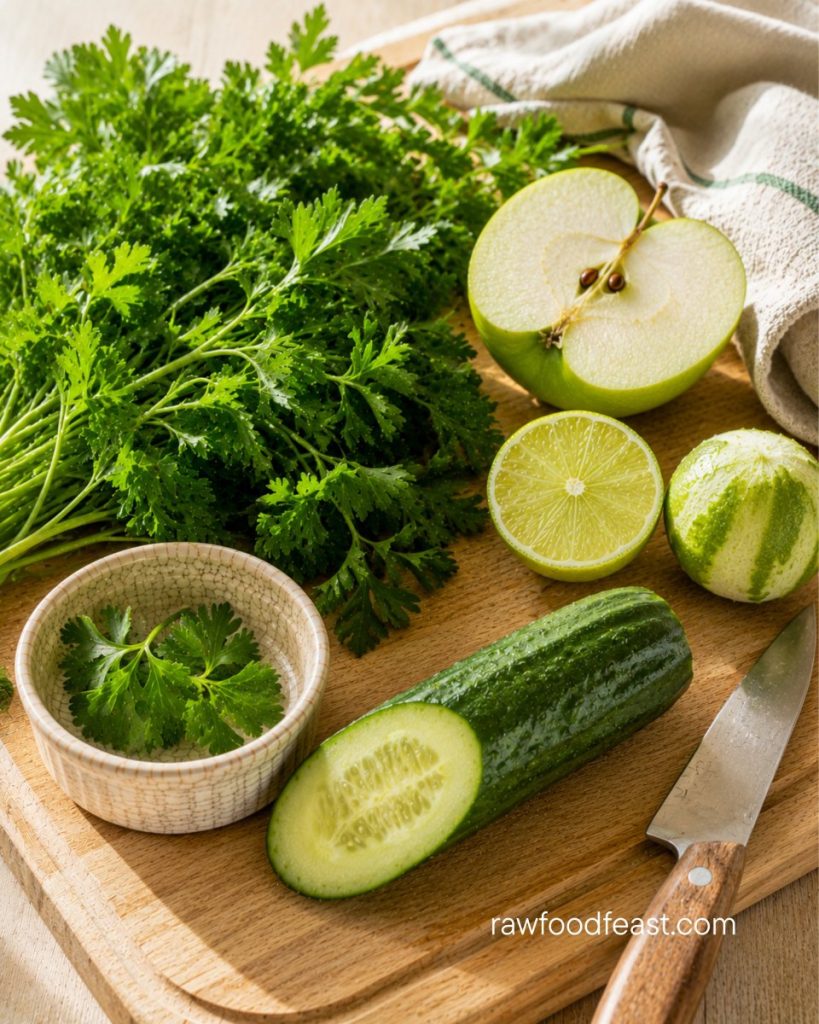
Parsley has been a traditional kidney tonic for centuries — and modern composition data backs up why. Two compounds do most of the work: apiol (a volatile oil that gently increases urine output) and apigenin (a flavonoid that calms inflammation in the urinary system). Together they make parsley one of the gentlest plant diuretics you can drink.
What that means in practice: a daily glass of parsley juice supports your kidneys’ filtration work without the harsh edge of pharmaceutical diuretics. Your kidneys move fluid through more efficiently, accumulated waste clears out, and the potassium in the juice replaces some of what comes out — so you finish hydrated and electrolyte-balanced rather than depleted.
People who add parsley juice to their daily routine often notice the change first in less morning puffiness, lighter ankles by evening, and an easier feeling around the ribs and lower back.
The same daily-juice mechanism appears with cucumber — another high-water-content juice that gently supports kidney work. The breakdown is in Cucumber Juice Benefits: What This Mineral-Rich Daily Juice Does for Hydration, Skin, and Kidneys.
What Does Parsley Juice Do for Bloating?
Bloating shows up for different reasons — water retention, slow digestion, gas, fermentation in the gut. Parsley juice addresses all of them in different ways.
For water retention bloating: the diuretic action covered above releases the stored fluid that’s been sitting under your skin or around your middle.
For slow-digestion bloating: parsley’s volatile oils stimulate the production of digestive enzymes and bile, which helps food move through your digestive tract instead of fermenting in place. Apigenin also calms the low-grade gut inflammation that often underlies persistent bloating.
For gas and trapped air: parsley has been used for generations to dispel intestinal gas — its compounds relax the smooth muscle of the gut just enough to let trapped air pass naturally.
The bloating release usually shows up within hours of drinking parsley juice, with the deeper digestive shifts settling in over days.
For the bigger picture on what helps move things through when digestion slows, the full breakdown is in Best Juice for Constipation: What to Drink for Easier, More Regular Bowel Movements.
How to Make Parsley Juice Every Day
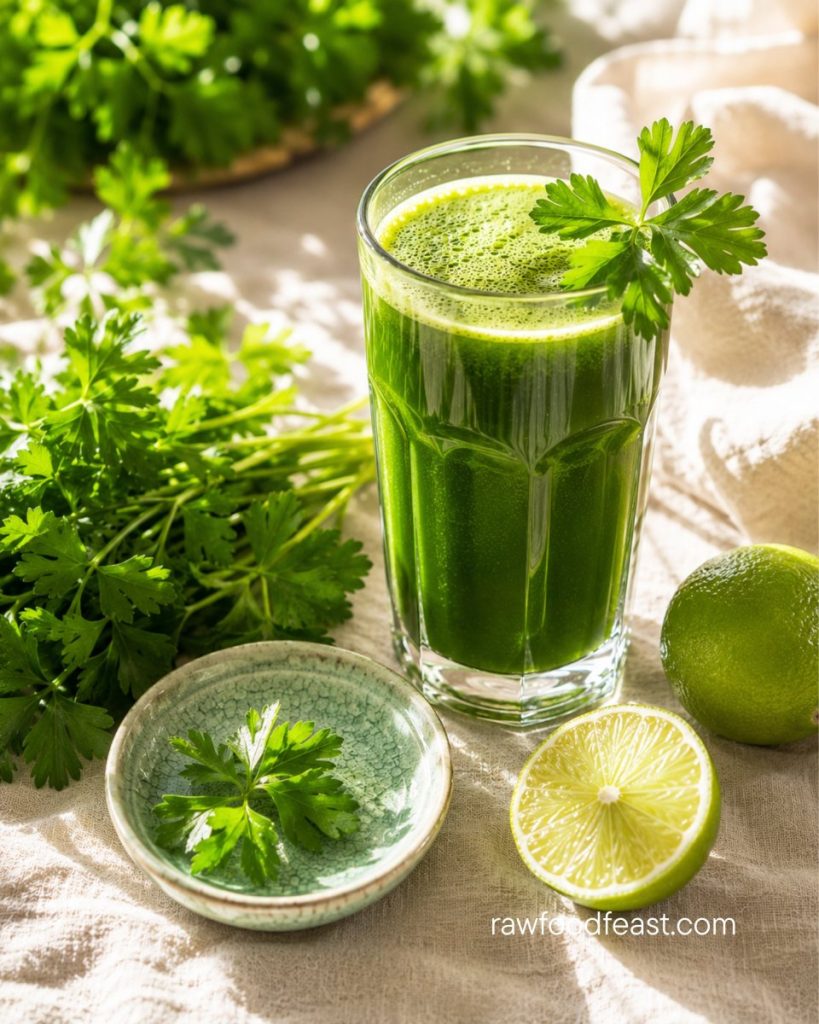
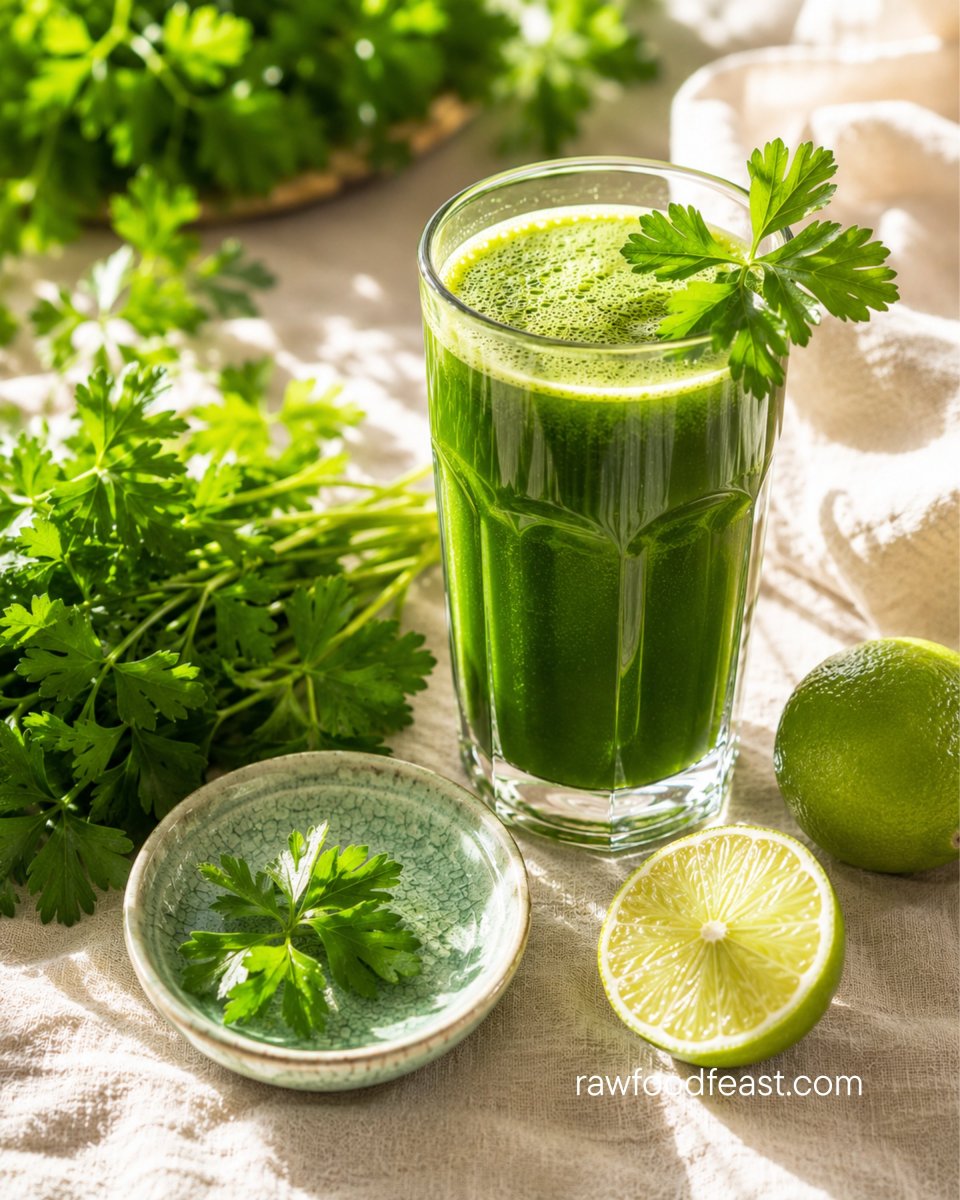
Parsley juice on its own is intense — grassy, bitter, almost medicinal. The fix is balancing it with cucumber for volume and gentle hydration, two apples for sweetness, and a lime for sharp citrus brightness. The result is a juice that keeps parsley at the center while making you actually want to drink it every day. The full recipe with exact amounts is in the card below.
If you’re juicing daily, the juicer you use makes a real difference for yield from leafy greens like parsley. A cold-press juicer keeps the produce cool, extracts more, and preserves the chlorophyll and live nutrients. For a daily rhythm, hands-free models like the Nama J2 or Hurom H320N take the work out of it — you load the hopper, the juicer does the rest.
Use discount code RAWFOODFEAST to save on the Nama J2 & Hurom H320N cold press juicers, the M1 plant-based nut milk maker, and accessories.
If you’re still deciding between the two leading hands-free slow juicers, this side-by-side breakdown makes the choice simple: Nama J2 vs Hurom H320N: The Real Differences Between These Hands-Free Slow Juicers.
Fresh parsley juice from a cold-press juicer keeps for up to 72 hours in a tightly sealed glass jar in the fridge.
What Daily Parsley Juice Actually Feels Like
A week of daily parsley juice doesn’t ask for effort once it becomes routine. One glass in the morning. Maybe another in the late afternoon if you want a between-meal lift. The changes settle in by the second week — less morning puffiness, easier digestion, lighter clothes by evening, brighter color in your skin and eyes that comes from chlorophyll doing its job in your bloodstream.
Intentional daily choices, steady minerals, steady chlorophyll. Your kidneys clear with less effort. Your gut stops holding water. Your energy settles into a rhythm. The benefits you came looking for arrive not from any one big moment — but because you finally gave your cells the daily green compounds and minerals they had been wanting more of.
Glow & Detox Green Juice
Ingredients
Equipment
Method
- Wash all produce thoroughly. Peel the lime to keep the juice bright (lime peel can add bitterness in larger amounts).
- Cut the cucumber in half lengthwise and the apples in half. The Nama J2 and Hurom H320N hoppers take generous pieces — no fine chopping required.
- Load the hopper in this order, softest first: parsley leaves and stems, then the peeled lime, then the cucumber pieces, and finally the apples.
- Stir the finished juice once. Pour into a glass and drink within 20 minutes for maximum chlorophyll color and nutrient activity, or store in a tightly sealed glass jar in the fridge for up to 72 hours.
Nutrition
Notes
Tried this recipe?
Let us know how it was!