Mirjam Henzen
 Plant-based foods for collagen production work through a route most people don’t see. Your body has always made its own collagen — every day, in every layer of skin, every joint capsule, every connective fiber. The plants below are what it uses to build it. You don’t take collagen and place it where it’s needed. Your body builds collagen from the inside, using the building blocks and cofactors that whole plant foods deliver directly.
Collagen is the structural protein your skin, joints, hair, and connective tissue are made from. It’s the framework that holds everything together — and you’re losing it slowly as you age. Production peaks in your twenties and starts dropping about one percent a year from there. The plants you eat decide how much of that loss you actually feel.
This guide covers whether plant foods can actually build collagen, the specific nutrients your body needs to make collagen at full strength, the nine plant foods that deliver those nutrients best, and the timeline your skin actually runs on.
Do Plant Foods Actually Build Collagen?
Yes — through the building blocks, not the protein itself. Plants don’t contain collagen because collagen is animal tissue: skin, bone, cartilage, connective fascia. What plants contain is everything your body uses to make its own collagen from scratch: the amino acids that form the protein, the vitamin C that locks them into stable triple-helix strands, the zinc and copper that enable the enzymes, the silica that strengthens the cross-links, and the antioxidants that protect what’s already been built.
Plant-based collagen production isn’t a workaround. It’s the route your body has always used. Collagen supplements get broken down in your digestive tract into the same amino acids you’d absorb from plants — and then your body has to make collagen anyway, using the cofactors that come from plants. The plants deliver everything in one step.
The most important thing to know about collagen production is that it doesn’t happen all at once. Your body builds collagen continuously, in tiny amounts, every day, replacing what’s been lost. The daily inputs you provide are what your skin uses tomorrow. Not next month — tomorrow.
Which Nutrients Drive Collagen Production?
Seven nutrients do most of the work for collagen production. Knowing what they are makes the food list below make sense.
Amino acids — specifically proline, glycine, lysine, and hydroxyproline — are the building blocks of the collagen protein itself. Your body needs all of them in adequate supply to assemble new strands. Plant proteins deliver them in usable form, especially seeds, nuts, leafy greens, and sprouts.
Vitamin C is what your body uses to convert proline and lysine into hydroxyproline and hydroxylysine — the stable forms that hold collagen strands together. Without enough vitamin C, your body can take in all the amino acids in the world and still produce weak collagen. Bell peppers, citrus, berries, and leafy greens are all dense daily sources.
Zinc and copper enable the enzymes that build and cross-link collagen. Zinc deficiency in particular is one of the most common reasons collagen production runs sluggish — and it’s common in people who eat plant-rich diets without paying close attention to seed and nut intake.
Sulfur — from cruciferous vegetables, garlic, and onions — provides the bonds that hold collagen strands together. Raw cabbage, sprouts, and red onion are all dense daily sources.
Silica supports the cross-links between collagen strands and strengthens the tensile quality of skin, hair, and connective tissue. Cucumber is the densest daily source.
Antioxidants — vitamin E, anthocyanins, polyphenols, lycopene — protect existing collagen from oxidative damage. Your body is always making AND losing collagen; antioxidants slow the loss side of that equation.
Collagen builds the same structural protein in your skin, joints, hair, and nails — which is why the foods supporting it overlap with the ones that build thicker hair. The full breakdown of the hair-specific story is in 9 Raw Foods for Hair Growth: Thicker, Stronger Hair Without Supplements or Topical Products.
The 9 Plant-Based Foods for Collagen Production That Build It Daily
Each of the foods below delivers one or more of the cofactors above in a form your body absorbs efficiently. Rotate through them daily — variety covers more cofactor ground than any single food can.
1. Bell Peppers
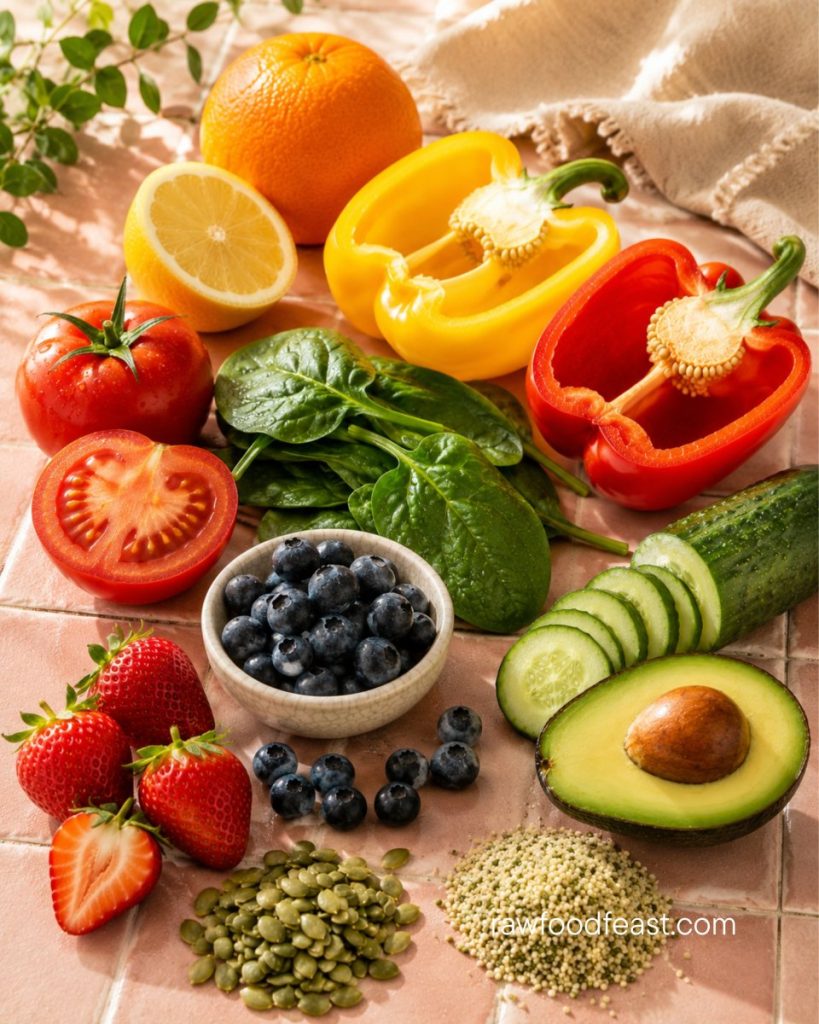
Red, yellow, and orange bell peppers deliver more vitamin C per cup than oranges — about three times more. Vitamin C is the single most important cofactor in collagen production, and bell peppers make hitting a substantial daily dose easy. Slice them into salads, eat them with fresh dips, or blend them into raw soups. Half a bell pepper a day covers a full day’s vitamin C needs for collagen support.
2. Citrus Fruits
Oranges, grapefruits, lemons, and limes deliver vitamin C in a form your body recognizes immediately, along with flavonoids that strengthen blood vessels and support skin circulation. A whole orange a day, or the juice of half a lemon in your morning glass of water, is the easy daily target. Pair citrus with leafy greens — the same vitamin C that builds collagen also unlocks more iron absorption from the greens.
3. Berries
Strawberries, blueberries, raspberries, and blackberries deliver vitamin C alongside anthocyanins — the deep pigment antioxidants that protect existing collagen from breakdown. Berries are the rare daily food that both builds new collagen AND defends the collagen you already have. A cup of mixed berries a day is the simple target.
4. Leafy Greens
Spinach, kale, romaine, and chard deliver amino acids, vitamin C, chlorophyll, and minerals — all the ground floor of collagen production at once. A daily handful (or two) of dark leafy greens is one of the highest-leverage moves you can make for skin, hair, and joint health together. Eaten with citrus or bell peppers, the vitamin C also unlocks more iron absorption from the greens.
5. Cucumber
Cucumber is the densest daily food source of silica — the mineral that builds and strengthens the cross-links between collagen strands. Silica in cucumber is in a form your body absorbs efficiently. Slice it into salads, blend it into juices, or eat it straight. The full breakdown of what cucumber does in a daily glass is in Cucumber Juice Benefits: The Daily Hydration Glass That Quietly Builds Your Skin, Hair, and Gut.
6. Tomatoes
Tomatoes deliver lycopene — the deep red pigment antioxidant that protects skin from UV damage — alongside vitamin C and small amounts of amino acids. Lycopene specifically slows the rate at which existing collagen breaks down, which makes tomatoes one of the strongest defensive foods for the collagen you’ve already built. Sun-ripe tomatoes have the most lycopene; eat them raw, sliced or diced, in salads daily.
7. Pumpkin Seeds
Raw pumpkin seeds deliver zinc, copper, and amino acids — three of the most important cofactors for collagen production stacked into one small handful. Two tablespoons a day is the working dose. They’re best soaked overnight to activate the enzymes and improve mineral absorption.
8. Avocado
Avocado delivers vitamin E, healthy fats, and small amounts of vitamin C. The fats specifically support the skin barrier from underneath — collagen builds the structural framework, healthy fats build the membrane that keeps skin hydrated and supple. Half an avocado a day is the typical serving.
9. Hemp Seeds
Raw hemp seeds — also called hemp hearts — deliver complete amino acids (all nine essentials in the right ratios), plus zinc and a balanced omega-3 ratio. Three tablespoons a day covers a meaningful portion of your collagen-building amino acid needs. Sprinkle on salads, blend into smoothies, or turn them into fresh hemp seed milk.

How Long Does It Take Plant-Based Foods for Collagen Production to Work?
Skin renews on a fairly slow cycle — about 28 days for the outer layer to fully turn over in your twenties, stretching to 40 to 60 days as you age. That means the changes you make this week show up in your skin’s surface texture within four to six weeks. Deeper changes — the elasticity and firmness that come from new collagen woven into the dermis — usually arrive in the three-to-six-month window, because collagen synthesis is slower than surface cell renewal.
The first signs aren’t always at the face. Most people notice better recovery from small cuts, faster nail growth, or softer skin on their hands before they see facial change. After that, the skin around the eyes and the laugh lines starts looking smoother, fuller, and more reflective — the visual signs of newly built collagen filling out the dermis.
There’s one thing about collagen-supportive eating that’s frustrating to track: you can’t tell from one week’s eating whether you’ve actually hit all the cofactors. Collagen production needs all of them — amino acids, vitamin C, zinc, copper, sulfur, silica, antioxidants — and missing any one limits the whole process. You can eat well-ish and still produce mediocre collagen because one piece was missing.
That’s where Fiber First closes the gap. The fiber tracker for gut health counts every plant you eat in a week, plus your daily fiber and hydration. A week of rotating through the nine foods above lands you nine to twelve different plants — bell peppers, citrus, berries, leafy greens, cucumber, tomatoes, pumpkin seeds, avocado, hemp — toward your weekly variety. Plant variety is the strongest signal for a thriving gut microbiome, and gut inflammation directly suppresses collagen production. You stop guessing — you see exactly which cofactors you’re hitting every day.
Collagen building is patient work. The skin you have today was built three months ago. The skin you’ll have in three months is being built right now.
What a Daily Collagen-Supporting Plate Looks Like
A daily plate built for collagen production doesn’t ask for anything elaborate. Half a bell pepper sliced into your morning salad. A whole orange or the juice of a lemon in your water. A cup of mixed berries with breakfast. A few handfuls of leafy greens at lunch. Cucumber alongside everything. Two ripe tomatoes sliced into a salad. Pumpkin seeds and hemp seeds sprinkled wherever they fit. Half an avocado on something — bread, salad, straight.
None of it asks for restriction or effort once it becomes routine. Steady vitamin C, steady amino acids, steady zinc, steady silica, steady antioxidants. Six weeks in, your skin’s surface texture changes. Three months in, the elasticity and firmness start showing. Six months in, the people around you start asking what you’ve been doing.
You didn’t take a collagen supplement. You fed your body what it had always been waiting to use.