Mirjam Henzen
 Search “foods for thicker hair” and almost every list opens with eggs, fish, dairy, and protein powders. Strip those out and you’re left with what your body was always built to use: a set of plants that deliver every nutrient your follicles need, in a form they absorb directly. Raw foods for hair growth start where most lists don’t — not at the strand, but at the gut signal that runs upstream of every follicle.
Hair grows about one centimeter a month. That means the hair on your head right now was built from what you ate three months ago — what reached your follicles, what your scalp could absorb, what your body could spare for hair when other systems were also asking for it. Strong, thick hair isn’t a topical project. It’s a nutrient-density project.
This guide covers what actually drives hair growth at the follicle level, the specific nutrients your hair needs to thrive, the nine raw plant foods that deliver them in the most usable form, and the timeline your body actually runs on.
What Actually Determines Hair Growth and Thickness?
Hair grows from the follicle — a tiny structure under your scalp that pulls nutrients out of your bloodstream and turns them into new hair, one strand at a time. Three factors determine how well that process runs: the blood supply reaching the follicle, the nutrients available in that blood, and the level of systemic inflammation in the body. All three trace back to what you eat.
Genetics set the ceiling — your hair’s potential thickness, density, and texture are written into your DNA. What you eat determines how close to that ceiling you actually reach. Most people eating a standard pattern come nowhere near it, not because of genetic limits but because the follicle isn’t receiving what it needs to build hair at full strength.
The third factor — systemic inflammation — quietly determines whether your follicles even get the chance to do their job. Chronic low-grade inflammation pushes follicles into rest phase prematurely and shortens the active growth cycle. That’s why hair thinning often follows periods of high stress, gut imbalance, or nutrient-poor eating. The signal upstream is the work being done at the follicle.
Which Nutrients Do Your Hair Follicles Need to Thrive?
Eight nutrients do most of the heavy lifting for hair growth and thickness. Knowing what they are helps you understand why the foods below were chosen.
Biotin (B7) is what your body uses to build keratin — the structural protein that hair is made of. Without enough biotin, hair becomes thin, brittle, and slow to grow.
Silica builds the cross-links between keratin strands that give hair its tensile strength and shine. It’s also what makes hair feel thick and substantial rather than fine and limp.
Zinc and iron are both critical to follicle function. Zinc supports the cell division that builds new hair; iron carries oxygen to the follicle through the blood. Low iron is one of the most common causes of unexplained hair thinning, especially in women.
Omega-3 fatty acids calm follicle inflammation, support scalp health, and feed the cellular membranes that hair is built from. Without enough omega-3, the follicle environment runs hot — and hair thins. The full picture of what omega-3 deficiency looks like across the body, including in the scalp, is in 8 Signs of Omega-3 Deficiency — and the Plant Foods That Restore Your Balance.
Vitamin C is what your body uses to make collagen, which supports the follicle structure itself. It also helps you absorb iron from plant foods.
B vitamins, particularly B12, B6, and folate, run the energy and cell-division processes that hair growth depends on.
Selenium supports the antioxidant systems that protect follicles from oxidative damage — the kind that accumulates over time and erodes hair quality.
The 9 Raw Foods for Hair Growth That Build Thicker, Stronger Strands
Each of these raw plant foods delivers one or more of the hair-supportive nutrients above in a form your body absorbs efficiently. Rotate through them daily — variety covers more nutrient ground than any single food can.
1. Cucumber
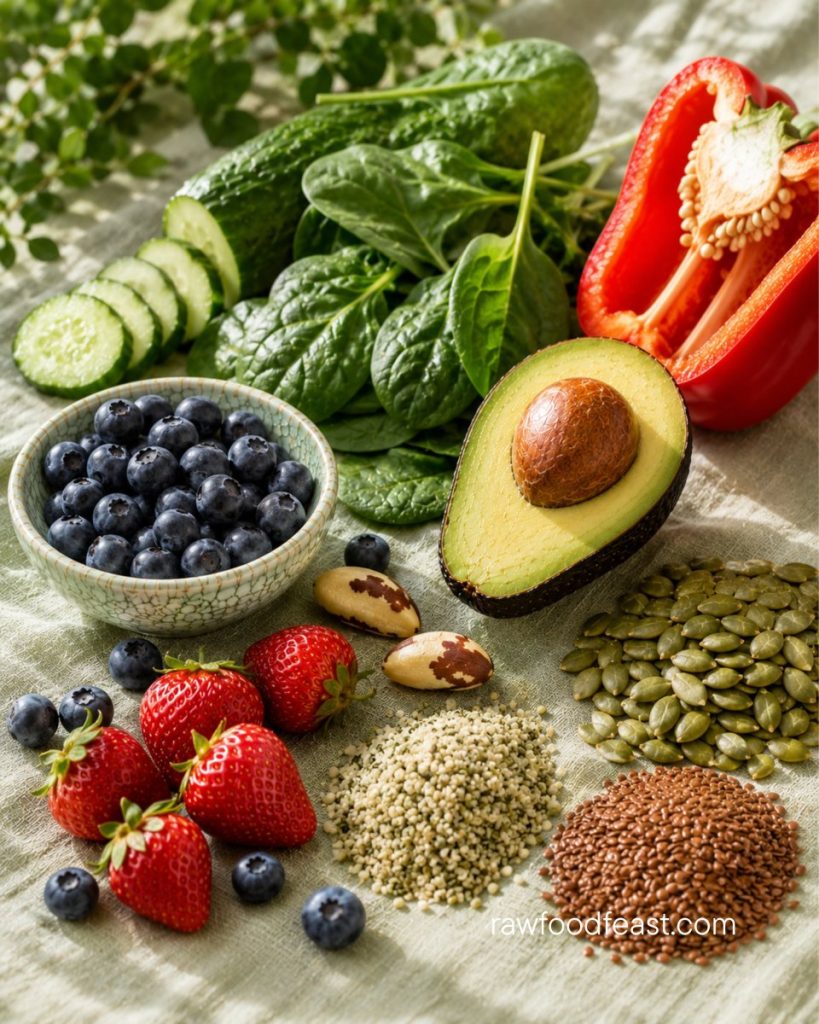
Cucumber is the densest daily food source of silica — the nutrient that builds keratin’s cross-links and gives hair its thickness and shine. The silica in cucumber is in a form your body absorbs efficiently, and because cucumber is so easy to eat in volume, you can hit a meaningful daily dose without thinking about it. Sliced into salads, blended into juices, or eaten straight. The full breakdown of what cucumber delivers as a daily food is in Cucumber Juice Benefits: The Daily Hydration Glass That Quietly Builds Your Skin, Hair, and Gut.
2. Leafy Greens
Spinach, kale, romaine, and chard deliver three nutrients that hair desperately needs: iron for follicle oxygenation, folate for cell division, and biotin for keratin building. Iron from plants absorbs better when paired with vitamin C — squeeze lemon over your salads, eat your greens alongside bell peppers or berries. A daily handful of dark leafy greens is one of the single highest-leverage moves for hair.
3. Brazil Nuts
Two brazil nuts a day give you a full day’s worth of selenium — the antioxidant mineral that protects follicles from oxidative damage. Brazil nuts are so concentrated that two is the right number; more isn’t better. They’re best soaked overnight to soften them and activate the enzymes, which makes the minerals more absorbable. If you’re not sure how long to soak them, the free soaking calculator at howlongtosoak.com gives you the exact time for every nut and seed.
4. Pumpkin Seeds
Raw pumpkin seeds are one of the densest plant sources of zinc, plus a substantial amount of iron. A small handful — about two tablespoons — daily covers a meaningful portion of your zinc needs. Sprinkle them over salads, blend into dressings, or eat them by the handful as a snack. Like brazil nuts, they’re best soaked to activate the enzymes and improve mineral absorption.
5. Avocado
Avocado delivers vitamin E, biotin, and the kind of fats that build the cellular membranes hair is made from. Half an avocado a day is the typical hair-supportive serving — easy to add to salads, blend into dressings, or eat straight with a squeeze of lemon. Vitamin E in particular protects the scalp from oxidative stress that thins hair over time.
6. Berries
Strawberries, blueberries, raspberries, blackberries — all dense in vitamin C, which your body uses to make collagen, the structural protein that follicles are built into. Berries also deliver anthocyanins, the pigment antioxidants that calm inflammation in the scalp. A cup of berries a day is the easy daily target. Eaten alongside leafy greens, the vitamin C also unlocks more iron absorption from the greens.
7. Hemp Seeds
Raw hemp seeds — also called hemp hearts — deliver three things your hair wants at once: a balanced ratio of omega-3 and omega-6 fats, complete plant protein, and zinc. Three tablespoons a day covers a meaningful portion of your omega-3 needs. Sprinkle on salads, blend into smoothies, or stir into nut milk for an instant hair-supportive add-on.
8. Bell Peppers
Bell peppers — particularly the red and yellow varieties — deliver more vitamin C per serving than oranges. They also support collagen production and iron absorption, which makes them a natural partner for leafy greens at lunch. Slice them into salads, eat them with guacamole, or blend them into raw soups.
9. Flaxseeds
Ground flaxseeds deliver the highest plant concentration of omega-3 along with lignans — compounds that support hormone balance, which directly affects hair. One to two tablespoons of ground flaxseeds daily is the working dose. They need to be ground (not whole) for your body to access the omega-3, and they’re best ground fresh and used within a few days. Add to smoothies, add to nut milk, or blend into salad dressings.
How Long Until You See Thicker, Stronger Hair?
Hair grows about one centimeter a month — which means the changes you make this week show up at the scalp within four to six weeks and become visible along the strand by twelve weeks. Real thickness shifts, not just length, usually arrive in the four-to-six-month window because the follicle has to cycle through a full rest-and-grow phase to start building new hair under the new conditions.
The first signs aren’t always at the head. Most people notice their nails growing faster and stronger before they notice the hair change — nails respond to the same nutrient input on a similar timeline. After that, the new growth coming in at the scalp feels different — thicker, with more body, and less prone to breaking near the root.
There’s one thing about hair-supportive eating that’s frustrating to navigate: it’s hard to know whether you’re actually hitting the variety and consistency needed to support a follicle cycle that takes months to fully turn over. You can eat well for a week and not know whether your daily intake actually adds up to thicker hair four months out.
That’s where Fiber First closes the gap. The fiber tracker for gut health counts every plant you eat in a week, plus your daily fiber and hydration. A week of rotating through the nine foods above lands you eight to ten different plants — cucumber, leafy greens, brazil nuts, pumpkin seeds, avocado, berries, hemp seeds, bell peppers, flax — toward your weekly variety. Plant variety is the strongest signal for a thriving gut microbiome, and gut inflammation is upstream of follicle inflammation. You stop guessing — you see exactly where you are.
The timeline asks for patience that most hair-product approaches don’t. There’s no four-week miracle. There’s a body that’s been doing repair work in the background, on a four-to-six-month timetable, while you’ve been adding inputs daily. The work happens whether you’re watching or not.
What a Daily Hair-Supporting Plate Actually Looks Like
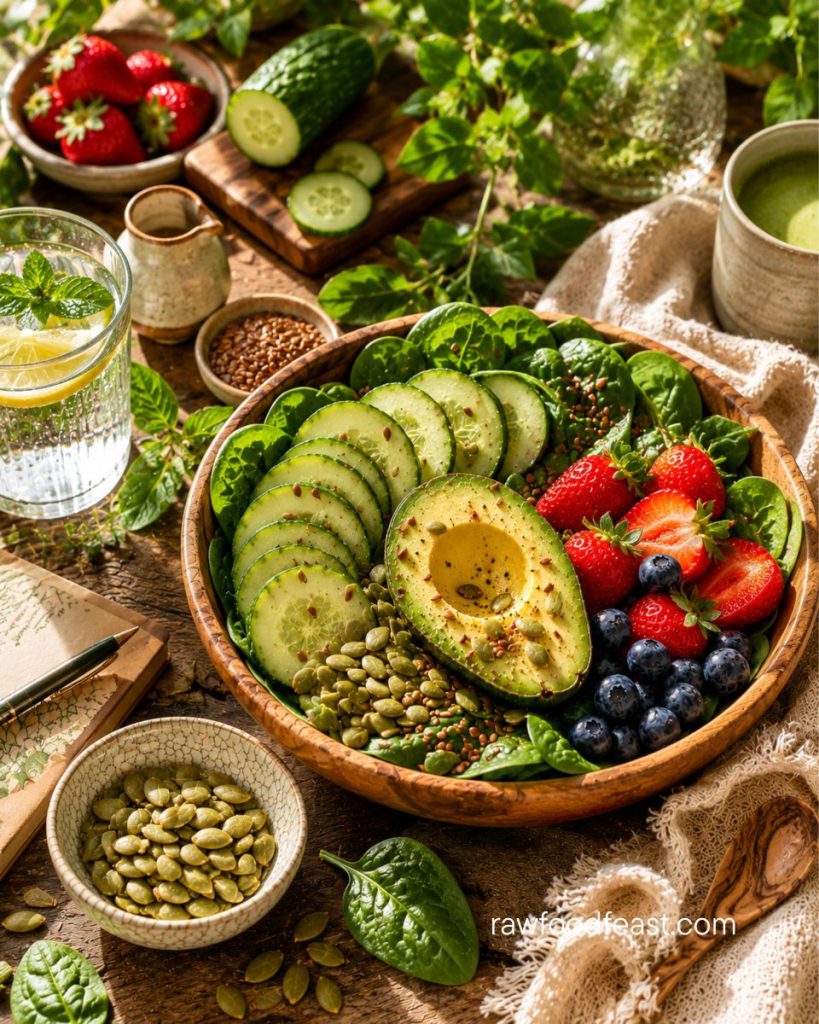
A daily plate built for thicker hair doesn’t ask for anything elaborate. A few handfuls of leafy greens at lunch with bell peppers and a squeeze of lemon. Two brazil nuts in the morning. A small handful of pumpkin seeds with avocado on a salad. Berries with fruit at breakfast. Hemp seeds and ground flax stirred into nut milk or sprinkled on whatever you’re already eating.
None of it looks like effort once it becomes routine. Steady silica, steady zinc, steady iron, steady omega-3, steady vitamin C. Three months in, the new growth at the scalp comes in differently. Six months in, your hair looks different. You didn’t chase any single hair product. You fed your follicles the daily input they’d been wanting more of.