Mirjam Henzen
 It usually shows up at the smaller scale first. A sudden calf cramp that wakes you in the night. A fingernail that splits at the corner. A flash of dental sensitivity to cold water. Your hands going briefly numb during a still moment. These are some of the signs of calcium deficiency — they tend to land in places you’d never think to connect to one mineral.
Calcium is one of the most familiar nutrients in any conversation about health. Bones get the headline. But your body uses calcium across more than your skeleton — your muscles, your nerves, your heart rhythm, your blood clotting, your hormone signaling all depend on a steady daily supply. When intake drops, you feel it first in the small, unexpected places.
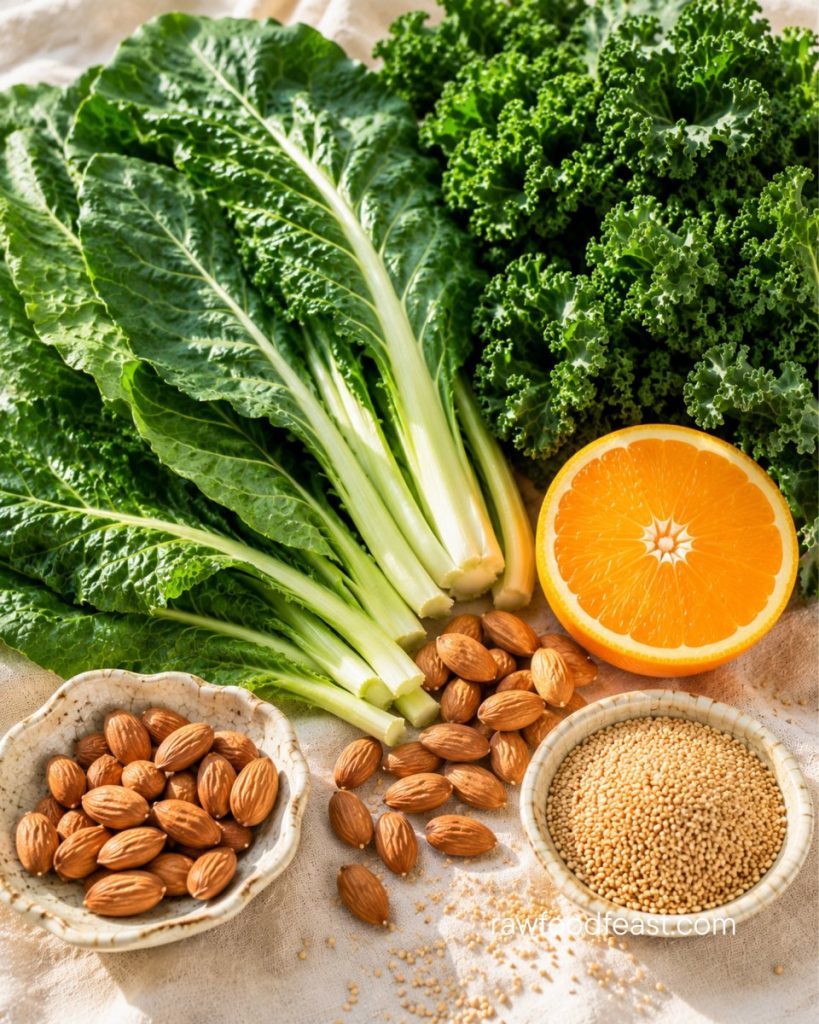
The good news: raw plant foods are full of calcium. Leafy greens, sesame seeds, almonds, figs, tahini — all of them carry the kind of calcium your body can use, paired with the companion nutrients that make it actually land in your bones.
What Does Calcium Actually Do in Your Body?
Calcium is best known for bones — and your skeleton holds about 99% of the calcium in your body. The other 1% does the daily work everywhere else: it’s what your muscles use to contract and release, what your nerves use to send signals from your brain to the rest of your body, what your heart uses to keep its rhythm steady. Blood clotting needs calcium. Hormone signaling needs calcium. Even how your cells release energy depends on a steady supply.
Your body keeps blood calcium tightly regulated. When daily intake runs low, your body simply pulls calcium from your bones to keep the daily work running. That’s why bone-level signs of deficiency usually show up late — by the time your skeleton is talking, the rest of your body has been compensating for a while.
So the early signs of calcium deficiency usually appear in the systems that use calcium minute by minute: your muscles, your nerves, your nails.
What Are the Signs of Calcium Deficiency?
These are the small body signals that show up when calcium has been running low for a while. Most people notice two or three at first — rarely all eight at once.
1. Muscle cramps, especially in the calves at night. The most common early sign. Your muscles need calcium to release after each contraction. When supply is short, that release stalls — and you wake up with a cramp.
2. Tingling or numbness in your fingers and toes. Nerve signals depend on calcium. When the supply runs thin, signals scramble at the small extremities first.
3. Brittle nails that split or chip easily. Calcium isn’t the only nail factor, but it’s a major one. When intake is low, the nail bed builds weaker nails.
4. Dental sensitivity, especially to cold. Your teeth are built on a calcium-rich structure. When that structure isn’t being rebuilt at the same rate it’s wearing down, you feel it in temperature reactions.
5. Slow recovery after exercise. Muscles that depend on calcium to function smoothly rebuild more slowly when calcium is short.
6. Dry, flaky skin. The skin barrier uses calcium for the signaling that keeps it functioning correctly. When supply is low, that signaling slows.
7. Mood changes — anxiety, low mood, irritability. Calcium plays a role in how your nervous system regulates the chemicals that affect mood. Steady calcium means steady regulation.
8. Heart palpitations or irregular rhythm. Calcium is what keeps your heart’s rhythm steady. When intake drops persistently, you may feel the rhythm shift — extra beats, skipped beats, an off feeling you can’t quite explain.
If two or three of these are stacking up, it’s worth looking at how much daily calcium you’ve actually been getting — and how well your body is using it.
The same kind of signal-spread shows up in adjacent mineral series too. If muscle tension and sleep trouble are the louder voices in the picture, the magnesium side is unpacked in 6 Signs of Low Magnesium — and the Raw Foods That Fix It Every Day. And if skin breakouts, slow wound healing, or frequent colds are also part of the picture, the zinc piece is covered in 8 Signs of Zinc Deficiency — and the Raw Plant Foods That Restore Your Skin and Immunity.

How Your Body Actually Uses Plant Calcium
Calcium doesn’t work alone. Your body uses it best when it arrives with the companion nutrients it works with — vitamin D, vitamin K2, magnesium, and a steady acid environment in your gut. Plants deliver all of these together, which is part of why daily intake from food works better than concentrated doses.
Vitamin K2 is the one that often gets forgotten. It directs calcium where it belongs — into your bones — and away from places it shouldn’t accumulate, like your arteries. Plants rich in vitamin K1 (leafy greens lead the list) give your gut bacteria the raw material to make K2, which is why a fiber-rich plant diet keeps calcium landing in the right places.
Magnesium is the other major partner. The minerals that drive muscle contraction (calcium) and release (magnesium) work in a constant pair. When magnesium runs low, calcium gets stuck on the contraction side — which is part of why a persistent cramp can sometimes mean magnesium more than calcium.
The same companion-nutrient effect runs through the way plants deliver protein and amino acids — never one isolated input, always a full package. The full breakdown of how nutrients work together rather than in isolation is in The Plant Protein Myth: What Your Body Actually Needs (And Why Fiber Is the Real Gap).
The Plant Foods That Deliver Calcium Every Day
These are the foods that do the work — and the practical amounts that move your levels.
Sesame seeds and tahini lead the list. Two tablespoons of tahini (about 30g) delivers around 130mg of calcium. Whole sesame seeds with the hulls intact hit close to 280mg per ounce — among the densest plant calcium sources you can eat.
Dark leafy greens come next. Collard greens deliver around 230mg of calcium per cup raw. Kale brings about 150mg per cup. Bok choy contributes around 75mg per cup. Bigger bowls and green juices stack the numbers up across a day.
Almonds give you about 75mg of calcium per ounce (roughly 23 nuts) — one of the highest nut sources. Soaked almonds keep the same calcium plus add easier absorption.
Dried figs deliver around 60mg per fig. A small handful of four lands around 240mg. Sweet, portable, and surprisingly dense.
Chia seeds bring around 75mg per tablespoon. Stirred into pudding or juice, they pair calcium with omega-3 and fiber in one go.
Oranges (eaten whole, not just the juice) bring about 60mg per medium fruit. The natural citrus acid also helps your body take up the calcium more effectively.
Here’s where most people get stuck: you can eat plenty of calcium-rich foods and still come up short because your gut isn’t doing the conversion work, or because the same three foods are running on repeat — nowhere near the 30 different plants a week that build real microbiome diversity. A high-fiber plant rotation does two jobs at once — it delivers the calcium AND it builds the bacterial environment that decides where the calcium lands. The variety matters as much as the total.
That’s where Fiber First closes the gap. The fiber tracker for gut health counts every plant you eat in a week, plus your daily fiber and hydration. Sesame, tahini, collards, kale, bok choy, almonds, figs, chia, and oranges all show up as different plants. A week of rotating through them lands you eight to ten different plants toward your weekly variety. Plant variety is the strongest signal for a thriving gut microbiome, and gut microbiome health is upstream of how well calcium actually absorbs and lands in your bones. You stop guessing — you see exactly where you are.

How Much Calcium Do You Need Each Day?
The general recommendation is 1,000mg of calcium per day for adults under 50 and around 1,200mg for those over 50. Higher than most mineral targets — but plant calcium is built for steady daily delivery, especially when leafy greens, sesame, and tahini are part of the regular rhythm.
In practical terms: a generous salad at lunch with collards, kale, and bok choy topped with two tablespoons of tahini — and whatever else you’d usually add, from cucumber and bell peppers to sprouts and herbs — a handful of almonds with figs as an afternoon snack, an orange or two through the day, and you’ve stacked yourself above 600mg before counting greens in a juice or sesame seeds on a dinner bowl. Hitting the daily target from raw plant foods is genuinely doable when calcium-rich plants land in your everyday rhythm.
If supplementation questions come up — calcium is one of the most commonly supplemented minerals — the honest framing on whether you actually need one is in Do I Need Supplements? The Truth About B12, Isolates, and Why Food Wins.
What a Calcium-Steady Week Actually Looks Like
A week that covers calcium doesn’t feel like effort. Tahini stirred into a morning smoothie or blended into a creamy lemon-tahini dressing — like the one in this Shaved Asparagus Salad with Lemon Herb Dressing. A generous green salad at lunch — collards, kale, bok choy, or whatever leafy greens are fresh. A handful of soaked almonds and a fig or two as an afternoon snack. Sesame seeds sprinkled on whatever bowl you’re building for dinner. An orange when you want something fresh and sweet. None of it has to be deliberate once it becomes routine.
The shift happens in weeks, not days. Bones rebuild slowly — your skeleton turns its calcium over across years, not months — but the everyday systems that depend on calcium catch up much faster. The calf cramps ease. The dental sensitivity settles. Your nails come back stronger. The small body signals stop showing up where they used to.
Intentional daily choices, steady intake, and a body that catches up on its own time. Your muscles release. Your nerves calm. Your bones grow stronger one day at a time. The signs you noticed start fading not from any one big moment — but because you finally gave your cells what they were waiting for.