Mirjam Henzen
 Most people address joint pain from the outside in — topical creams, painkillers, hot showers. Those might work for a moment. What moves the needle long-term is what you’re eating and drinking every day, because joint pain is rarely just about joints. It’s the visible end of a chronic inflammatory pattern that starts further upstream, and the right daily food and juice can support the body’s own anti-inflammatory work at its source.
Juice for joint pain works when the ingredients carry the specific anti-inflammatory compounds your body uses to lower chronic inflammation — and when those ingredients arrive in a form your body can absorb fast. That second part is why juicing matters: fresh, cold-pressed juice delivers turmeric, ginger, pineapple, and other anti-inflammatory powerhouses with their enzymes and oils intact, the way none of them survive in heated or processed form.
This guide covers what actually causes joint pain at the inflammatory level, the plant compounds that address it, four daily juice rotations you can run through the week, and how long it usually takes to feel the change.
What Actually Causes Joint Pain?
Joint pain has several specific causes — injury, autoimmune conditions, mechanical wear — but for most people experiencing daily or recurring pain without an acute injury, the underlying driver is chronic low-grade inflammation.
Chronic inflammation isn’t the sharp swelling you get from a sprained ankle. It’s a slow, persistent inflammatory signal humming through your body at low volume — invisible most of the time, but it accumulates damage in the joints over months and years. When your immune system stays in a low-grade activated state, it produces inflammatory compounds that erode joint cartilage, irritate the lining of joint capsules, and create the morning stiffness, the recurring ache, and the feeling that your body needs warming up before it’ll move properly.
What’s easy to miss is where that chronic inflammation usually starts: in the gut. A gut microbiome that’s out of balance — too low in diversity, too low in fiber-fed beneficial bacteria — produces inflammatory signals that travel through the bloodstream and reach every tissue in the body, including the joints. The gut-joint connection is one of the strongest findings in recent inflammation research, and it explains why diet shifts can change joint pain when topical treatments can’t.
What Anti-Inflammatory Compounds in Plants Address It?
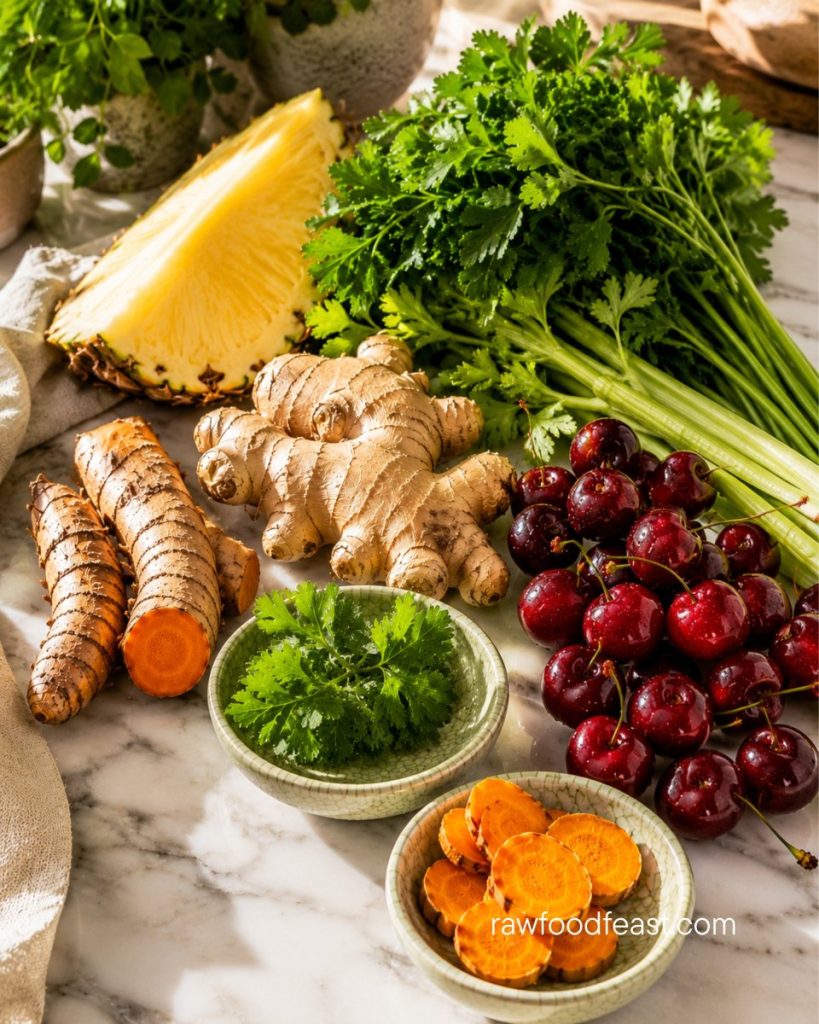
Five plant compounds do most of the anti-inflammatory work that lands in your daily juice. Knowing what they are helps you understand why the rotations below were built the way they were.
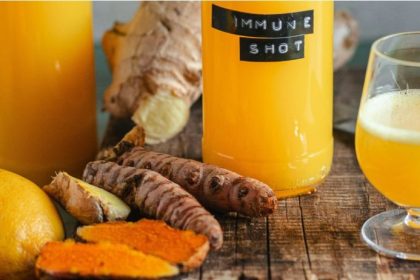
Curcumin (from turmeric root) is the most-studied. It reduces the inflammatory signals your body produces, calms the immune system’s chronic-activation pattern, and supports the gut lining directly. Fresh turmeric juice delivers curcumin in a far more usable form than dried powder — the full picture is in Turmeric Juice Benefits: What Fresh Turmeric Does That Powder Simply Can’t.
Gingerol (from ginger root) is curcumin’s daily companion. It calms inflammation through a slightly different pathway, supports digestion, and helps the body break down food efficiently — which reduces gut inflammation upstream. Ginger and turmeric pair so naturally because they cover overlapping but complementary anti-inflammatory ground.
Bromelain (from fresh pineapple) is a proteolytic enzyme that helps your body break down proteins, calm gut inflammation, and ease post-exercise muscle and joint soreness. Bromelain is destroyed by heat in commercial pineapple juice but preserved through cold-pressing at home. The deeper breakdown is in Pineapple Juice Benefits: The Enzyme Your Gut Has Been Waiting For.
Anthocyanins (from tart cherries, beets, dark berries) are pigment compounds that act as antioxidants and reduce inflammatory markers in the blood. Tart cherry juice specifically has been studied for its effects on joint pain and post-exercise recovery.
Apigenin and luteolin (from celery, parsley, and other herbs) are flavonoids that calm inflammation through yet another pathway and support liver detoxification, which helps clear inflammatory metabolites from your bloodstream. Parsley is one of the most concentrated daily sources of apigenin — the full picture of what it delivers in a daily glass is in Parsley Juice Benefits: What This Mineral-Rich Herb Does for Kidneys, Bloating, and Daily Detox.
The strongest daily approach isn’t to pick just one — it’s to rotate through them so your body gets a steady, varied supply of all five compound families over the course of a week.
The 4 Daily Anti-Inflammatory Juice Rotations
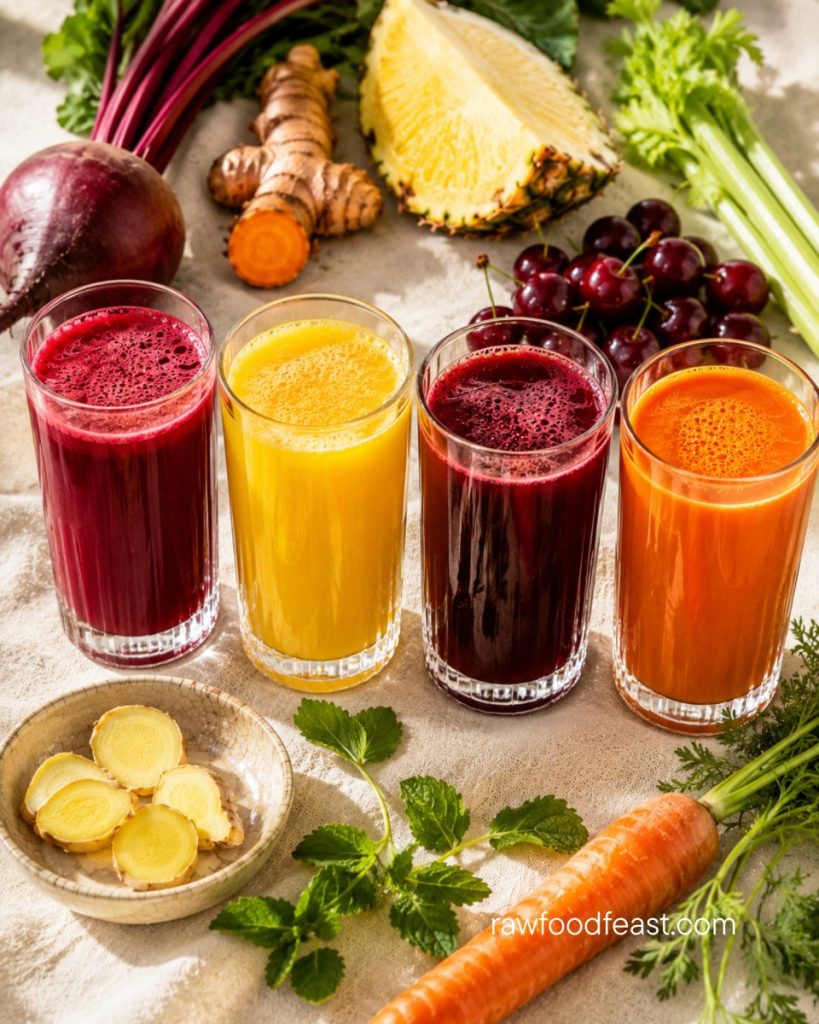
Here are four daily juice combinations that each emphasize a different anti-inflammatory angle. Rotate through them across the week — variety keeps your microbiome happy and ensures you’re hitting different compound families.
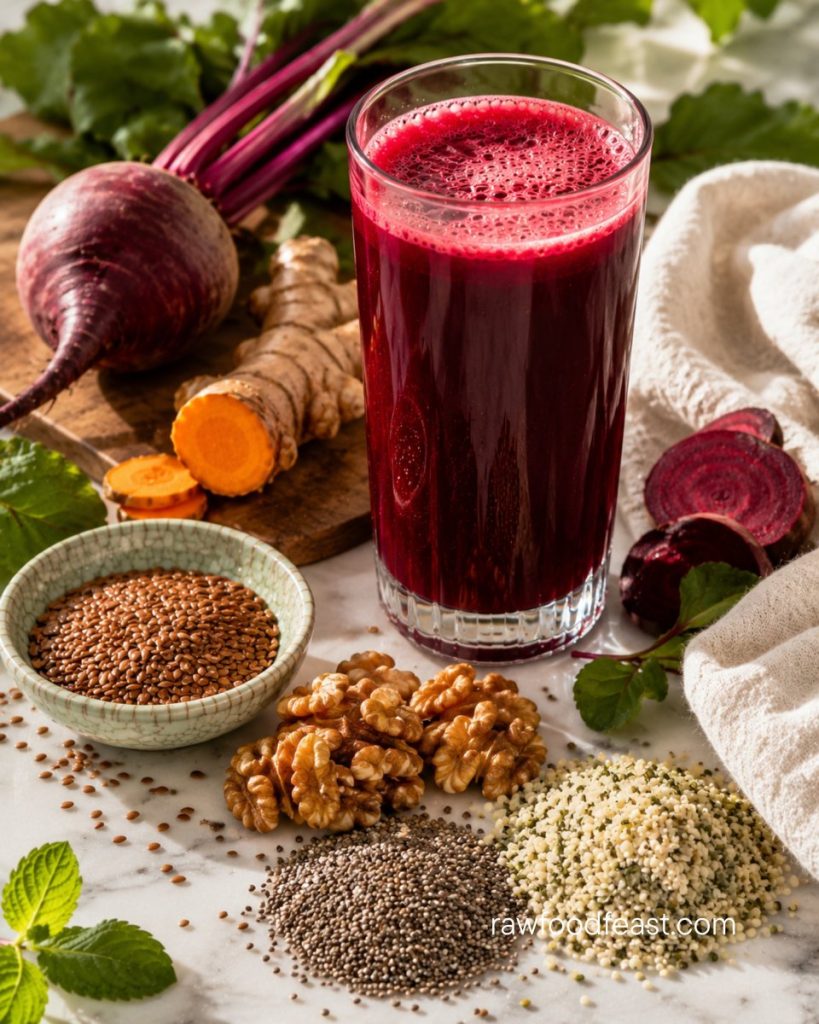
Turmeric-Beet Reset — turmeric root, beet, apple, lemon. Curcumin from the turmeric, anthocyanins and betalains from the beet, vitamin C from the lemon to support uptake. Deep red, earthy, slightly sweet.
Ginger-Pineapple Soother — pineapple, cucumber, ginger, mint. Bromelain from the pineapple, gingerol from the ginger, cooling hydration from the cucumber and mint. Bright, tropical, refreshing.
Tart Cherry Refresh — tart cherries, apple, lemon. The anthocyanin-rich rotation, particularly good after physical activity or for joint pain that flares with exercise. Sweet-tart and concentrated.
Celery-Carrot-Turmeric Daily — celery, carrot, turmeric, ginger, lemon. The everyday workhorse: apigenin from the celery, beta-carotene from the carrot, curcumin and gingerol stacked together. Savory-sweet, grounding, the easiest one to drink daily.
If you’re juicing daily, the juicer you use makes a real difference for yield, oxidation, and how much of these compounds actually make it into the glass. A cold-press juicer keeps the produce cool, extracts more, and preserves the enzymes and oils that make the anti-inflammatory plants work. For a daily rhythm, hands-free models like the Nama J2 or Hurom H320N take the work out of it — you load the hopper, the juicer does the rest.
Use discount code RAWFOODFEAST to save on the Nama J2 & Hurom H320N cold press juicers, the M1 plant-based nut milk maker, and accessories.
If you’re still deciding between the two leading hands-free slow juicers, this side-by-side breakdown makes the choice simple: Nama J2 vs Hurom H320N: The Real Differences Between These Hands-Free Slow Juicers.
Fresh cold-pressed juice keeps for up to 72 hours in a tightly sealed glass jar in the fridge. For the anti-inflammatory rotations especially, drinking within 24 hours preserves the maximum enzyme and oil activity, but most of the nutrient profile holds for up to 72 hours.
How Long Does Juice for Joint Pain Take to Work?
Most people who add a daily anti-inflammatory juice notice the first changes within seven to ten days. The shift usually shows up as less morning stiffness — your hands grip things more easily, your knees bend more readily when you first get out of bed. Recovery from physical activity speeds up. The background ache that came and went starts coming less often.
The bigger shift — the kind that changes how your joints feel across an entire day — usually arrives in the four-to-six-week window. Chronic inflammation took months or years to build up; calming it takes weeks or longer of consistent input. The work is in showing up every day, not in any one heroic dose.
Chronic inflammation is invisible. You can’t feel it in real time, and there’s no easy way to see whether your daily anti-inflammatory practice is adding up.
But the work happens upstream of the joints. Chronic systemic inflammation usually starts in the gut, and the strongest lever for calming gut inflammation is plant variety — a steady weekly intake of different plants feeds a thriving microbiome and lowers inflammation everywhere it reaches, including your joints.
That’s what Fiber First is for. The fiber tracker for gut health counts every plant you eat in a week, plus your daily fiber and hydration. A week of rotating through the four anti-inflammatory juices above lands you ten to twelve different plants — turmeric, ginger, pineapple, beet, cherry, celery, carrot, cucumber, apple, lemon, mint — toward your weekly variety. Plant variety is the strongest signal for a thriving gut microbiome, and gut inflammation is upstream of joint inflammation. The work you can actually see is the work actually happening.
Why Omega-3 Belongs Alongside Your Daily Juice
Juice handles the water-soluble side of anti-inflammatory eating — curcumin, gingerol, bromelain, anthocyanins, apigenin. These compounds calm inflammation through specific pathways your body uses every day. But there’s a parallel pathway your body runs on fats, and the juicing rotation can’t reach it. That’s where omega-3 comes in.
Omega-3 fatty acids are what your body uses to make the molecules that actively resolve inflammation — not just calm it, but shut it down once the work is done. Without enough omega-3, the inflammatory response keeps running longer than it needs to, and joint pain lingers because the resolution signal is missing.
The full picture of why omega-3 matters as much as the juicing rotation, and which plant foods deliver it, is in 8 Signs of Omega-3 Deficiency — and the Plant Foods That Restore Your Balance.
What a Daily Anti-Inflammatory Practice Actually Looks Like
A week of daily anti-inflammatory juicing doesn’t ask for effort once it becomes routine. One juice in the morning, rotated through the four combinations above so no week looks identical. Fresh fruit and vegetables walking through your kitchen every few days. A jar of golden-tinged juice in the fridge that you reach for before reaching for anything else.
Intentional daily choices, steady curcumin, steady gingerol, steady bromelain, steady anthocyanins. Your joints loosen. The morning stiffness lifts. Recovery from movement gets faster. The background ache lifts off. The benefits arrive not from any one big moment — but because you finally gave your body the daily anti-inflammatory input it had been wanting more of.