Mirjam Henzen
 You eat better. You move more. You keep your phone out of the bedroom. And still — restless wake-ups, slow mornings, the strange feeling that something else is running in the background.
The piece most sleep advice misses is the link between gut health and sleep. When your gut is calm and well-fed, the rest tends to follow almost by accident. When it isn’t, no amount of sleep hygiene quite fixes it.
How Does Your Gut Affect Sleep?
Your gut and your brain talk to each other constantly through a thick highway of nerves called the vagus nerve. About 90 percent of the signals run upward — from gut to brain — not the other way around. That means whatever is happening in your digestive system is steering a huge amount of what your brain decides to do, including how easily it shifts into sleep.
Your gut bacteria also produce the building blocks for the chemicals that regulate your mood, your stress, and your sleep cycle. When the gut is healthy, those chemicals are made in steady, predictable amounts. When it’s inflamed, sluggish, or fed only on processed food, that production gets erratic — and so does your sleep.

The Gut-Sleep Connection Through Serotonin and Melatonin
Here’s the part most people don’t know: about 90 percent of your body’s serotonin is made in your gut, not your brain. Serotonin is what your body converts into melatonin — the chemical that tells you it’s time to sleep. So the entire melatonin supply chain starts with what your gut bacteria are doing.
If your microbiome is thriving — diverse, well-fed, calm — your gut produces serotonin in steady amounts, your body converts it cleanly into melatonin as the day winds down, and your sleep follows that rhythm. If the microbiome is depleted or inflamed, the whole conversion runs unevenly, and you feel it as 3 a.m. wake-ups or a body that won’t quite settle. The full picture of how the gut shapes the brain is covered in The Gut-Brain Connection — sleep is one of many things that runs through this same wire.
Why Your Microbiome Has Its Own Circadian Rhythm
This is the surprising part. Your gut bacteria run on a day-night cycle, just like you do. Different bacterial communities are active in the morning, in the afternoon, and overnight. The bacteria that handle overnight repair work are different from the ones working through your lunch.
When that rhythm is healthy, the microbiome and your body sleep on the same clock — and you wake up feeling like both finished the job. When it’s disrupted by late-night eating, alcohol, or a low-variety diet, those cycles fall out of sync, and your sleep gets shallower, choppier, less restorative. The microbiome also shifts as you age, which is one of the quiet reasons sleep changes over the decades — explored further in 5 Signs Your Gut Microbiome Is Aging.
Can Poor Gut Health Cause Insomnia?
Yes — and often more directly than people expect. The two most common gut-driven sleep problems are nighttime bloating and low-grade inflammation. Both show up as 2 a.m. or 4 a.m. wake-ups, the kind where you’re suddenly fully awake with no idea why.
When you eat late or eat in a way that bloats you, your gut spends the night working hard instead of resting. Your nervous system reads that activity as a signal to stay alert, and sleep stays light. The same goes for low-grade inflammation — your body keeps cortisol slightly elevated, which is exactly the opposite of what you need overnight. Stop Bloating on Raw Food walks through the simple shifts that quiet the digestion enough for sleep to actually take hold.

Raw Foods That Support Both Your Gut and Your Sleep
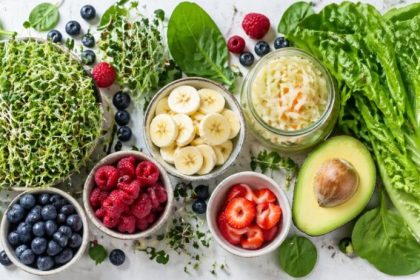
The foods that help your gut also tend to help your sleep. Leafy greens (spinach, swiss chard, romaine) feed the bacteria that produce calming compounds. Pumpkin seeds, almonds, and dark leafy greens deliver magnesium — the single most sleep-relevant mineral. Kiwi, papaya, and ripe banana support both gut motility and melatonin production. Cucumber and celery cool inflammation overnight.
None of these are dramatic. They work the way real changes work — slowly, then suddenly. Magnesium deficiency in particular shows up as restless sleep, leg cramps, and 3 a.m. wake-ups, and most people are running lower than they realize. 6 Signs of Low Magnesium covers what to watch for and the raw foods that quietly restore it.
If you want to make gut-supporting eating something you actually keep doing — not a one-week experiment — Healthy & Free is the online community built around practical, delicious whole food (un)cooking and juicing. Come join us. You’ll feel it in your energy, your digestion, and your glow.
How Long Does It Take to Notice the Change?
The first thing that shifts is usually how you fall asleep — within one to two weeks. The dropping-off feels easier. The lying-in-bed-with-a-busy-mind part gets shorter. Most people notice that before they notice anything else.
Deeper changes — fewer wake-ups, waking up genuinely rested, dreaming more vividly — show up around weeks four to six. That’s the timeline of your microbiome actually shifting. Bacteria don’t change overnight, but they change faster than almost anything else in your body when you start feeding them differently. By week eight, most people stop thinking of their sleep as a problem to manage.
Is Gut Health the Missing Piece in Your Sleep Routine?
For most people who’ve already tried the standard sleep checklist — earlier dinner, no screens, cool room — and still aren’t sleeping the way they want to, yes. The missing piece is upstream of all of that, sitting in the gut, deciding how much serotonin gets made in the first place.
You don’t have to overhaul anything. Eat more plants. More variety. Cut back the late-night food. Give it a few weeks. The sleep you’ve been chasing tends to be waiting on the other side of a calmer gut.