Mirjam Henzen
 The gut-brain connection is one of those things that sounds like a wellness buzzword until you actually feel it. You skip a few meals of real food, eat heavy for a couple of days, and suddenly your thinking is foggy, your mood dips, and your sleep falls apart. That is not a coincidence — and it is not in your head.
Your gut and your brain are in constant conversation. The gut produces the vast majority of the chemical messengers that shape how you feel, how clearly you think, and how well you sleep. When the gut is thriving, those signals run clean. When it is struggling, everything downstream feels it — mood first, energy second, focus third.
This is not a fringe theory. It is one of the most well-supported areas of research in modern nutrition science. And it changes everything about how you think about food.
What Is the Gut-Brain Connection?
Your gut and your brain talk to each other constantly — through three distinct channels that run in both directions. What most people do not realize is that roughly 80% of those signals travel upward. The gut is telling the brain what is going on far more than the brain is telling the gut.
The first channel is the vagus nerve — a long nerve that runs from your brainstem all the way down to your gut. Think of it as a direct phone line between the two. When your gut bacteria are thriving, they send steady, calm signals up through the vagus nerve. When something is off — inflammation, imbalance, damage to the gut lining — those signals shift, and your brain registers it as unease, anxiety, or brain fog before you consciously know anything is wrong.
The second channel is chemical. Your gut bacteria produce chemical messengers — compounds like serotonin, dopamine, and GABA — that travel through the bloodstream and directly affect how you feel, how motivated you are, and how clearly you think. These are the same compounds that run your mood and your thinking. Your gut is not just digesting food — it is making the raw materials your brain depends on.
The third channel is your immune system. When the gut is inflamed — from processed food, stress, or a damaged gut lining — it sends alarm signals through the bloodstream. Those alarm signals reach the brain, and the brain responds the way it responds to any threat: it slows down, becomes less sharp, and shifts into a kind of low-grade survival mode. That is why chronic gut issues and chronic brain fog so often show up together.
Three channels. All running constantly. And most of the information flows from the gut up — not the other way around.
Why Does Your Gut Make Most of Your Serotonin?
This is the fact that shifts how most people think about their gut: 90 to 95% of your body’s serotonin is produced in the gut, not in the brain. Research published in Cell by Caltech confirmed that gut bacteria directly tell gut cells to produce serotonin — and without those bacteria, serotonin levels drop significantly.
Serotonin is the compound that helps you feel calm, settled, and genuinely good. It is also what your body uses to make melatonin — the compound that helps you fall asleep and stay asleep. So when gut bacteria are underfed or out of balance, serotonin production drops. And you feel it in your mood before you feel it anywhere else.
The reason so much serotonin is produced in the gut — rather than the brain — is that the gut is the body’s largest interface with the outside world. Everything you eat passes through it. The gut needs to constantly evaluate what is coming in: safe or dangerous, nourishing or inflammatory. Serotonin plays a central role in that communication — it is both a mood compound and a signaling compound, and the gut uses it for both.
This is not a theory or an emerging idea. It is one of the most well-established findings in gut research. Your mood, your sleep, and your sense of calm are directly tied to what is happening in your gut — and the bacteria that live there are running the show.
How Does Your Gut Affect Your Mood?
Your gut bacteria produce the chemical messengers that run your mood, your motivation, and your ability to handle stress. Serotonin keeps you calm. Dopamine drives motivation and the feeling of reward. GABA — the compound that helps you feel relaxed instead of wired — is produced directly by specific strains of gut bacteria.
When those bacteria are thriving, production of these compounds stays steady. Mood is stable. Stress feels manageable. Sleep comes easily. When those bacteria are low — because they are not being fed the right food, or because the gut environment has become hostile — production drops. And what follows is familiar to a lot of people: low mood, irritability, a sense of anxiety that does not seem to have a clear cause.
A 2026 clinical trial confirmed that specific beneficial gut bacteria reduced anxiety and insomnia symptoms while raising GABA levels in participants. The bacteria were not acting as a supplement — they were doing what healthy gut bacteria naturally do when the conditions are right.
This is why mood issues so often resist solutions that only target the brain. If the gut is not producing the compounds your brain needs, no amount of willpower or mental reframing addresses the root. The gut is not just reacting to how you feel. It is shaping how you feel — every single day.
What Does the Gut-Brain Connection Have to Do with Brain Fog?
Brain fog is not a brain problem. It starts in the gut.
When the gut lining weakens — from processed food, chronic stress, or a lack of fiber — things leak through that should not. Undigested food particles. Bacterial fragments. Toxins. These trigger an immune response, and the resulting inflammation travels through the bloodstream straight to the brain. Once there, it interferes with how clearly you think, how well you remember, and how easily you concentrate.
Researchers call this the “leaky gut leads to leaky brain” pathway. The brain has its own protective barrier — similar to the gut lining — and when systemic inflammation is high, that barrier weakens too. The result is the kind of foggy, sluggish thinking that no amount of sleep fixes, because the problem is not fatigue. The problem is inflammation that should not be reaching the brain in the first place.
The fix is not a brain supplement. It is restoring the gut lining so those inflammatory compounds stop leaking through. And that process starts with what you eat — specifically, how much fiber and living food you are giving your gut bacteria to work with.
If brain fog is something you deal with regularly, this goes deeper into the specific raw foods and juices that lift it by addressing the gut first: How to Clear Brain Fog Naturally.
Can What You Eat Change How You Think and Feel?
Yes. And the answer is fiber.
When gut bacteria break down fiber, they produce small compounds called short-chain fatty acids. Think of them as the reward your gut bacteria give back for feeding them well. These compounds strengthen the gut lining, calm inflammation throughout the body, and directly support the production of the chemical messengers your brain depends on.
One of these fatty acids — butyrate — is especially important. Butyrate is the primary fuel source for the cells that line your colon. It keeps them strong, tight, and functioning properly. But it does more than that. A 2025 study confirmed that butyrate can cross into the brain and strengthen the brain’s own protective barrier — the same barrier that weakens when inflammation is running high. It also calms inflammation in brain tissue directly.
Raw plant food delivers fiber continuously — from dozens of different sources, every single meal. Leafy greens, fruits, sprouts, seeds. Each type of fiber feeds different strains of bacteria, and that diversity is what keeps the gut ecosystem balanced and productive. It is not about one food or one fiber type. It is about the steady, varied supply that a raw food lifestyle naturally provides.
Most people are eating somewhere between 10 and 15 grams of fiber a day. The gut needs at least 30 grams — and in my experience as a nutritionist, 40 is the real minimum — to function at its best. That gap — between what people eat and what the gut actually needs — explains a lot of the mood, focus, and energy issues people quietly accept as normal. The full picture of what that fiber gap does to the body is unpacked in Signs of Fiber Deficiency.
How Does Stress Damage Your Gut (and How Does a Damaged Gut Increase Stress)?
This is where the gut-brain connection becomes a feedback loop — and not a helpful one.
Stress raises cortisol. High cortisol weakens the gut lining, creating tiny gaps in the barrier that is supposed to keep harmful substances out of the bloodstream. Those gaps let toxins and bacterial fragments leak through. The immune system detects them and sends alarm signals — inflammation — that travel to the brain. The brain registers those alarm signals as threat, which triggers more stress, more cortisol, and more damage to the gut lining.
A 2021 study showed that psychological stress alone — with no diet change at all — increased gut leakiness in otherwise healthy people. The stress itself was enough to weaken the barrier. Add a low-fiber, processed diet on top of that, and the loop accelerates.
Raw food breaks the loop at multiple points. It reduces the workload on digestion — your body spends less energy breaking down food and more energy repairing tissue. It delivers fiber that directly feeds the bacteria responsible for producing the short-chain fatty acids that repair the gut lining. And it provides plant compounds that calm the inflammatory signals that are driving the stress response in the first place.
You cannot always control your stress. But you can change what your gut has to work with — and that changes how your body handles the stress it is under.
Does Sleep Depend on Your Gut?
More than most people realize.
Serotonin — the compound your gut produces in such large quantities — is what your body converts into melatonin. Melatonin is what helps you fall asleep, stay asleep, and wake up feeling rested. If your gut is not producing enough serotonin, your melatonin supply drops. And sleep suffers — not because your schedule is wrong or your bedroom is too bright, but because your body does not have what it needs to make melatonin in the first place.
People with insomnia consistently show lower gut bacteria diversity and fewer of the bacteria that produce short-chain fatty acids. A 2026 study published in Nature Communications confirmed that better sleep quality is directly tied to higher levels of beneficial gut bacteria. The connection was not subtle — it was one of the strongest associations the researchers found.
This is one of the first things people notice when they improve their gut health. Sleep gets deeper and more consistent — often before mood, energy, or digestion noticeably change. The body prioritizes repair during sleep, and when the gut finally has what it needs to produce serotonin steadily, the melatonin follows. You do not need to chase better sleep. You need to feed the system that produces it.

Which Raw Foods Support the Gut-Brain Connection?
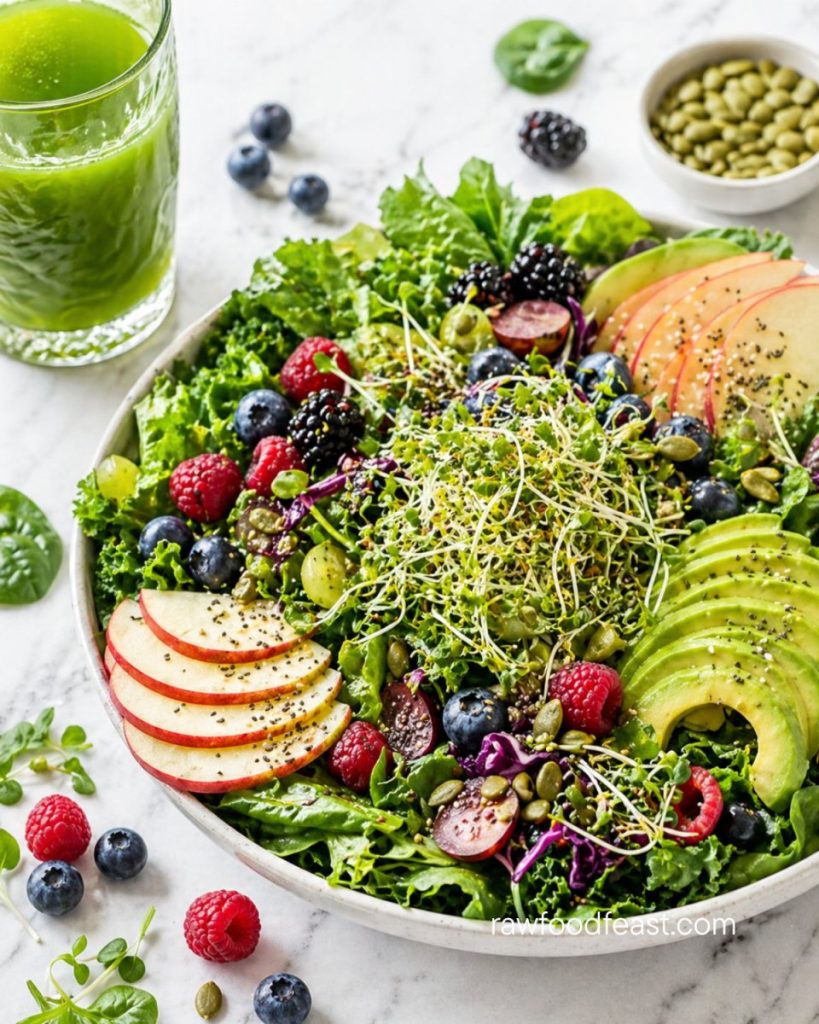
Leafy greens are rich in folate and magnesium — both essential for nerve signaling and steady mood. Folate is what your body uses to make the chemical messengers that keep your thinking clear and your emotions balanced. Magnesium calms the nervous system directly. A big handful of spinach or romaine in your daily salad is doing more for your brain than most people realize.
Fiber-rich fruits feed the bacteria that produce the short-chain fatty acids your brain depends on. Apples, pears, bananas, berries — the fiber in these fruits is exactly what your gut bacteria are asking for. Each fruit delivers a slightly different type of fiber, which means different bacteria get fed. That diversity is what keeps the whole ecosystem strong.
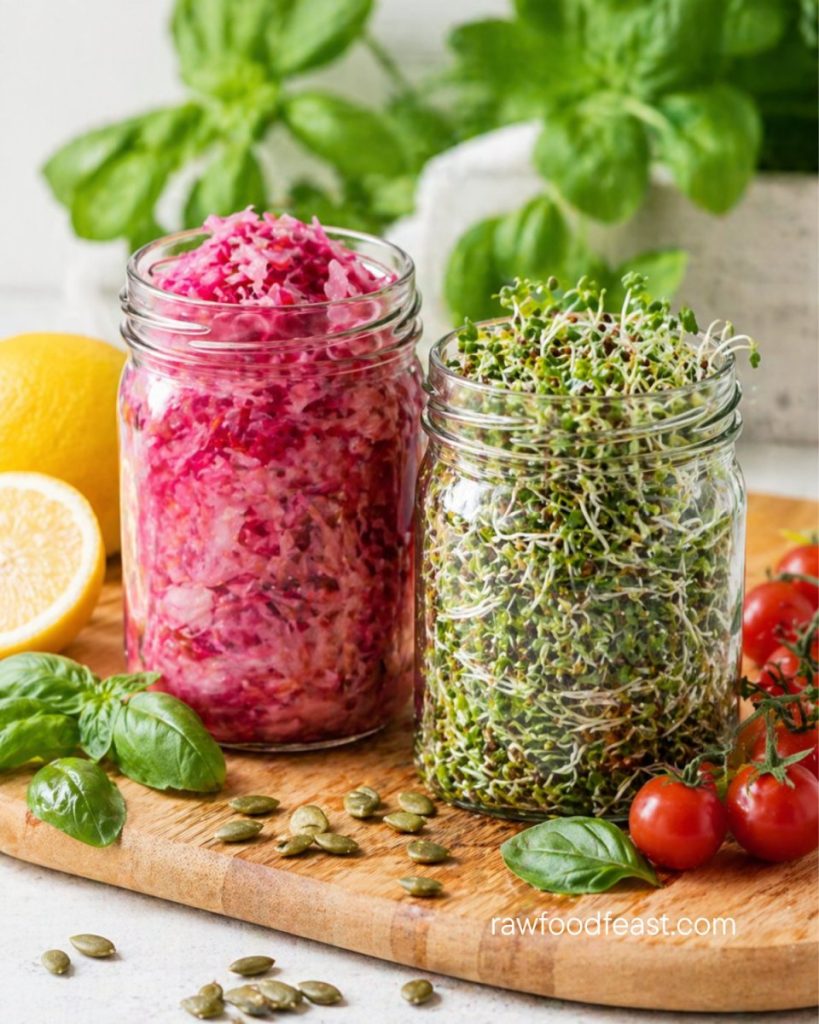
Sprouts are packed with living enzymes, fiber, and concentrated nutrients that support gut bacteria diversity. Broccoli sprouts deserve special mention — they contain sulforaphane, a compound that calms gut inflammation directly and supports the integrity of the gut lining. What sulforaphane actually does in your body — and why eating sprouts raw is the only way to get it — is explored fully in Broccoli Sprouts Benefits. A small serving of sprouts on your salad or in a wrap adds more gut-brain support than most people expect.
Fermented raw foods like sauerkraut and kimchi deliver beneficial bacteria straight into your gut. These are not supplements in a jar — they are living foods carrying the same strains of bacteria your gut is trying to maintain. A few forkfuls alongside a meal is enough to make a difference.
Fresh juice delivers concentrated nutrients and soluble fiber that support gut bacteria — minerals, plant compounds, and hydration that reaches the gut lining quickly. Paired with whole raw food for the full range of fiber bacteria need to thrive, the two together cover the full spectrum of what the gut-brain connection depends on. For the specific juices that support gut health daily, this guide goes deeper: Best Juices for Gut Health.
When the gut is too compromised to absorb the nutrients you are eating — even good food — the whole chain breaks down. That process, and how to recognize it, is explained in Not Absorbing Nutrients Properly.
What Changes When You Feed Your Gut Real Food?
Clarity. Focus. Steadier mood. Better sleep. These are the things people notice first — often within the first two to three weeks. Not because raw food is a brain supplement, but because the gut finally has what it needs and the brain responds.
The gut bacteria restructure. The species that depend on fiber and living food start growing back. The gut lining repairs — the cells that line it replace themselves every few days, and when they are built from real nutrients instead of processed ingredients, they hold together the way they are supposed to. The inflammation that was clouding everything begins to settle. And the chemical messengers your brain depends on — serotonin, dopamine, GABA — start flowing again at the levels your body was always designed to produce.
The full week-by-week timeline of what shifts — from gut bacteria to skin to sleep — is laid out in What Happens When You Eat Raw Food for 30 Days.
Sometimes people eat well and still feel tired, foggy, or flat. That is usually a sign that digestion is not keeping up — even good food cannot help if the body is struggling to process it. That pattern, and what to do about it, is covered in Eating Healthy but Still Tired.
If you want to build this kind of eating into a daily rhythm — with recipes, practical guidance, and people doing it alongside you — Healthy & Free is an online community built around practical, delicious whole food (un)cooking and juicing. Come join us and enjoy food that gives you energy, happy digestion, and glow.
Your Gut Is Already Talking — The Question Is What You’re Feeding It
The gut-brain connection is one of the reasons the protein conversation misses the point so completely. Fiber — not protein — is the real gap most people are living in. That full picture is unpacked in The Plant Protein Myth.
The gut-brain connection is not something you manage with a supplement or a protocol. It is something that improves naturally when you feed it real, living food. Working with clients over the years, this is one of the first things I see shift — mood steadies, sleep deepens, the fog lifts — and it almost always starts with the gut. That is what The 6-Week Reset is built around. Every salad, every juice, every handful of sprouts is part of the conversation your gut is having with your brain — and the quality of that conversation depends entirely on what you give it to work with.
You do not need to overhaul everything at once. A big green salad. A fresh juice in the morning. Some sprouts on the side. That is enough for your gut to start sending better signals — and for your brain to start listening.