Mirjam Henzen
 The protein question follows plant-based eating like a shadow. You mention that you eat mostly raw food and someone — usually someone who means well — asks right away: but where do you get your protein?
It is worth taking seriously. Not because the fear holds up when you look at it closely, but because it is real, widespread, and has been running for a long time. People genuinely believe that plant food leaves them short on protein, that eating this way means energy and muscle quietly fading. That belief has a very specific history — and once you know it, the plant protein myth loses its power.
What you find underneath is a 1914 experiment on rats, a bestselling book that walked back its own central claim, and an industry with a strong interest in keeping the myth alive. What you also find is that your body’s relationship with protein is nothing like most people have been told — and that the one deficiency genuinely affecting the vast majority of people has nothing to do with protein at all.
The Plant Protein Myth Explained: Where the Fear Comes From
The fear of incomplete plant protein has a specific origin. In 1914, two American chemists — Thomas Osborne and Lafayette Mendel — published research on protein quality using rats as their test subjects. They fed isolated proteins to rats and found that some produced better growth than others. From this, the idea developed that some proteins were “complete” and others “incomplete.”
Two problems. Rats are not humans — their nutritional needs differ from ours in meaningful ways. And the study used isolated proteins, not whole foods, not varied meals, not anything resembling how people actually eat. Nothing about it was designed to answer the question “does plant food give humans enough protein?” But that is exactly what it has been used to answer ever since.
The myth got its biggest push in 1971, when Frances Moore Lappé published Diet for a Small Planet — a book arguing that plant eaters needed to carefully combine foods at every single meal to build “complete” proteins. It was well-intentioned. It was also, as Lappé herself admitted in the 1981 revised edition, wrong on that central point. She wrote: “In 1971 I stressed protein complementarity because I assumed that the only way to get enough protein… was to create a protein as usable by the body as animal protein. In combating the myth that meat is the only way to get high-quality protein, I reinforced another myth.”
The retraction didn’t travel as far as the original claim. The protein combining idea is still repeated today as though that correction never happened.
Worth noting too: the Blue Zones — the communities around the world with the longest, healthiest lives on record — eat largely plant-based, high-fiber diets with modest protein. Their longevity was not built on protein powder.
Do Plants Have Complete Protein?
This is the question underneath most of the protein worry. And answering it honestly requires one piece of biology that changes the whole picture.
Your body doesn’t absorb protein. It absorbs amino acids.
When you eat something that contains protein — from any source — your digestive system takes it apart completely, right down to the individual amino acids it is made of. Those amino acids enter the bloodstream, and your body collects them and draws from them as it builds what it needs: enzymes, hormones, the structural material that holds everything together, the chemical messengers that run your mood and your thinking. Your body builds its own proteins from the ground up, using the building blocks it has available. It doesn’t borrow yours. It dismantles what arrives and rebuilds from the pieces.
This is why the plant protein myth around “complete protein” doesn’t hold up. The idea that a single food needs to contain all the right building blocks in the right proportions misses how the body actually works. What matters is whether your diet across the day gives you the full range. Not each meal. Your body draws from a pool that is always replenishing.
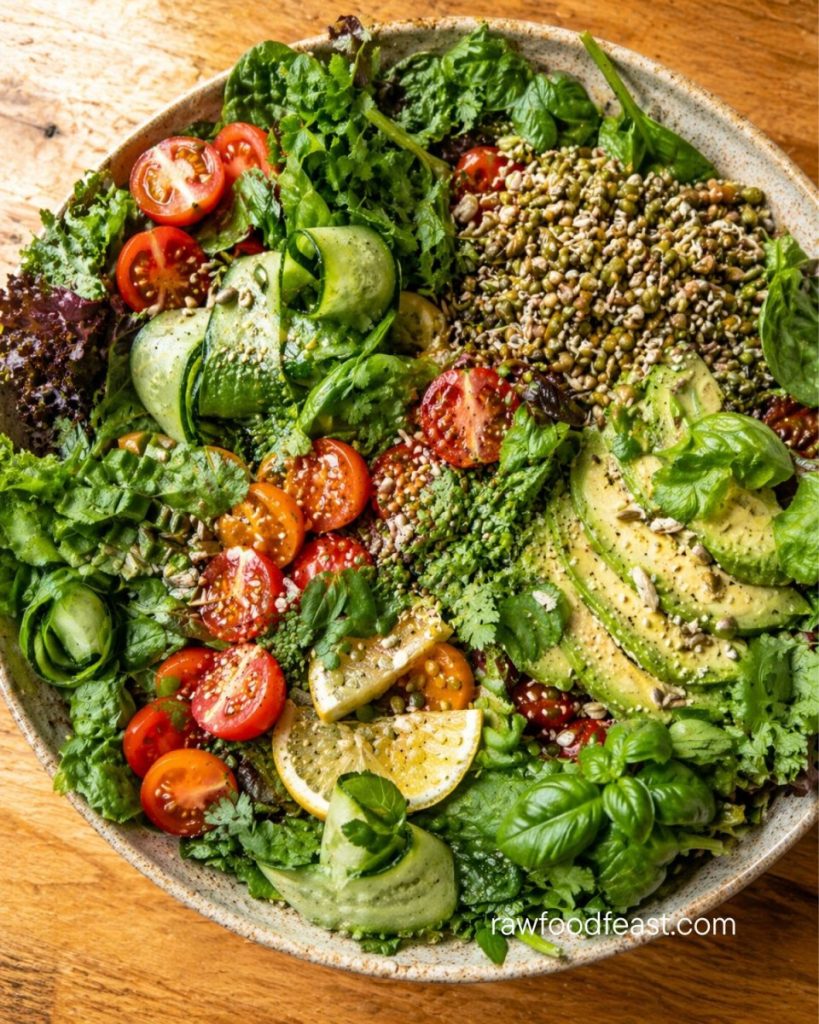
Here is what most people don’t realize: amino acids are in all whole plant foods. Not just the ones labeled “protein sources.” Broccoli. Spinach. Fruit. Sprouts. All of them. The difference between a “protein food” and “not a protein food” is how concentrated those building blocks are — not whether they are there at all. It is a marketing category, not a biological one.
On a varied (raw) plant food diet, your body is receiving amino acids from dozens of foods, continuously, throughout the day. The worry about whether any one food is “complete” only makes sense if you are ignoring everything else.
How the body breaks food down and turns it into what you actually absorb is covered in Digestive Enzymes Explained: How Raw Foods and Juice Help You Absorb More.
What Mother’s Milk Tells Us About Protein
If you want to understand what the human body actually needs to grow and build itself, look at what it designed specifically for that job.
Breast milk is what the body produces to nourish a newborn through the fastest growth phase of a human life. In the first six months, a baby doubles its birth weight. Bone, organ tissue, nervous system, brain — all of it building at a rate that will never be matched again. If high protein is what the body needs to grow and develop, this is exactly when and where that would show up.
It doesn’t.
Breast milk is primarily carbohydrate — lactose. Carbohydrates are the dominant component, nearly double the fat content by actual weight. Fat comes second. Protein is a small fraction of both. The fuel nature designed specifically to grow a newborn through the fastest growth phase of its life is built around carbohydrate first, fat second, with a modest contribution from protein.
Nature had every opportunity to load breast milk with protein. It built this food for one purpose — to grow a human as efficiently as possible during the most demanding growth phase of life. And it chose carbohydrate as the foundation.
That is not a study. Not a theory. It is what the body itself designed when it built something to grow a newborn through the most demanding growth phase of life. That, more than any argument, is the answer to the plant protein myth.
Does the Body Run on Protein?
No. And this matters more than most people realize, because a significant part of the high-protein story is built on the idea that more protein equals more energy, more strength, more of everything.
Glucose — the sugar that comes from carbohydrates — is the fuel every cell in your body runs on. Your brain uses it almost exclusively. It will only switch to burning fat as a backup during only when food has been absent for a long time, and even then reluctantly. Your muscles store glucose as their energy reserve and burn through it when you move. The body runs on carbohydrate. That is what it was built for.
When the body uses protein as fuel, it is because it has run out of better options. The liver has to do the conversion work, turning amino acids into glucose, and the kidneys have to filter the waste that process generates. It costs the body far more than simply eating fruit or root vegetables and having the fuel arrive ready to use. The body does this when it has to. Not because it is the preferred way.
Fruit, leafy greens, sprouts, vegetables — these are the foods the body is built to run on. The energy arrives ready to use. No diversion through the liver, no burden on the kidneys. Just fuel, doing exactly what fuel is supposed to do.
If you eat well but still find yourself running low on energy, the explanation is usually in digestion — specifically in how much of what you eat is actually reaching your cells. That is explored in Eating Healthy but Still Tired? Here’s What Your Digestion Is Missing.
What High Protein Does to Your Digestion
Of all the things you eat, protein costs the body the most to process. More work, more time, more digestive effort than fruit, vegetables, or fat. Do that three times a day, every day, and the digestive system is quietly running hard in the background almost constantly.
Raw plant food does the opposite. One of the things people notice earliest when they shift toward eating this way is that digestion stops feeling like an event. The body is not working as hard, and that freed-up energy goes somewhere — into clarity, into movement, into feeling genuinely awake after a meal instead of ready for a nap.
That heaviness after a high-protein meal — the need to sit down, the dip in energy, the fog that settles in — that is not just fullness. That is your digestive system pulling significant resources to deal with what arrived. Resources that would otherwise be available for the rest of your life.
There is something else worth knowing. Animal protein is acid-forming in the body — once it has been processed, the body has to work to bring itself back into balance, drawing on its own mineral reserves to do it. Plant protein is alkaline-forming. It does not create that correction work. It lands in a way the body handles without the extra effort.
What happens when digestion is regularly overloaded — and why it matters for whether nutrients actually reach your cells — is in Why Your Body Isn’t Absorbing Nutrients Properly (And How to Fix It Naturally).
Can Too Much Protein Damage Your Kidneys?
Every time the body breaks protein down — from food or from its own recycling of old tissue — it produces waste. Compounds the kidneys then have to filter out, continuously, with every meal. The more protein you eat, consistently and over time, the harder that filtering work becomes.
This is not just an athlete’s problem — though athletes make it especially visible, because they are intentionally pushing protein as high as possible, for years at a time. Anyone eating high protein day in and day out is putting the same sustained pressure on their kidneys. The athletic world just does it more deliberately and at greater scale.
The signal people miss most often: lower back pain. The kidneys sit mid-lower back, one on each side of the spine. That persistent aching that does not go away with stretching, does not respond to rest, keeps quietly coming back — many people have been living with that for years and blaming their posture, their desk chair, or their training. It rarely occurs to anyone to look at what they have been eating.
The kidneys are quiet. They compensate without complaint for a long time. That silence is not the same as the absence of strain.
Whole food delivers what the body needs in the form it was always meant to arrive in — without the concentrated waste load that comes with powders and isolates. What isolated supplements cannot do that whole food always can is explored in Do I Need Supplements? The Truth About B12, Isolates, and Why Food Wins.
The Real Deficiency Nobody Is Talking About
Here is what is genuinely widespread. The vast majority of people eating a standard Western diet are significantly fiber deficient. The gap between what the gut needs and what most people actually eat daily is enormous — and it shows up in ways that rarely get labeled correctly: bloating that comes and goes without explanation, energy that drops by mid-afternoon, persistent hunger even after eating, skin that will not quite clear.
Protein deficiency — as something separate from simply not eating enough food — is essentially not something that happens in people eating adequate whole food calories. Working with clients over the years, I have never seen a single case of it. Not one. Fiber deficiency? Consistently, across the board. The two conversations are happening with entirely the wrong balance of attention.
Fiber is what the gut microbiome feeds on. Without it, the community of microorganisms that runs your gut — the one managing immune function, nutrient absorption, and inflammation — goes hungry. The gut lining weakens. What you eat, however carefully chosen, reaches you less completely than it should.
The connection goes further than digestion. Your gut produces the vast majority of your body’s serotonin. When the gut is depleted and struggling, that production drops — and the effects show up far beyond the stomach. Brain fog, low mood, difficulty concentrating: these arrive through the gut before they arrive in the brain. What that connection looks like in practice — and how raw food addresses it — is explored in How to Clear Brain Fog Naturally: Why It Starts in Your Gut (And How Raw Food Lifts It).
What fiber deficiency actually looks and feels like in the body — and the raw foods that address it — is in Signs of Fiber Deficiency: Why Your Gut Is Still Sluggish (And How to Fix It with 30 Raw Plants).
If you want to build this kind of eating into a daily rhythm — with recipes, practical guidance, and a community doing it alongside you — Healthy & Free is an online community built around practical, delicious whole food (un)cooking and juicing. Come join us and enjoy food that gives you energy, happy digestion, and glow.
What Does Your Body Actually Need to Build Muscle?
This one is simpler than the protein industry would have you believe.
You build muscle by using it. That is the thing no supplement, powder, or protein target can replace — the actual training, the actual effort, the consistent challenge to the muscle itself. Food supports what happens after that. It does not do it for you.
What the body needs from food is variety. Enough fiber to keep the gut working well. Enough vitamins and minerals to support repair. Enough omega-3 fatty acids to keep inflammation low and recovery clean. It does not need to be a fully raw diet — though a high raw diet is genuinely extraordinary for this. What it needs is real food, across the full range of what the body asks for. Not one number on a label.
People who shift toward raw plant food often notice something in their recovery. Less heaviness the next day. More clarity. The body feeling like it bounced back rather than needing to dig out. That is not about protein. That is about everything else the body was finally getting enough of.
The protein-for-muscle story is largely something the supplement industry built and the fitness world repeated. The body responds to training — and to a varied, nourishing diet that gives it what it actually needs. Chasing protein grams at the expense of everything else is a trade-off that quietly costs the kidneys and digestive system over time, in ways that rarely get traced back to the cause.
Eat Variety and Let Your Body Do the Rest
The building blocks your body draws from every day are already in raw plant food — spread across everything you eat, arriving from dozens of directions without you having to think about it. These foods are worth knowing not because you need to track them, but because they are genuinely wonderful and variety across them is the whole idea.
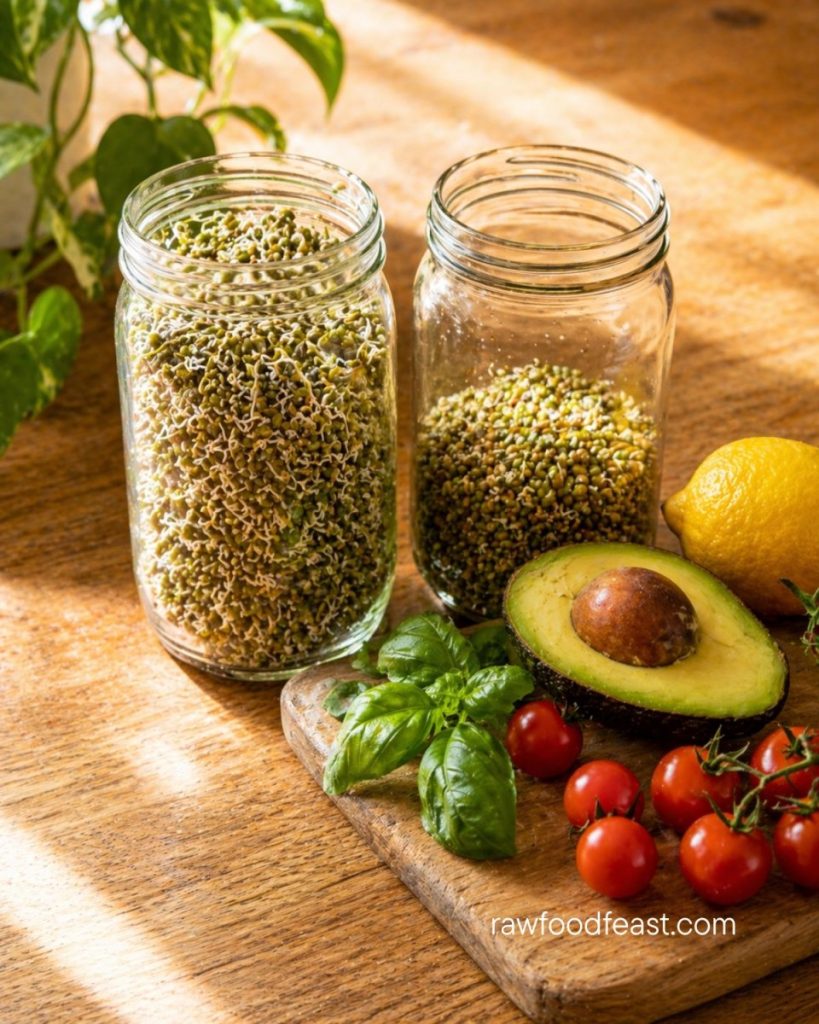
Sprouted lentils are one of the most nourishing plant foods you can eat — and sprouting takes them further. Something opens up in a lentil when it germinates. It becomes more alive, easier to digest, and more of what is in it actually reaches you. Iron, folate, and potassium come along too.
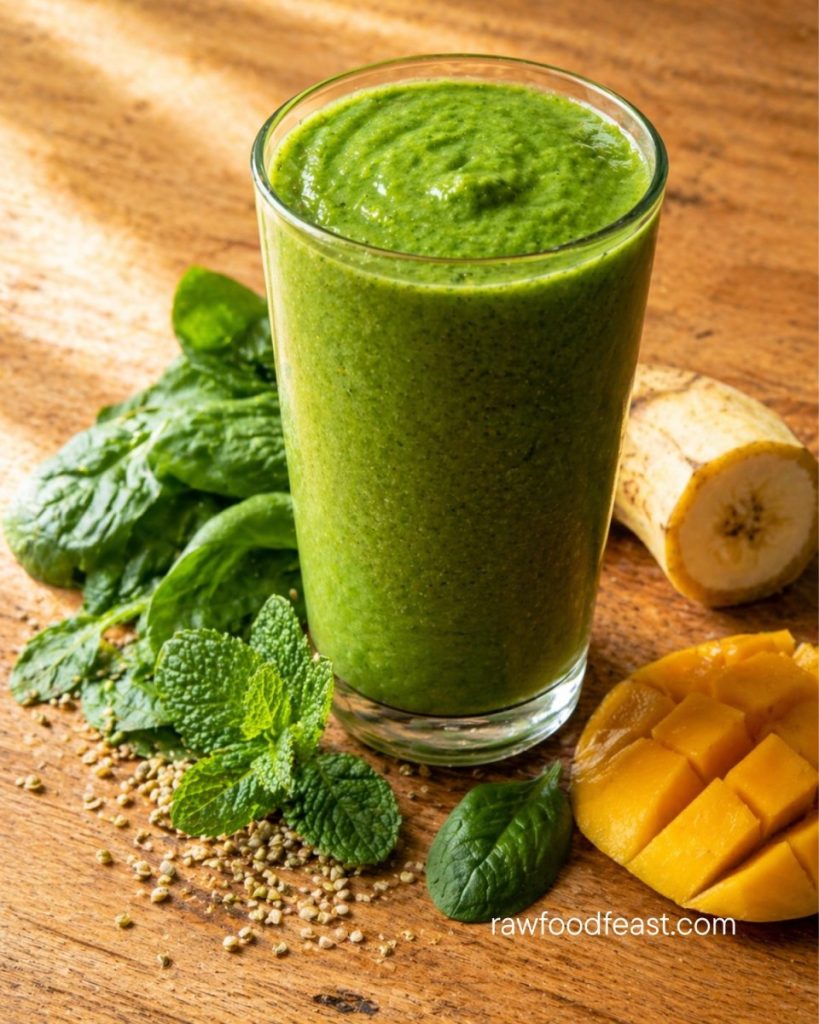
Hemp seeds are one of the easiest things you can add to your day. A few tablespoons into a smoothie or over a salad and your body has a wide range of building blocks to draw from — with almost nothing asked of your digestion in return.
Pumpkin seeds are deeply nourishing. Rich in magnesium and iron alongside their amino acids — a combination that supports recovery, steady energy, and mineral balance. One of the most quietly powerful seeds in the raw food kitchen.
Spinach delivers more than most people expect from a leafy green. A big handful in a smoothie brings a full range of building blocks, iron, folate, chlorophyll, and vitamin K. It earns its place in daily rotation many times over.
Sunflower seeds are consistently overlooked and consistently useful. Easy to add to almost anything, and one of the better plant sources of methionine — a building block that often gets less attention than it deserves.
Spirulina and chlorella are whole foods, not supplements — algae, dried and powdered, with some of the broadest nutritional profiles in the plant world. A teaspoon in a smoothie does more than most capsules ever could.
Sprouted buckwheat is mild, versatile, and works in smoothies, raw porridge, and anywhere you want something a little more substantial. Sprouting opens it up the same way it does with lentils — more available, easier on the body, more alive.
Eat variety. Eat these foods because they are extraordinary — not because you are watching a number. Your body is running the calculation quietly and continuously, the way it always has.
What eating this way consistently looks and feels like is in What Happens When You Eat Raw Food for 30 Days.
What Happens When You Stop Worrying About Protein?
The plant protein myth is a modern story with a clear beginning and a clear winner — and neither of them is your health. A 1914 experiment on rats. A book that walked back its own central claim. An industry that found the worry useful and kept it going long after the science had moved on.
The body, meanwhile, keeps doing what it has always done. Taking what it needs from everything you eat, building what it needs to build, running on the fuel it was always designed for — and asking, quietly and consistently, for more fiber.
Feed it variety. Feed it real whole plant food. Give your gut what it needs to receive everything properly. The rest takes care of itself.