Mirjam Henzen
 There is something quietly powerful about eating food that is still growing. Broccoli sprouts are three to five days old when you eat them — barely out of the seed — and already loaded with more protective power than a full head of mature broccoli will ever produce. The broccoli sprouts benefits most people hear about start with sulforaphane — one of the most studied and promising things to come out of nutrition research. But what it actually does in your body is more interesting than any headline gives it credit for.
And the reason it matters for raw food is simple — the way you eat broccoli sprouts determines whether you get sulforaphane at all.
What Are Broccoli Sprouts and Why Are They Different from Broccoli?
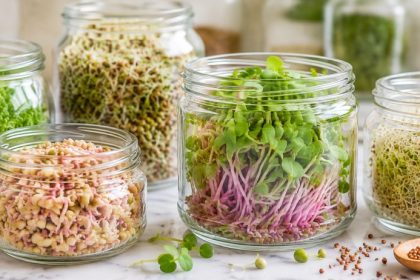
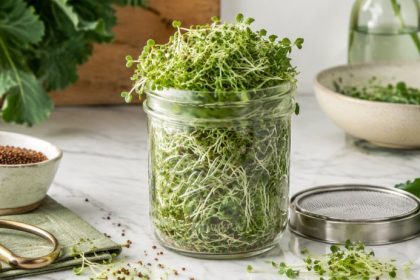
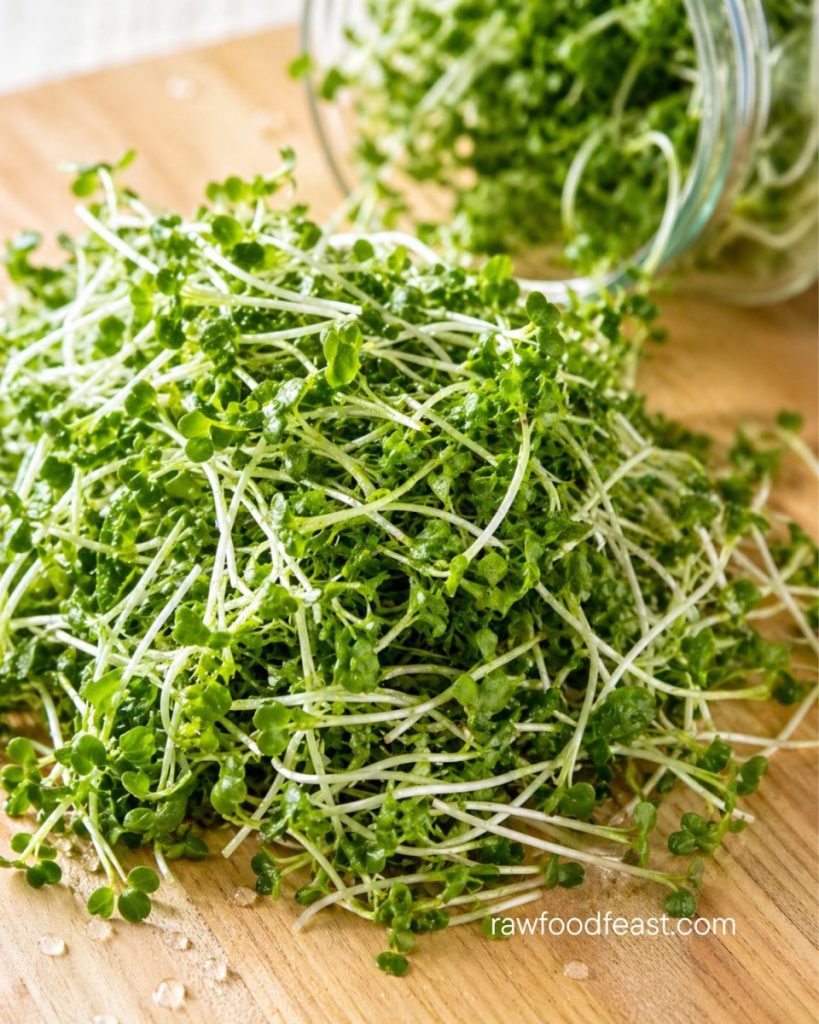
Broccoli sprouts are not baby broccoli. They are the very first growth from a broccoli seed — thin white stems with tiny green leaves, harvested after just three to five days. They taste mild, slightly peppery, and surprisingly fresh. Nothing like the dense, sometimes bitter character of mature broccoli.
The difference that matters most is what is inside them. Broccoli sprouts contain 10 to 100 times more glucoraphanin — the compound your body converts into sulforaphane — than a full-grown broccoli head. That range was first documented in 1997 by researchers at Johns Hopkins University, led by Paul Talalay and Jed Fahey. Their work changed the way scientists thought about sprouts entirely.
Why do broccoli sprouts contain so much more sulforaphane than mature broccoli? Because glucoraphanin is concentrated in the seed. As the plant grows, that concentration gets spread across stems, leaves, and florets. A tiny sprout still has almost everything the seed packed in — all of it in a form your body can use immediately.
This is why a small handful of broccoli sprouts delivers what an entire plate of broccoli cannot. The broccoli sprouts benefits you will read about in the rest of this article all trace back to this concentration. The plant is at its most potent when it is barely days old.
What Is Sulforaphane?
Sulforaphane does not exist inside a broccoli sprout — not until you break it open. Here is what actually happens. The sprout stores two things in separate compartments within its cells: glucoraphanin and an enzyme called myrosinase. They sit apart, doing nothing, until you chew, chop, juice, or blend the sprout. That is when the cell walls break. The two meet. And myrosinase converts glucoraphanin into sulforaphane.
Think of it as two things that only become powerful together. One is the starting ingredient, the other is the activator. Without the enzyme, the starting ingredient just passes through. Without the starting ingredient, the enzyme has nothing to work on. It is the meeting that matters.
This is exactly why eating broccoli sprouts raw is the point. Myrosinase is alive in raw sprouts — ready to do its work the moment you start chewing. Cook them, and you lose the activator. The glucoraphanin survives heat reasonably well, but without the enzyme to convert it, your body gets far less sulforaphane. The full conversion happens in your mouth, on your cutting board, in your juicer, in your blender. Right there.
What Does Sulforaphane Do in Your Body?
Once sulforaphane enters your bloodstream, it does something unusual. Instead of acting like a typical antioxidant — one molecule neutralizing one free radical — it flips a switch inside your cells. That switch is called the Nrf2 pathway, and the simplest way to understand it is this: it is your body’s master defense switch. When sulforaphane activates it, your cells ramp up production of their own protective enzymes — hundreds of them — all at once.
This is not something you get from a supplement that picks off one free radical at a time. This is your body building its own defense system from the inside. One compound tells your cells to protect themselves, and they respond by producing an entire arsenal.
Among those enzymes are what researchers call phase 2 detox enzymes — your body’s cleanup crew. These are the enzymes that neutralize harmful compounds before they can damage DNA or trigger inflammation. Sulforaphane is one of the most powerful natural activators of these enzymes ever identified.
It also calms inflammation at the source. Sulforaphane quiets NF-kB — a protein complex that drives inflammatory responses throughout the body. When NF-kB is overactive, inflammation becomes chronic. Sulforaphane settles it down.
What people notice: clearer skin. Steadier energy through the day. Calmer digestion. The science explains why, but the felt experience comes first — and it often shows up within weeks.
Do Broccoli Sprouts Help with Detoxification?
The broccoli sprouts benefits related to detoxification are real — not a tea, not a three-day reset with a catchy name. Sulforaphane activates phase 2 detox enzymes in the liver, the organ that does the heavy lifting when it comes to processing and removing what your body does not need. These enzymes take what your body cannot use — pollutants, waste, damaged molecules — and turn them into something it can actually flush out.
A clinical trial at Johns Hopkins measured this directly. Participants in a heavily polluted region of China drank a broccoli sprout beverage daily, and researchers tracked how much of certain airborne pollutants — benzene and acrolein — left the body through urine. The results were significant. People drinking the broccoli sprout beverage flushed out up to 61% more benzene and 23% more acrolein than the control group. Their bodies were clearing these pollutants faster and more efficiently.
This is not about a dramatic cleanse. This is the body’s own detoxification system — already in place, already running — being supported by a compound that tells it to work harder. The way your body naturally handles toxins through the liver, kidneys, lymphatic system, and gut is explored fully in How to Detox Naturally, which covers the daily workflow of real detoxification through juicing, hydration, and mineral-rich raw food.
If you are interested in how fiber-rich raw foods help trap and remove environmental contaminants before they are absorbed, that process is unpacked in Foods That Remove Microplastics from Your Body — including the specific role of soluble fiber, chlorella, and psyllium husk in binding particles in the gut.
How Do Broccoli Sprouts Benefit Gut Health?
The broccoli sprouts benefits that show up in your gut are some of the most well-documented. A Japanese study gave participants 70 grams of fresh broccoli sprouts daily — about a large handful — for eight weeks. The results were clear: the bacteria levels in their stomachs dropped significantly, and the inflammation in their stomach lining calmed down noticeably. When participants stopped eating the sprouts, the bacteria returned. The sprouts were doing the work, and the gut responded directly.
That anti-inflammatory effect ties back to NF-kB suppression. When chronic inflammation is running quietly in the gut lining, digestion slows down. Nutrient absorption suffers. Energy drops. Sulforaphane calms that inflammation at the cellular level — not masking symptoms, but addressing what is driving them.
Broccoli sprouts also contribute fiber — not enormous amounts, but enough to support the bacteria in your gut that thrive on raw plant food. A diverse, fiber-fed microbiome produces short-chain fatty acids that strengthen the gut lining and improve how efficiently your body absorbs nutrients from everything else you eat.
If you have ever wondered what happens when fiber drops too low — and how quickly the gut responds — that full picture is explored in Signs of Fiber Deficiency, which breaks down the fiber gap most people are living in and how raw plant variety closes it.
Does Cooking Destroy Sulforaphane?
Yes — and this is the single most important practical detail about broccoli sprouts. Myrosinase — the enzyme that converts glucoraphanin into sulforaphane — is destroyed by heat. Boiling eliminates sulforaphane formation entirely. Steam for too long and you lose most of it. The glucoraphanin survives, but without the enzyme, your body cannot convert it efficiently.
This is exactly why broccoli sprouts belong in raw food — and why the broccoli sprouts benefits you hear about depend entirely on how you eat them. The enzyme needs to be alive. The cells need to break open in your mouth, not in a pot. The conversion happens right there, and everything that makes broccoli sprouts extraordinary depends on it.
It is the same reason raw food preserves the digestive enzymes naturally present in plant foods — enzymes your body puts to work immediately. That connection between raw food and enzyme activity is unpacked in Digestive Enzymes Explained, which covers how raw foods arrive with their own enzymes and reduce the workload on your digestive system.
Why the Seeds You Choose Matter More Than You Think
Not all broccoli seeds are created equal — and the difference is bigger than most people realize. When researchers tested 48 commercially available broccoli seed varieties, only 15 had significant levels of glucoraphanin. Of those 48, only nine were actually broccoli — the rest were mislabeled. Some were rapini, some were other brassicas entirely. The label said broccoli. The chemistry said otherwise.
Even among genuine broccoli seeds, the range is enormous. Certain varieties have been specifically selected and grown to contain two to three times more glucoraphanin than standard seeds. That means the sprouts you grow from high-glucoraphanin seeds deliver significantly more sulforaphane per serving — without eating any more volume. Same handful. Different impact.
Most seed sellers do not test glucoraphanin content. They sell broccoli sprouting seeds based on germination rate and appearance — which tells you nothing about what is actually inside. Batch testing matters for safety too. Sprouting seeds need to be tested for pathogens like E. coli and salmonella, and not every supplier does this consistently.
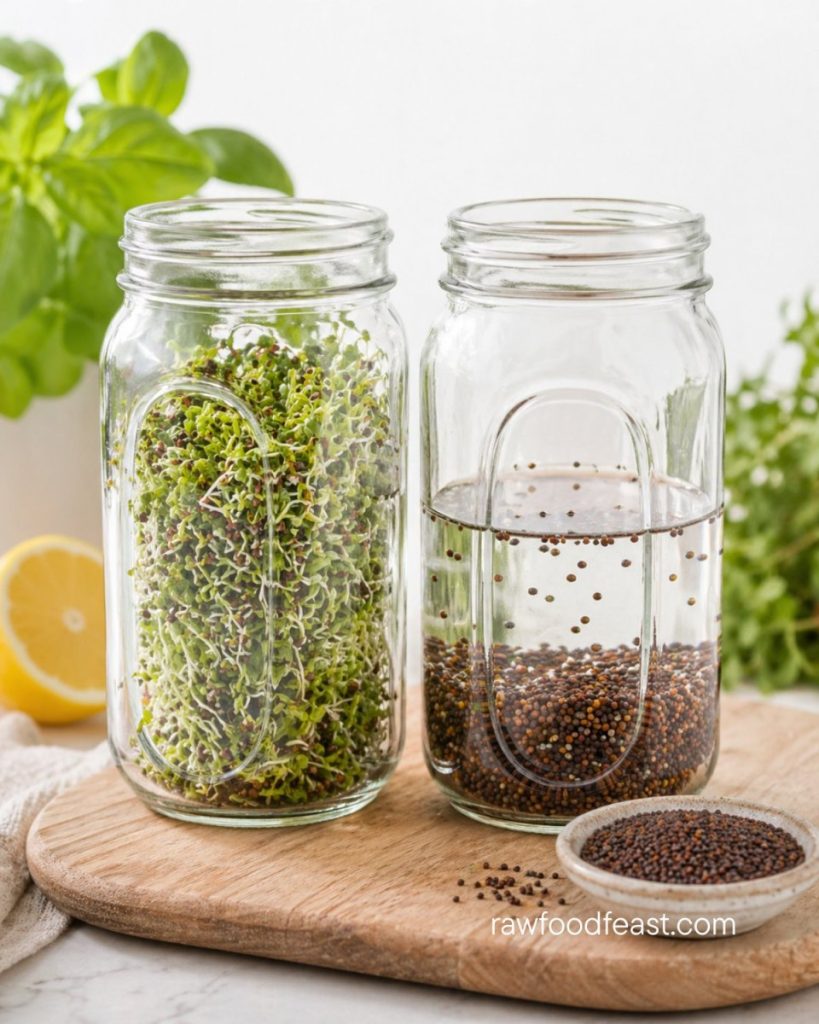
High-glucoraphanin broccoli seeds exist — and they make a real difference. These are seeds grown from broccoli varieties that naturally contain three times more glucoraphanin than typical broccoli seeds, and they are batch-tested for both potency and pathogens. That means you know what you are growing, and you know it is safe.
When those seeds go into a sprouter with proper airflow and drainage — the kind that keeps sprouts clean and thriving from day one — everything comes together. The germination is strong, the growth is even, and what you harvest actually contains what it is supposed to. That is the difference between sprouting and sprouting well.
The Sprouting Company carries exactly this — high-glucoraphanin seeds and a sprouter built for the job. Use discount code RAWFOODFEAST to save at The Sprouting Company on all products.
How to Eat Broccoli Sprouts Every Day (More Ways Than You Think)
The easiest way to eat broccoli sprouts consistently is to stop thinking of them as a side dish and start treating them as an ingredient that goes into what you are already making. They are mild enough to blend into strong flavors and fresh enough to stand on their own when you want that gentle, peppery kick.
In juice, a cup of broccoli sprouts blends right in with any green combination. They add a subtle depth alongside celery, cucumber, and apple — and the sulforaphane is there in every sip. In smoothies, they pair beautifully with fruit. Blend them with banana, mango, or berries and the flavors complement each other naturally. A little green, a little sweet, and everything your body needs from both.
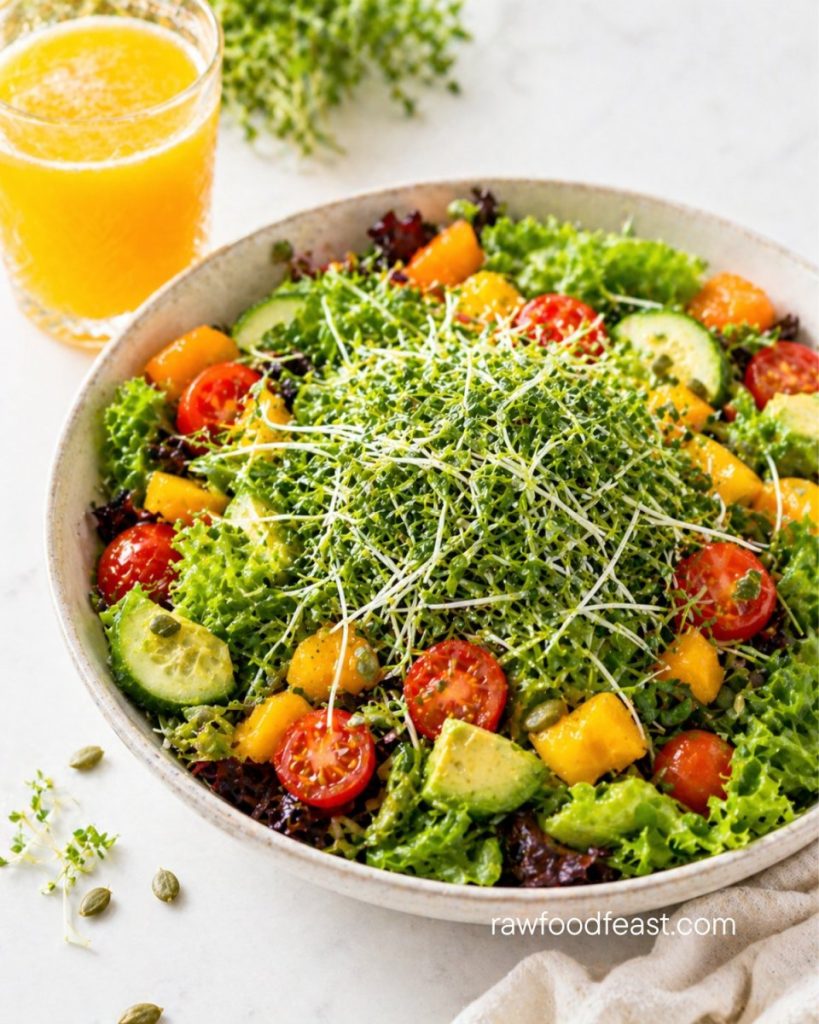
On salads, broccoli sprouts add a light crunch and a mild spice that pairs well with leafy greens, seeds, and citrus dressings. A handful on top is enough. In raw dressings, blend them with avocado, lemon, and garlic for a green dressing with a lively edge.
One of the best ways to enjoy them is as a topping on raw flatbread — broccoli sprouts pair beautifully with the warmth and texture of a savory base. If you have not tried it, Almond Carrot Pulp Flatbread is a perfect match.
If you want to build this kind of eating into a daily rhythm — with recipes, practical guidance, and people doing it alongside you — Healthy & Free is an online community built around practical, delicious whole food (un)cooking and juicing. Come join us and enjoy food that gives you energy, happy digestion, and glow.
The point is abundance. Broccoli sprouts are not a prescription — they are one more living food in a kitchen full of them. Rotate them with your leafy greens, your other sprouts, your juices. Variety is what makes this way of eating sustainable and genuinely enjoyable.
How Much Broccoli Sprouts Should You Eat?
When it comes to broccoli sprouts benefits and how much to eat, most of the research used between 70 and 100 grams daily — roughly a large handful. That is the amount that reduced stomach bacteria, helped the body flush out pollutants, and calmed inflammation in the studies that have been done.
In practice, you do not need to weigh anything. A generous handful — about a cup — on your salad, blended into your morning juice, or tossed into a smoothie is plenty. Some days you will eat more, some days less. That is fine. Consistency over weeks matters more than precision on any single day.
What is worth knowing is that broccoli sprouts also contribute amino acids — 15 of them, including ones your body uses for muscle repair and immune function. They are not a standalone protein source, but they are a meaningful contributor to the full spectrum of amino acids your body assembles from every plant food you eat across the day. The idea that plant foods cannot provide complete amino acid profiles is one of the most persistent myths in nutrition — and it is thoroughly dismantled in The Plant Protein Myth, which traces the fear back to a single 1914 rat study that was never meant to apply to humans.
The real answer to “how much” is the same answer that applies to all raw food: variety. Broccoli sprouts as one of many living foods you eat regularly. Not the only thing on your plate — just one of the best things on it.
What Happens When You Add Broccoli Sprouts to a Raw Food Diet?
When your diet is already built around raw, living food — fresh juices, big salads, fruits, seeds, leafy greens — adding broccoli sprouts is like turning up the volume on something that was already working. The broccoli sprouts benefits build on everything else. The sulforaphane activates defense systems that are already being supported by the enzymes, fiber, and minerals in everything else you eat. It all adds up.
People who eat this way for even a few weeks notice changes that are hard to explain to someone who has not experienced them. Energy that does not dip in the afternoon. Skin that genuinely glows. Digestion that works so well you stop thinking about it. These are not dramatic overnight shifts — they are the quiet, cumulative result of consistently giving your body what it actually needs.
What that looks like week by week — the gut bacteria restructuring, the skin renewal, the steady energy — is mapped out in What Happens When You Eat Raw Food for 30 Days, which covers what actually changes in your body when you stay with it.
Broccoli sprouts are the kind of food that makes you understand why raw matters. Not as an ideology. Not as a restriction. But because the very thing that makes them extraordinary — the enzyme that creates sulforaphane — is alive in the raw sprout and gone the moment heat reaches it. The benefit lives in the aliveness.
There is something deeply right about eating food that is still in the middle of becoming. A sprout is not finished. It is three to five days old, packed with everything it needs to grow into a full plant, and you are eating it at the moment of its greatest concentration. Every enzyme intact. Every compound at its peak. That is not just nutrition. That is food at its most alive.