Mirjam Henzen
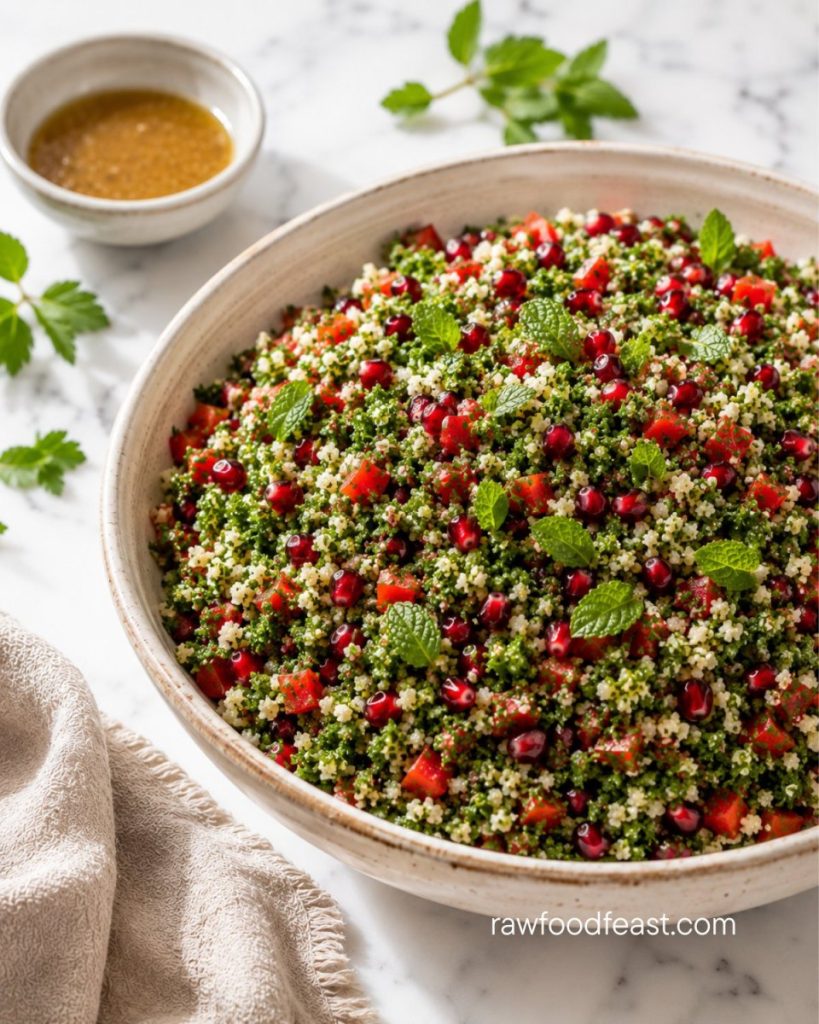
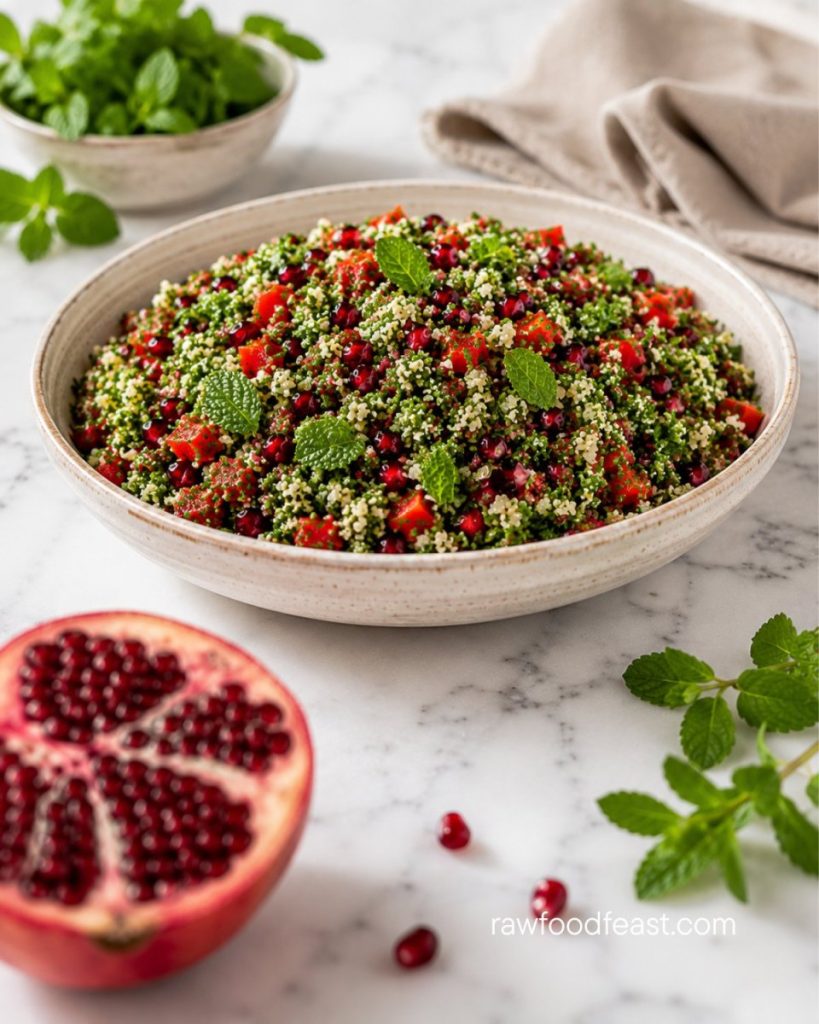
 Tabbouleh is one of those salads that quietly defines a culture. Bulgur, parsley, mint, lemon — Lebanon, Syria, Israel, Jordan, every household with its own version, every grandmother with strong opinions. This raw cauliflower tabbouleh with pomegranate keeps every reason the original is loved and changes a few things to make it work harder for your body. Riced cauliflower replaces the bulgur. A creamy lemon date dressing replaces the olive oil. Pomegranate seeds get scattered across the top for color, crunch, and that ruby-burst of sweet-tart that makes every bite different.
It comes together in twenty minutes. It feeds two as a generous meal or four as a side. And it carries eleven different plants in one bowl, which is the kind of fiber math your gut microbiome will thank you for.
Why This Cauliflower Tabbouleh with Pomegranate Belongs in Your Rotation
Tabbouleh is meant to taste alive. Herbs by the fistful, lemon bright enough to make your jaw tingle, tomatoes ripe and a little juicy. This raw cauliflower tabbouleh with pomegranate hits every single one of those notes — and skips the parts that weigh the original down.
What gets changed: the bulgur, a refined grain that needs cooking, and the olive oil, a refined fat that adds calories without nutrition. What stays: the parsley by the fistful, the mint, the lemon, the bite. What gets added: cauliflower as the base, dates as the natural sweetener that makes the dressing creamy without any oil, and pomegranate seeds for that ruby-red moment that makes everyone who sees the bowl reach for a fork.
It comes together in 20 minutes, marinates for another 15 while you set the table, and feeds two as a generous meal or four as a side. It gets better the second day, which means you can absolutely make it ahead.
The other thing this bowl does — quietly, in the background — is feed your gut microbiome. Eleven different plants in one serving is exactly the kind of variety your gut bacteria want, and the soluble fiber in the dates plus the insoluble fiber in the cauliflower covers both jobs at once. If you’re already thinking about how to feed your gut bacteria daily, fresh juices made with the right combinations are the other half of this equation. The build-out of which juices do the most for your microbiome is laid out in Best Prebiotic Juices for Gut Health.
What Makes This Version Different from Classic Tabbouleh
Classic tabbouleh is a Levantine grain salad — Lebanese in particular, where it’s considered one of the dishes that defines the cuisine. The traditional version uses fine bulgur, which is cracked wheat, soaked just long enough to soften, tossed with chopped parsley, mint, tomatoes, lemon juice, olive oil, and salt. Some versions add cucumber, scallions, or a touch of sumac.
Three things change in this raw plant-powered version, and each one earns its place.
The first change is riced cauliflower instead of bulgur. Cauliflower in its raw form has a tiny crunch, a mild flavor that takes on whatever you season it with, and almost no calories — which means the herbs and the dressing become the loudest voices in the bowl. It’s also gluten-free, grain-free, and ready in seconds with a food processor.
The second change is the lemon date dressing instead of olive oil. Olive oil makes everything coat-and-shine, but in a raw vegan kitchen we want the dressing to do something more. Whole-food dates blended with lemon juice and a touch of garlic create a creamy emulsion without any added fat — and the natural sweetness from the dates balances the bright acid in the lemon perfectly.
The third change is pomegranate seeds on top. Some traditional recipes use pomegranate molasses for a sweet-tart layer. Whole pomegranate seeds give the same flavor with all the fiber, texture, and color the molasses leaves behind.
The cumulative effect of eating raw food consistently — what shifts in your gut at week one, what your energy does by day ten, what your skin shows by week three — is mapped out clearly in What Happens When You Eat Raw Food for 30 Days. A bowl like this one isn’t a one-off. It’s the kind of food that compounds.
Ingredients for Raw Cauliflower Tabbouleh
Most of these ingredients you probably already have. The full quantities live in the recipe card at the end of this article. What follows is the why behind each one.
The cauliflower is the base. One medium-large head yields about 4 to 5 cups (560 to 700 g) riced, which is the right amount for two large meal portions or four sides. White, purple, or green cauliflower all work. White is the cleanest contrast against the pomegranate.
Tomatoes are where the juiciness comes in. Cherry tomatoes work beautifully because they hold their shape and release less liquid into the salad. If you’re using regular vine tomatoes, deseed them with a teaspoon before dicing, or chop them and add them to the bowl right before serving rather than during the marinate. All three approaches keep the tabbouleh crisp instead of soggy.
Red bell pepper brings sweetness and crunch. Yellow or orange peppers are equally good. I’d skip green here — the flavor is grassier than the herbs already deliver.
For cucumber, English cucumbers — the long ones — have fewer seeds and thinner skin than regular cucumbers, which means less prep and less water in the bowl. Half a cucumber is enough.
Spring onions are lighter and brighter than red or yellow onion. Slice them thin enough that they melt into the rest. Four scallions covers it.
Flat-leaf parsley is the soul of this dish. A whole bunch, finely chopped. Italian flat-leaf parsley has more flavor than curly parsley, which is why classic tabbouleh recipes specifically call for it. Don’t be shy with the quantity.
Fresh mint is what makes tabbouleh tabbouleh. Half a bunch, finely chopped. The combination of parsley plus mint plus lemon is the holy trinity here.
Pomegranate seeds get scattered on top at serving — a full cup (150 g). Buy whole pomegranates and de-seed them yourself if they’re in season; the freshest seeds are unbeatable. Out of season, pre-seeded packets from the produce section work fine. If you fall in love with pomegranate the way most people do once it’s part of their kitchen, the cleanest way to extract a whole pomegranate’s juice without staining everything is covered in How to Juice Pomegranate Without the Mess.
The medjool dates are the base of the dressing. Plump, sticky, soft dates blend silky-smooth. Soak them first — the next section explains why and how. Four big medjool dates is enough for the dressing.
Two juicy lemons gives you both the juice and the zest you need. Always pick organic since you’re using the zest.
One small garlic clove pulls everything together. Garlic is traditional in Levantine dressings.
Sumac is optional but recommended. It’s a Middle Eastern spice with a tangy, lemony, slightly fruity note — the secret ingredient that makes this taste like the version you’d order at a Lebanese restaurant.
Eleven plants in one bowl. Cauliflower, tomato, bell pepper, cucumber, spring onion, parsley, mint, pomegranate, dates, lemon, garlic. Hitting thirty different plants a week is one of the most powerful things you can do for your gut microbiome, and bowls like this one make that math easy. The full breakdown of why fiber deficiency is the issue most people don’t realize they have, plus what closing the gap actually does in the body, is in Signs of Fiber Deficiency: Why Your Gut Is Still Sluggish (And How to Fix It with 30 Raw Plants).
Why Dates Are the Secret to a Creamy, Oil-Free Dressing
Maple syrup, agave, and dates are all natural sweeteners — and each has its place. Maple is beautiful in baking. Agave works in mocktails and chilled drinks where you want something to dissolve fast. Dates are the one that turns into a creamy dressing.
Here’s why. When you blend dates with lemon juice and a splash of water, the natural sugars and the soluble fiber work together to create body. The dressing pours like a vinaigrette and clings to the riced cauliflower like it has oil in it — but there’s no oil. Dates also bring trace minerals along for the ride: potassium, magnesium, copper, plus dietary fiber that neither maple nor agave can offer in the same form.
This is why date-based dressings have become the secret ingredient of raw food kitchens. They give you the silky, emulsified texture that everyone associates with oil-based dressings, without the refined fat. They sweeten without spiking. And they make the lemon shine instead of softening it.
If you’ve never blended dates into a dressing before, this is the recipe to start with. The flavor is balanced, the texture is luxurious, and the lemon date combination is one you’ll come back to for other salads, slaws, and bloomed wild rice bowls.
If you want another oil-free dressing in your rotation that uses a different whole-food trick — hemp seeds for the creaminess instead of dates — the Cilantro Lime Dressing is built on the same plant-powered logic with a completely different flavor profile. Bright lime, fresh cilantro, a hint of jalapeño. Two of these in your rotation and your salad bowls never get boring.

How to Soak Medjool Dates for the Silkiest Dressing
Medjool dates look soft in the package — and they are softer than dried Deglet Noor dates — but they still benefit from a soak before blending. The soak softens the skin, hydrates the flesh, and lets your blender break them down into pure cream instead of fibrous chunks.
For raw food specifically, the soak matters even more. Skip the hot water shortcuts altogether. Microwaving compromises the natural sugar structure of dates, and pouring boiling water over them breaks down the enzymes you’re trying to preserve. Room temperature soaking keeps the dates raw, alive, and at their nutritional peak.
How long to soak medjool dates: 1 to 2 hours in filtered water at room temperature. Cover them so they stay submerged. After two hours they’ll be plush and ready to blend silky-smooth.
The bigger picture on raw food and enzymes — why your body uses less of its own digestive work when food arrives intact, and what that quiet shift does for absorption and energy — is unpacked in Digestive Enzymes Explained. It’s the article that explains why “raw” isn’t a label, it’s a method.
If you’ve ever wondered exactly how long to soak any nut, seed, or dried fruit — and you’ve ever pulled chickpeas out of soaking water at hour 18 wishing you’d checked sooner — bookmark this soaking tool. It tells you the optimal soak time for every ingredient in raw food, from almonds to chickpeas to figs to medjool dates. It’s the kitchen reference I open every time, and it lives at howlongtosoak.com.
Bookmark the page. Pin it to your home screen. The next time you start a recipe at 4 pm and it calls for soaked something, you’ll have the exact answer in two clicks.
How to Rice Cauliflower in Seconds
A food processor turns a head of cauliflower into perfect, couscous-sized rice in about ten to fifteen seconds. There’s no faster way and no better tool for this job.
Break the cauliflower into florets — golf-ball-sized pieces are perfect — and drop them into the food processor. Pulse, don’t blend. About six to eight pulses, just until the texture looks like fine couscous. If you blend continuously, you’ll over-process and end up with mush, which makes the salad watery.
What’s left after the pulsing is light, fluffy, and ready to absorb dressing. Tip it into your largest mixing bowl.
If you don’t own a food processor, a box grater works on the largest grate setting — but it takes longer and your knuckles will know about it. The food processor is the right tool here, and a basic one will earn its place in your kitchen if you cook this way regularly.
How to Make Raw Cauliflower Tabbouleh Step by Step
The whole process takes 20 minutes hands-on, plus 1 to 2 hours of dates soaking (mostly while you’re doing other things) and a 15 to 20 minute marinate at the end.
Start by pitting four medjool dates and submerging them in filtered water at room temperature. Set a timer for an hour minimum, two hours ideal. While they soak, you can prep the rest.
When the dates are ready, drain them and add them to a high-speed blender with the lemon juice, filtered water, the garlic clove, lemon zest, sea salt, ground sumac if you’re using it, and a pinch of black pepper. Blend for about 30 seconds until silky and creamy. Add a splash more water if it’s too thick to pour easily. Taste — it should be bright, slightly sweet, and fully balanced. Set the dressing aside.
Rice the cauliflower next. Break the head into golf-ball-sized florets and pulse in your food processor 6 to 8 times until it looks like fine couscous. Tip it into your largest mixing bowl.
Now the chopping. Finely dice the cherry tomatoes (or deseeded vine tomatoes), red bell pepper, and English cucumber. Slice the spring onions thin. Finely chop the parsley and mint. Add everything to the cauliflower bowl.
Pour the dressing over the bowl and toss gently until every grain of cauliflower is coated. The cauliflower should look glossy, the herbs should be evenly distributed, and the bowl should smell like a Lebanese kitchen.
Let the bowl sit at room temperature for 15 to 20 minutes. This step is non-negotiable — it’s where the flavors merge and the cauliflower softens just enough.
Transfer to a wide serving platter or shallow bowl. Scatter a full cup of pomegranate seeds generously across the top. Finish with a few whole mint leaves and an extra dusting of sumac if you have it. Serve immediately or chilled.
For more rhythm, more raw recipes like this, and the daily support that turns it into a routine instead of a one-off, Healthy & Free is where we explore this in depth.
Serving Ideas for Cauliflower Tabbouleh
This raw cauliflower tabbouleh with pomegranate holds its own as a main, a side, or a starter — and it stretches across cuisines further than you’d expect.
As a Mediterranean bowl base, spoon a generous portion into a wide bowl, top with hummus or baba ganoush — both easy to make raw — scatter cucumber slices and microgreens, and add a few olives if you do olives. Lunch in five minutes.
As a side at a Middle Eastern spread, the tabbouleh ties a whole table together. Falafel, fresh sprouts, lettuce wraps, sliced tomato — all of it works alongside.
Stuffed into hollowed bell peppers or large lettuce cups, this becomes a no-cook lunch you can take to work. Cut the bell peppers in half lengthwise, scoop out the seeds, and pile in the tabbouleh. Eat with a fork or pick them up.
If you have a dehydrator, the natural dipper for this tabbouleh is a tray of Sundried Tomato Crackers. They’re oil-free, herb-loaded, and built on soaked sunflower seeds with flax — the kind of cracker that turns a bowl of salad into a full plate. Seven plants per cracker, before you’ve even added the tabbouleh on top.
And if you’re building out a full raw Mediterranean spread for friends, Pasta Puttanesca is the next dish on the table. Sun-dried tomatoes, kalamata olives, capers, caper brine, and a kick of chili over spiralized cucumber noodles. Same oil-free approach as this tabbouleh, completely different flavor — bold, savory, deeply satisfying.
On top of fresh greens, the tabbouleh becomes its own meal. Bed of butter lettuce or romaine, generous mound of tabbouleh, a few extra pomegranate seeds. Done.
How Long Does Cauliflower Tabbouleh Last in the Fridge?
This raw cauliflower tabbouleh keeps beautifully. Store it in an airtight container in the fridge for up to 3 days. The flavors actually deepen over the first 24 hours as everything continues to marinate.
Two storage tricks make a real difference. The first is to keep the pomegranate seeds in a separate small container and add them to each portion right before eating, so they stay jewel-bright instead of bleeding pink across the salad. The second is the same logic for a final sprinkle of fresh mint or sumac — finish each plate at serving time, not at storage.
If you’ve used regular vine tomatoes rather than cherry tomatoes, expect a small pool of liquid at the bottom of the container after a day. That’s normal — drain it before serving the next round, or stir it back through if you like the dressing extra-loose.
Cauliflower Tabbouleh FAQ
What’s the Difference Between Tabouli and Tabbouleh?
None. Both spellings refer to the same Levantine herb-and-grain salad. “Tabouli” is the more anglicized spelling. “Tabbouleh” is closer to the Arabic transliteration. Use whichever feels natural — they describe the same dish.
Can You Make Tabbouleh Without Bulgur?
Absolutely. Riced cauliflower is the most popular grain-free swap because the texture is closest to fine bulgur. Quinoa works for a gluten-free grain version. Hemp hearts and millet are other alternatives. This recipe uses cauliflower so the result stays raw, grain-free, and as fresh-tasting as possible.
Is Cauliflower Tabbouleh Healthy?
Yes — and “healthy” understates it. This bowl delivers eleven different plant foods, multiple grams of fiber per serving, vitamins A, C, K, and folate from the herbs and pomegranate, and zero refined ingredients. Eaten as a regular part of a whole-food plant-powered diet, it supports your gut microbiome, your cardiovascular system, and your skin.
How Do You Keep Cauliflower Tabbouleh from Getting Watery?
Three approaches, pick what works for you. Use cherry tomatoes; they release less juice. Deseed regular tomatoes with a teaspoon before chopping. Or chop the tomatoes separately and add them right before serving instead of during the marinate. All three keep the cauliflower crisp instead of soggy.
Can I Add Chickpeas or Quinoa to This Recipe?
You can — though if you’re going for fully raw, both would need to be sprouted rather than cooked. Sprouted chickpeas add protein and a nutty crunch. Sprouted quinoa adds chew. Either is welcome but neither is necessary; the cauliflower carries the dish on its own.
Can I Prepare This Ahead for a Dinner Party?
Yes. Make everything except the pomegranate up to a day in advance. Refrigerate covered. About 30 minutes before serving, take it out so it returns to room temperature, then top with pomegranate seeds and any final mint or sumac.
Tabbouleh has been around for centuries because it does something specific. It makes herbs the main event, lemon the loudest note, and the rest of the bowl a supporting cast. Riced cauliflower is a modern adjustment, but the heart of the dish stays the same.
Make this version once and you’ll see why dates earn their place in raw vegan kitchens. The dressing pours like a vinaigrette, coats every grain of cauliflower, and turns lemon into something silky instead of sharp. Pomegranate brings the burst, parsley brings the green, and you get a bowl that tastes more alive than almost anything you’ll make this week.
If this becomes a regular in your kitchen, I’d love to hear what you change up. Different herbs, different add-ins, different ways to serve it. The variations are always the most fun part.
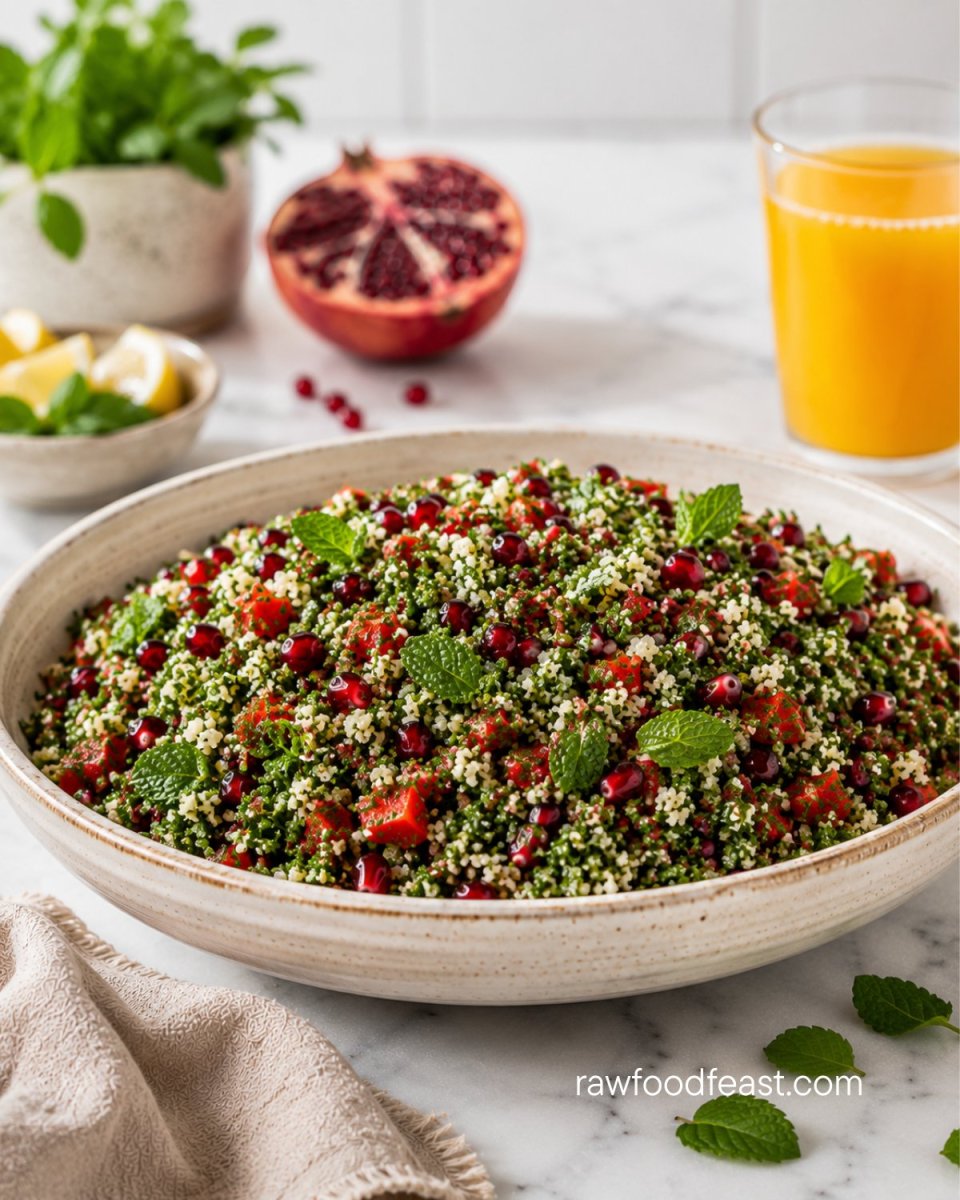
Raw Cauliflower Tabbouleh with Pomegranate and Lemon Date Dressing (Vegan, Oil-Free, Gluten-Free, Nut-Free)
Ingredients
Equipment
Method
- Pit the medjool dates and submerge them in filtered water at room temperature for 1 to 2 hours.
- Drain the soaked dates. Add them to a high-speed blender with the lemon juice, water, garlic, lemon zest, sea salt, sumac (if using), and black pepper. Blend until silky and creamy, about 30 seconds.
- Break the cauliflower into florets and pulse in a food processor 6 to 8 times until couscous-fine. Tip into a large mixing bowl.
- Finely dice the tomatoes, bell pepper, and cucumber. Slice the spring onions thin. Finely chop the parsley and mint. Add everything to the cauliflower bowl.
- Pour the dressing over the bowl and toss gently until every grain of cauliflower is coated.
- Let the bowl sit at room temperature for 15 to 20 minutes for the flavors to meld.
- Transfer to a wide serving platter. Scatter the pomegranate seeds generously across the top. Finish with whole mint leaves and an extra dusting of sumac if using. Serve immediately or chilled.
Nutrition
Notes
Tried this recipe?
Let us know how it was!