Mirjam Henzen
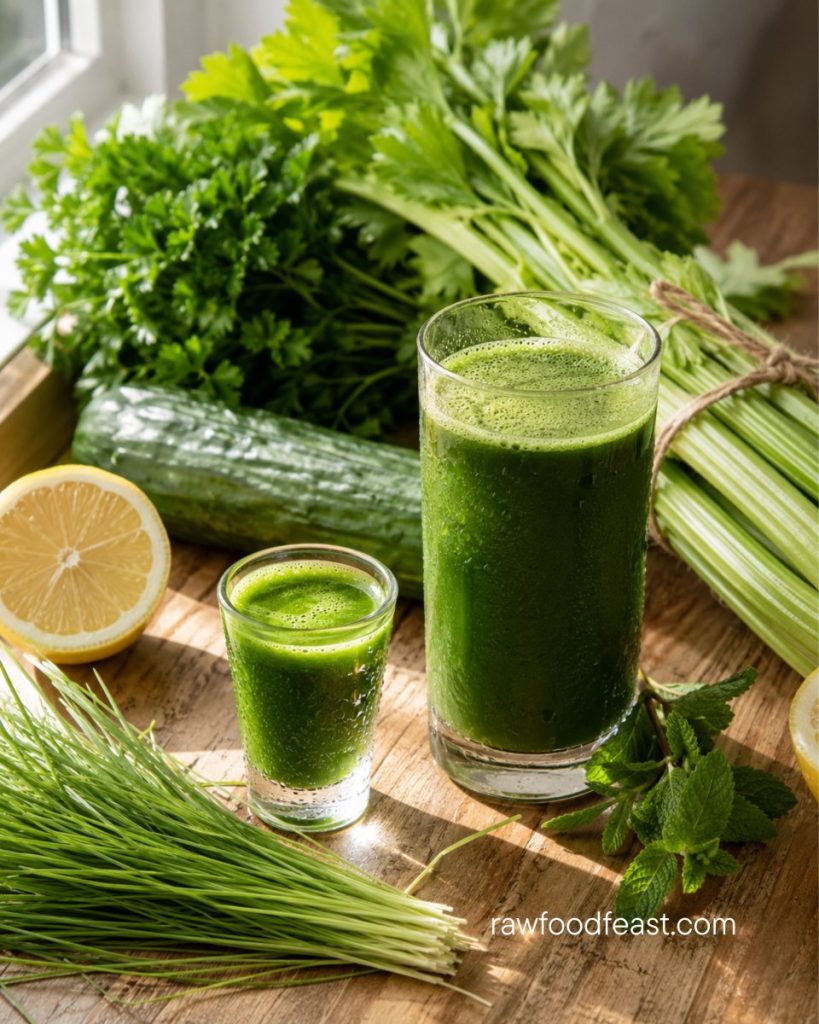
 A 30ml shot of fresh wheatgrass juice looks like almost nothing — barely a thimbleful of bright green liquid in a small glass. And yet within minutes of drinking it on an empty stomach, you feel it. Your energy lifts, not in a spiky or jittery way but as if a switch flipped — steady and bright. Your eyes feel clearer. Your skin warms faintly. This is what real wheatgrass juice benefits look like in the body — small in volume, large in effect.
Wheatgrass juice is the pressed juice of young wheat plants, harvested when the grass is seven to twelve days old and still tender. At that stage the plant is essentially a microgreen — pure chlorophyll, enzymes, vitamins, and minerals, with almost none of the starch that develops later when the grain forms. The juice that comes out of it is one of the most nutrient-dense liquids you can put into a human body. That is not marketing language. That is what every nutritional analysis of fresh wheatgrass juice confirms.
This article is for anyone who has wondered what wheatgrass juice actually does — whether it lives up to its reputation, whether you really need it if you already drink green juice, and the simplest way to make a daily shot part of your morning. The short answer is yes, it earns its reputation, no other green replaces it cleanly, and the daily practice is simpler than most people expect.
The Real Wheatgrass Juice Benefits (And Why They Show Up So Fast)
Wheatgrass juice does three things very well, and it does them faster than almost any other plant food.
The first is delivering chlorophyll. Wheatgrass is exceptionally dense in chlorophyll — the green pigment plants use to convert sunlight into energy. Inside your body, chlorophyll supports red blood cell function, binds to certain toxins so your body can move them out, and helps oxygenate tissues. The molecular structure of chlorophyll is remarkably similar to hemoglobin, the protein that carries oxygen in your blood, with one main difference: chlorophyll has magnesium at its center while hemoglobin has iron. Drinking concentrated chlorophyll gives your body a steady supply of the raw materials it uses to keep your blood, your cells, and your energy systems running well.
The second is delivering active enzymes. Because wheatgrass is juiced fresh and consumed within minutes, the enzymes naturally present in the plant arrive in your body still alive. These enzymes help your digestive system break down what you eat, reduce the energy your body has to spend on digestion, and free up resources for repair and recovery. Heat-dried wheatgrass powders lose most of these enzymes during processing. Freeze-dried raw powders preserve them much better and are the best powder option available. Even so, fresh juice consumed within minutes of pressing remains the most alive form — no powder, however carefully processed, fully replaces what fresh delivers.
The third is delivering bioavailable vitamins and minerals. Wheatgrass contains meaningful amounts of vitamin A (as beta-carotene), vitamin C, vitamin E, and vitamin K, along with iron, magnesium, calcium, and potassium. It also contains all essential amino acids in trace amounts — small quantities, yes, but the full spectrum. Because the cell walls have been broken open by juicing, absorption begins almost immediately. You do not need to digest it the way you would digest a salad. The nutrients arrive ready to be used.
This is why people often report feeling a shift within minutes. Your body is responding to a fast delivery of concentrated, ready-to-absorb nutrition that you would otherwise have to extract from a much larger volume of food across hours.
Why a Small Wheatgrass Shot Delivers More Than Most Glasses of Greens
The standard serving of fresh wheatgrass juice is 30 to 60ml — a single or double shot. People often ask why so little. The answer is concentration.
To press 30ml of wheatgrass juice you typically need around 100 grams of fresh wheatgrass. That is a substantial volume of grass for a thimble of liquid. What you are drinking is the concentrated essence of a plant that grew for ten days dedicating all its energy to producing chlorophyll, enzymes, and nutrient density before any of that goes into building stalks, seeds, or stem fiber. Every drop is the most active part of the plant’s life.
By comparison, a 250ml glass of green juice made from celery, cucumber, parsley, and spinach is wonderful — and a regular green juice habit is one of the most powerful daily practices you can build. But the concentration is different. A glass of green juice gives you breadth: minerals, hydration, gentle chlorophyll, multiple plant compounds. A wheatgrass shot gives you depth in one specific direction: chlorophyll and enzyme density, fast.
This is why so many people use them together. The wheatgrass shot is the front-loaded burst of concentrated chlorophyll on an empty stomach. The longer green juice is the broader nutritional baseline through the day. Each one does something the other cannot.
If you want a deeper understanding of what daily green juice does in your body across weeks of consistent drinking, the full picture is covered in: Green Juice Benefits: What Happens in Your Body When You Drink Green Juice Daily
Is Wheatgrass Juice Really Better Than Other Leafy Greens?
This question deserves a clear answer because the truth sits between two simplifications. Wheatgrass is not simply a better version of spinach or kale. It is, however, structurally different from leafy salad greens — and that structural difference is what makes it valuable.
Most leafy greens contain chlorophyll. Spinach, kale, parsley, romaine, dandelion, watercress — all leafy greens produce it. But the concentration in wheatgrass is on another level. A single shot of fresh wheatgrass juice can contain more chlorophyll than several large salads. That density is the practical advantage. You absorb a meaningful dose of chlorophyll quickly without needing to eat a wheelbarrow of greens.
Wheatgrass also contains a different mineral profile than typical leafy greens. The magnesium and iron content is high. The amino acid spectrum is more complete than what you find in lettuce-type greens. And because wheatgrass is harvested at the microgreen stage — meaning the sprouted seed has used some of its starch reserves to push out a vibrant shoot — the nutritional density per gram is higher than it would be in either the seed alone or in a mature plant.
That said, the comparison is not wheatgrass against spinach in a contest where one wins. Wheatgrass is best as a concentrated addition to a green-rich diet, not a replacement for one. The minerals, fiber, and broader nutrient picture you get from a bowl of leafy greens or a green juice cannot be replicated by a 30ml shot. The shot is targeted. The salad is structural. Both belong in a body that wants to feel well.
If you want to compare wheatgrass to one of its closest cousins in the green-juice world, spinach juice is a useful companion piece — different mineral profile, different drinkability, similar chlorophyll-driven energy effects: Spinach Juice Benefits: What This Leafy Green Does for Your Energy, Skin, and Gut
What’s the Best Way to Drink Fresh Wheatgrass Juice?
Fresh wheatgrass juice has a vivid, deeply green, slightly sweet flavor — pure concentrated meadow in a small glass. It tastes alive, because it is. Some people love it from the very first sip. For others, the first sip is bold and unmistakable, and it takes a few days of daily shots before they start to crave the brightness. Either way, the practices below turn a daily wheatgrass shot into a ritual you actually look forward to.
The freshest version always wins. A 30ml shot of wheatgrass that was pressed within the last ten minutes carries the full chlorophyll, enzymes, and vitamins that make this juice what it is. Wheatgrass powder comes in several forms — heat-dried versions lose most of the enzyme activity, while freeze-dried raw powders preserve significantly more. Neither fully matches what fresh juice delivers in the first ten minutes after pressing. Wheatgrass is one of those foods that gives back exactly what you put in. Fresh equals alive.
Three small practices that turn a daily wheatgrass shot into a ritual:
First, drink it on an empty stomach in the morning, before anything else. Your body is most receptive at that hour, your palate is clean, and the energy lift comes through clearly.
Second, follow it with a wedge of fresh orange, lemon, or lime. This classic juice-bar pairing brightens the green flavor and rounds it out with citrus zing. Many people end up loving the combination so much they keep it forever.
Third, chase it with a full glass of water. Wheatgrass is so concentrated that some people feel a brief flush of warmth their first few times — a sign the chlorophyll and minerals are landing fast. Water helps your body integrate what just arrived.
One more thing worth knowing: fresh wheatgrass juice is at its peak in the first five to ten minutes after pressing. Drink it then. The chlorophyll, enzymes, and vitamins are all most active the moment the juice meets your body. This is why making it at home — or having it pressed in front of you — is genuinely different from anything else.
There is also a smart pairing trick worth knowing if you want to layer in even more digestive benefits. Wheatgrass pairs beautifully with fresh pineapple juice — the natural sweetness of pineapple complements the green intensity, and the bromelain enzyme in raw pineapple stacks with the digestive enzymes in wheatgrass for an even stronger gut effect. The full pairing case is made in: Pineapple Juice Benefits: The Enzyme Your Gut Has Been Waiting For
Can You Juice Wheatgrass in a Regular Cold Press Juicer?
Yes — but not every juicer handles it equally well, and this matters more for wheatgrass than for almost any other produce.
Wheatgrass is fibrous, dry, and structurally tough. Centrifugal juicers, which spin produce at high speed to extract juice, struggle with wheatgrass. The blades spin the grass without breaking the cell walls properly. The yield is poor — sometimes almost nothing comes out — and what you do get oxidizes quickly because of the heat and air introduced during the spinning.
Cold press juicers, which use slow pressure rather than speed to extract juice, are far better for wheatgrass. The slow grinding action breaks the cell walls of the grass and presses out the juice cleanly. The yield is significantly higher and the juice is stable enough to taste its full vibrancy. The difference between these two extraction methods is covered in detail in: Cold Press vs Centrifugal Juicer: Key Differences, Benefits, and Why It Matters
For daily juicing — wheatgrass and everything else — a hands-free cold press juicer like the Nama J2 or the Hurom H320N makes the rhythm easy. Drop the wheatgrass in, walk away, come back to a clean shot of bright green juice. Both handle fibrous greens beautifully and produce a stable, high-yield juice you can actually rely on every morning.
Use discount code RAWFOODFEAST to save on the Nama J2 & Hurom H320N cold press juicers, the M1 plant-based nut milk maker, and accessories.
If you are deciding between the two leading hands-free slow juicers, the side-by-side breakdown makes the choice simple: Nama J2 vs Hurom H320N: The Real Differences Between These Hands-Free Slow Juicers
One other note on equipment. Manual wheatgrass juicers — small hand-cranked or single-purpose machines — also work and are inexpensive if you only plan to juice wheatgrass and nothing else. For anyone already juicing daily across a wide range of produce, a quality cold press handles wheatgrass plus everything else without needing a separate device.
How to Grow Wheatgrass at Home
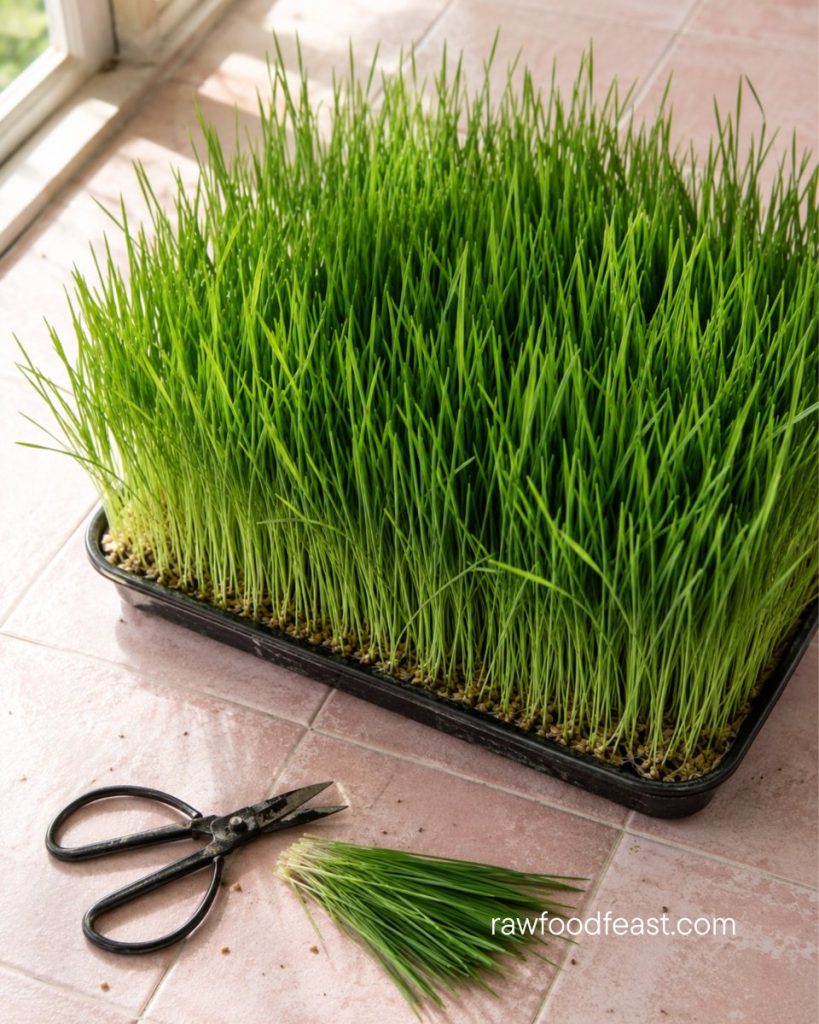
Growing wheatgrass at home is genuinely easy. You need wheat berries (the seeds of the wheat plant), a shallow tray, water, and a bright spot that gets indirect daylight. The whole arc from seed to harvest takes about ten days, and the grass grows into a thick, vibrant green carpet that is satisfying to watch every single day.
For the full step-by-step approach — how long to soak the berries, when to expect the first sprout tails, when to move them to the tray, and how to know when the wheatgrass is ready to cut — the free sprouting tool at howlongtosprout.com walks you through every step. The link drops you directly on the wheatgrass card so you can see the full sequence at a glance and follow it in your own kitchen.
Because wheatgrass is grown at the microgreen stage, it sits in the same general category as broccoli microgreens, sunflower shoots, and pea shoots. The growing technique is similar across all of them. For a wider understanding of how seeds transform into nutrient-dense food during this stage, this companion piece is worth reading: Benefits of Sprouting: Why Sprouts Are One of the Most Nutrient-Dense Foods You Can Grow
And because wheatgrass is technically a microgreen rather than a sprout — these two are often confused — the distinction is covered cleanly here: Sprouts vs Microgreens: What’s the Difference and Which Should You Grow?
One harvest of homegrown wheatgrass gives you roughly two weeks of daily shots if you are juicing one per day. Cut wheatgrass keeps in the fridge for forty-eight hours before juicing, so you can harvest in batches. After that, oxidation starts to affect the nutrient profile and you are better off harvesting fresh.
Who Benefits Most From Daily Wheatgrass Juice
Wheatgrass juice is supportive for almost anyone, but a few specific situations are where it shines most clearly.
People with low iron or low energy often respond quickly to daily wheatgrass shots. The combination of chlorophyll, iron, and easily absorbed vitamins gives the body what it needs to support blood quality and oxygen delivery. Within a few weeks of daily shots, many people notice steadier energy that does not depend on stimulants to get going.
People recovering from periods of stress or depletion benefit too. Wheatgrass is concentrated, gentle on digestion, and helps the body do its own repair work without having to spend energy on breaking down food. That combination — high nutrient density with low digestive demand — is exactly what the body wants when it is conserving energy for healing.
People with skin concerns often find that wheatgrass, paired with broader hydration and a clean plant-based diet, supports clarity over time. Chlorophyll’s binding action and the vitamins in the juice both contribute to the body’s natural detoxification pathways. The visible result tends to show up in the skin first, usually somewhere in the second or third week of daily shots.
And anyone who simply wants a single daily practice that delivers a lot of nutrition in very little time will find wheatgrass useful. A 30ml shot takes ten seconds to drink. There is no easier way to put concentrated chlorophyll, enzymes, and minerals into your body before the day even begins.
What wheatgrass is not is a quick fix or a cure. It is one of the most nutrient-dense things you can drink, but it works best as part of a daily rhythm — fresh juice, water-rich fruit, leafy greens, soaked seeds, the unhurried practice of eating food that is alive. The shot is not the whole rhythm. It is a small, concentrated piece of it that makes the whole rhythm stronger.
One shot a day. Fresh, on an empty stomach, ideally homegrown or from a juice bar you trust. Give it a few weeks. Your body will notice even before your mind does.