Mirjam Henzen
 Cucumber is the everyday workhorse of fresh juicing — and the one most people overlook. It doesn’t have a bold flavor or a flashy reputation. What cucumber juice benefits actually amount to in your body is something subtler and more useful than any single bold-flavored juice can match: deep hydration paired with silica, potassium, and magnesium, all in a form your body can take in within minutes.
If you’ve been juicing for a while, you’ve probably noticed that some juices feel like work to drink while others slip in easily. Cucumber juice sits firmly in the second category. Pale green, mildly sweet, faintly grassy on its own. And yet over a few days of drinking it daily, you start to notice things settling in your body that don’t have an obvious single cause: clearer skin, easier hydration, a steadier energy that doesn’t spike or crash.
That’s not random. Cucumber delivers a specific cluster of plant compounds your body uses every day — and in juice form, those compounds get to work fast.
What’s Actually in Cucumber Juice?
Cucumber juice is about 95% water — but it’s the other 5% that does most of the work. Fresh cucumber juice carries silica (the mineral your body uses to build connective tissue, skin, hair, and nails), potassium (around 150mg per cup), magnesium (around 14mg per cup), vitamin K (which supports blood clotting and helps direct calcium toward bones), and small amounts of vitamin C. Everything is dissolved in mineral-rich water that your body absorbs faster than plain tap water alone.
That 95% water number matters. Most hydration issues aren’t really about volume — they’re about whether your body can hold onto the water it takes in. Plain water without electrolytes can pass through quickly. Cucumber juice arrives with the potassium and magnesium that help your cells actually keep the water where it’s needed.
For the full picture on why people can drink plenty of water and still feel under-hydrated, the mechanism is unpacked in Why You Can Drink Plenty of Water and Still Feel Dehydrated.
Tracking hydration usually feels like a guess. You know you drank some water, some juice, maybe a herbal tea — but the actual number rarely lands clearly. The same goes for plant variety. Eating 30+ different plants in a week is one of the strongest signals for a thriving gut microbiome, but remembering whether you’ve already had cucumber, ginger, mint, sage, apple, and lemon this week is honestly impossible.
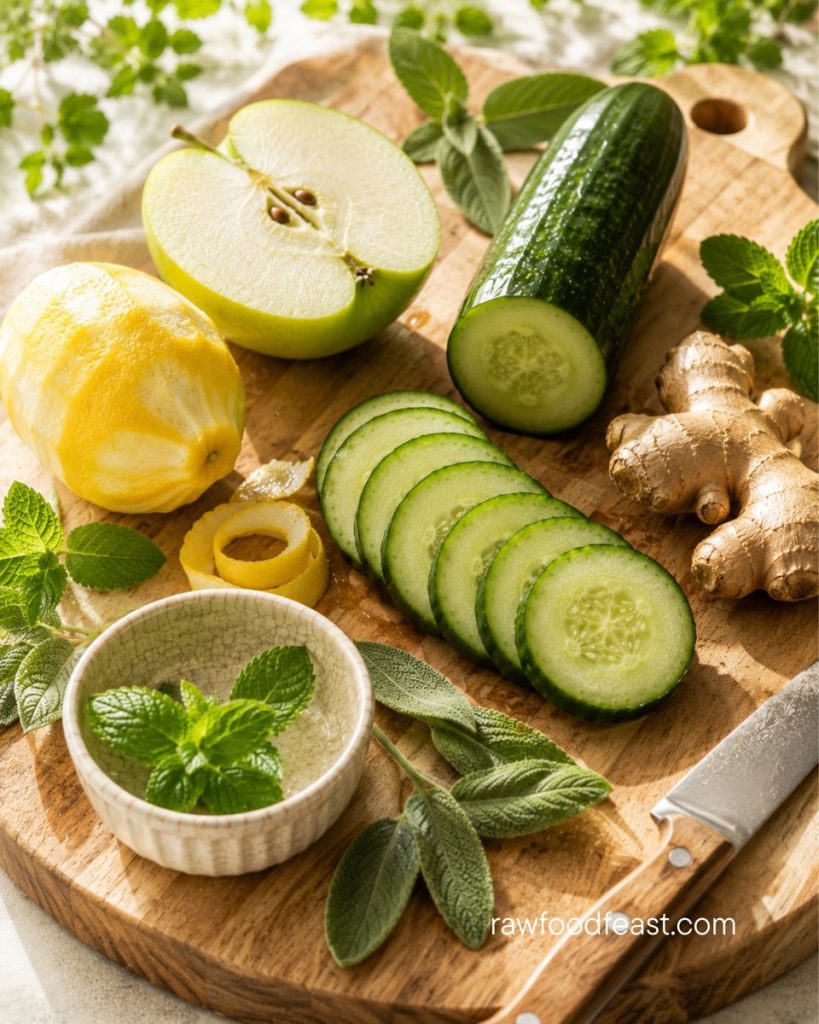
That’s what Fiber First is for. The fiber tracker for gut health counts every plant you eat in a week, plus your daily fiber and hydration. One cup of this cucumber juice alone lands six plants in a single glass — cucumber, apple, lemon, mint, sage, and ginger — plus 200 to 240ml toward your daily hydration target. You stop guessing — you see exactly where you are.
What Does Cucumber Juice Do for Your Skin?
Silica is the headline here. Your body uses silica to build the connective tissue under your skin — the framework that holds collagen and elastin in place. Without enough silica, even good collagen production has nothing structural to attach to. Silica is also what gives skin its bounce — the kind of softness that comes from the inside rather than the moisturizer outside.
Cucumber juice delivers silica in a form your body absorbs efficiently. Daily intake supports the skin barrier, helps maintain hydration in the deeper layers of skin, and gives collagen the scaffolding it needs to settle in. People who drink cucumber juice daily often notice the change first around the eyes and the cheek surface — small dryness lifts, fine lines look softer, the skin reflects light differently because it’s hydrated from the inside.
The bigger picture of how daily juicing changes skin from the gut and bloodstream outward is in Juicing for Clear Skin: How Hydration and Minerals Change Your Glow.
What Does Cucumber Juice Do for Your Kidneys?
Your kidneys are filtration powerhouses — they process about 200 liters of fluid every day to keep your blood clean and your minerals balanced. Cucumber juice helps the work in two ways.
First, it provides the volume your kidneys use to flush. Without enough water moving through, waste accumulates in your blood instead of being cleared out — and your kidneys have to work harder for the same result. Daily cucumber juice keeps the volume steady without the spike-and-crash that comes with caffeinated or sugary drinks.
Second, cucumber juice acts as a gentle diuretic — meaning it helps your kidneys move fluid through more efficiently. Not the harsh kind that strips minerals along the way, but a soft increase in flow that carries waste out while leaving electrolytes balanced. The potassium and magnesium content actually replaces some of what comes out, so you finish the day with more electrolyte balance than you started.
The same hydrating-juice mechanism appears with watermelon — another high-water-content juice with its own mineral profile. The breakdown is in Watermelon Juice Benefits: The Most Hydrating Juice You Can Make at Home.
And if you’re wondering about the best moment of day to drink cucumber juice for specific outcomes — morning hydration, adrenal support, between-meal energy — that’s unpacked separately in Best Time to Drink Cucumber–Celery Juice for Hydration, Adrenals, and Clear Skin.
How to Make Cucumber Juice Every Day
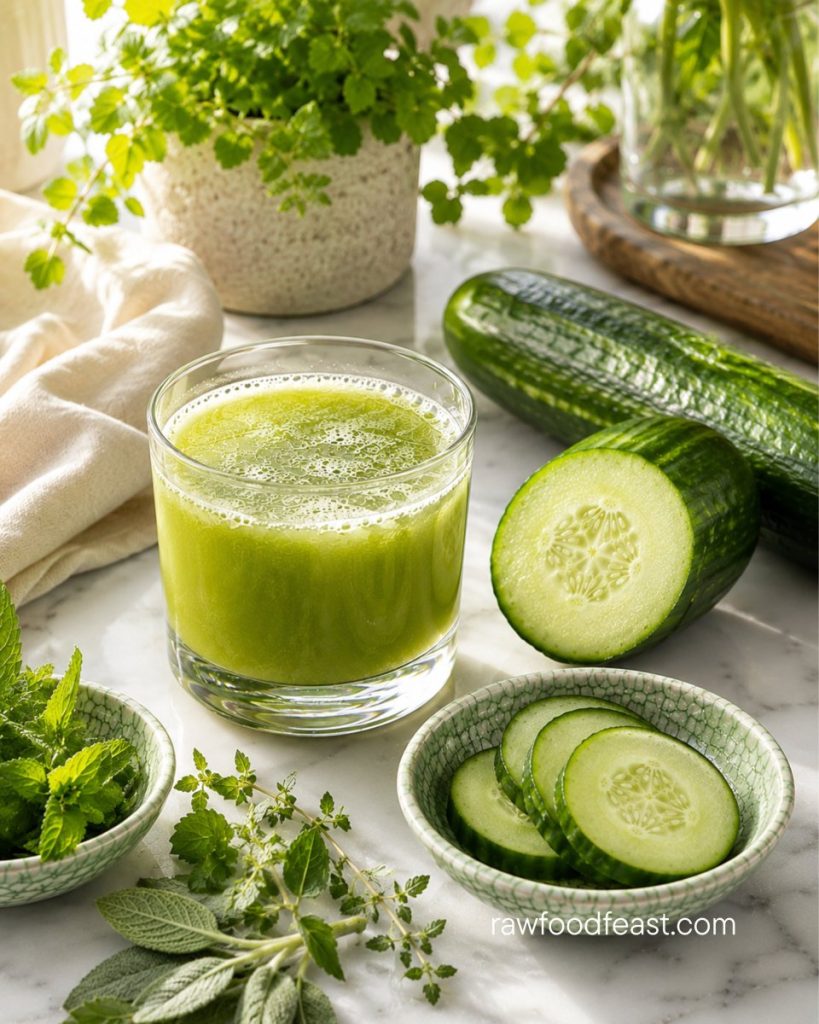
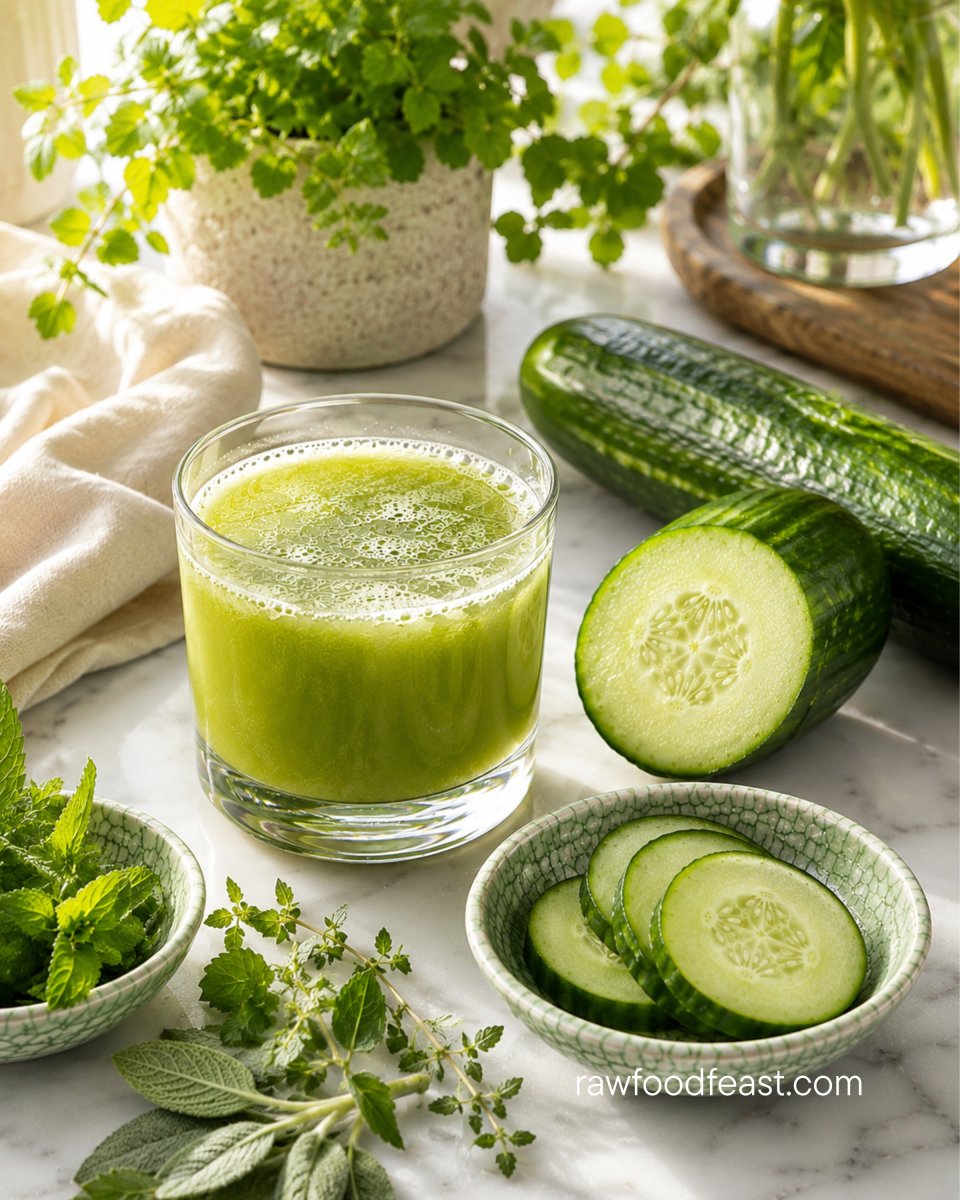
Cucumber juice on its own is fairly bland — pleasant but not the kind of thing you’d reach for every morning. The fix is simple: apple to give it real character, lemon to sharpen, fresh mint to cool, a few fresh sage leaves for a savory grounding note, and a touch of ginger to add warmth. The result is a juice that keeps the cucumber center forward while making you actually want to drink it every day. The full recipe with exact amounts is in the card below.
If you’re juicing daily, the juicer you use makes a real difference for yield, oxidation, and the silica and minerals you’re actually drinking this for. A cold-press juicer keeps the produce cool, extracts more, and preserves the live nutrients. For a daily rhythm, hands-free models like the Nama J2 or Hurom H320N take the work out of it — you load the produce, the juicer does the rest.
Use discount code RAWFOODFEAST to save on the Nama J2 & Hurom H320N cold press juicers, the M1 plant-based nut milk maker, and accessories.
If you’re still deciding between the two leading hands-free slow juicers, this side-by-side breakdown makes the choice simple: Nama J2 vs Hurom H320N: The Real Differences Between These Hands-Free Slow Juicers.
Fresh cucumber juice stays best within 24 to 48 hours in a tightly sealed glass jar in the fridge. The silica and potassium stay stable; the brightness fades after that.
What Daily Cucumber Juice Actually Feels Like
A week of daily cucumber juice doesn’t ask for effort once it becomes routine. One juice in the morning. Maybe another in the afternoon if you want it. The changes settle in by the second week — clearer skin, easier hydration even on warm days, steadier energy through the afternoon, fewer of those little body signals that tell you you’re not quite drinking enough water.
Intentional daily choices, steady minerals, steady hydration. Your skin softens. Your kidneys clear with less effort. Your energy settles into a rhythm. The benefits you came looking for arrive not from any one big moment — but because you finally gave your cells the daily hydration and minerals they had been wanting more of.
Daily Cucumber Refresher
Ingredients
Equipment
Method
- Wash all produce thoroughly. Peel the lemon to keep the juice bright (lemon peel can add bitterness in larger amounts).
- Cut the cucumbers in half lengthwise and the apples into halves. The Nama J2 and Hurom H320N hoppers take generous pieces — no fine chopping required.
- Load the hopper in this order, softest first: mint leaves and sage leaves, then the peeled lemon, then the ginger root, then the cucumber pieces, and finally the apple.
- Stir the finished juice once. Pour into a glass and drink within 20 minutes for maximum nutrient activity, or store in a tightly sealed glass jar in the fridge for up to 72 hours.
Nutrition
Notes
Tried this recipe?
Let us know how it was!