Mirjam Henzen
 Most people who search for juicing for weight loss are looking for a shortcut. A three-day cleanse. A way to drop pounds fast and get back to eating the way they were before. And that approach works — for about a week. Then the weight comes back, the body feels worse than it did before, and the whole cycle starts again.
But there is another way this works. A way that does not involve restriction, willpower, or counting anything. When you start flooding your body with fresh-pressed juice, big raw salads, smoothie bowls loaded with fruit and greens, and genuinely delicious food — something shifts. The inflammation quiets. Digestion starts working the way it should. Energy comes back. And somewhere in the middle of all that nourishment, the body starts letting go of weight it no longer needs to hold.
That is what juicing for weight loss actually looks like when it works long-term. Not deprivation. Not a diet. Just a body that finally has what it needs.
Does Juicing Help You Lose Weight?
Yes — but not for the reasons most people think. It is not about cutting calories. It is not about replacing meals with juice and hoping the numbers on the scale move. What actually happens is quieter and more powerful than that.
When you give your body the minerals, enzymes, and hydration it has been missing — through fresh juice, through raw food, through real whole plants — it responds. Inflammation drops. Digestion improves. Hormones start finding their rhythm again. And when all of those things settle into place, the body does what it was always designed to do: find its natural weight.
Weight loss can be a goal. But it should not be the main goal. The main goal is healthy living — growing older with energy, with clarity, with a body that feels good to live in. When you eat a high-raw diet and focus on plenty of fiber and nutrients through salads with rich dressings, dreamy smoothie bowls, and fresh-pressed juices, natural weight loss happens as a side effect. And it happens in a healthy way — without the rebound, without the fatigue, without the slow erosion of your metabolism that crash diets always leave behind.
Why Feeding Your Body Works Better Than Starving It
The jojo effect is real. Every crash diet teaches your body to hold on tighter next time. And the reason is simple: your body does not know you are dieting. It has no concept of swimsuit season or a wedding in three weeks. All it knows is that food has become scarce — and it responds accordingly.
When calories drop sharply, your body reads that as a famine. Cortisol — the stress hormone — rises. Metabolism slows down to conserve energy. Your body shifts into storage mode, holding on to every calorie it can because it genuinely believes survival is at stake. The hunger signals get louder. The cravings get more intense. And the only way to keep losing weight under those conditions is to restrict even more — which is exactly how eating disorders develop. That is not a side note. That is the reality of how restriction works in a human body.
Juicing for weight loss works when it comes from the opposite direction. Instead of taking food away, you add nourishment. You flood the body with minerals, with living enzymes, with deep hydration from fresh produce. You eat more — more greens, more fruit, more raw meals that leave you genuinely satisfied. And something remarkable happens: the body stops panicking. Cortisol settles. Metabolism picks back up. The body starts releasing what it does not need because it finally trusts that there is enough.
Your body is smart. It is designed to protect you — and it responds to what you give it. When you feed it well, it stops holding on and starts letting go. That is where the shift begins.
What Makes Juice Different from Other Foods?
Fresh juice delivers a concentrated wave of minerals, plant compounds, and hydration in a form your body absorbs almost immediately. There is very little digestive work required. The nutrients move into your bloodstream within minutes — not hours — and that speed matters more than most people realize.
Digestion takes energy. A lot of it. When your body is spending less energy breaking down food, that energy becomes available for everything else — repair, detox, mental clarity, physical stamina. That freed-up energy is what people feel as lightness. As the kind of steady alertness that lasts through the afternoon without a dip. As a body that feels like it is running cleanly.
Juice is concentrated nourishment that gives your body what it needs faster than anything else can. When you drink a fresh green juice in the morning, your cells get minerals and plant compounds that would take hours to extract from a solid meal — and they get them right away. That is why a single glass of juice can shift how you feel within twenty minutes.
Why Fiber Still Matters (Even When You Are Juicing)
Juice delivers soluble fiber and concentrated nutrients — but the daily rhythm that creates lasting change is juice and whole raw food together. Big salads with rich dressings. Smoothie bowls loaded with fruit and greens. Nutrient-dense sprouts. Whole fruits eaten as nature made them. These deliver the full range of fiber your gut bacteria need to thrive — and gut bacteria, as it turns out, have a lot to say about your weight.
The two together is the answer. Juice gives your body rapid access to minerals, soluble fiber and plant compounds. Whole raw food adds the full range of fiber your gut needs to build a strong, diverse microbiome. Together, they create something neither can do alone.
There is an important distinction to make here. A thoughtful, well-guided juice feast — done with adequate calories, proper preparation, guided support, and a careful refeeding plan — is a powerful practice in its own right. I have personally completed juice feasts ranging from 3 days up to 93 consecutive days and have guided many people through the process. A real juice feast nourishes — that is why I call it a feast. What a properly guided juice fast actually does in your body — day by day — and how to approach it without losing the benefits is explored fully in Juice Fast Benefits: What Really Happens in Your Body When You Stop Eating and Start Juicing.
The distinction matters because a proper juice feast is nothing like a random three-day crash diet. A crash diet provides dangerously few calories, no guidance, and no plan for building back up — and it triggers the exact survival response discussed earlier. A real juice feast nourishes. It provides volume, minerals, and enough calories to sustain the body while giving digestion a deep rest. Breaking a juice feast irresponsibly — going straight back to food without transition — can undo the benefits entirely. Preparation, guidance during, and building back up after all matter.
Whether you notice the signs early or not, fiber deficiency affects energy, digestion, and how your gut bacteria function — all of which influence your weight. The full picture of how this shows up in your body is unpacked in Signs of Fiber Deficiency. And if you have ever wondered what actually stays in the glass when you juice — and what leaves with the pulp — that is explained in Does Juicing Remove Fiber?.
How Your Gut Health Affects Your Weight
Your gut bacteria influence far more than digestion. They affect how your body stores energy, how hungry you feel between meals, and how efficiently you burn what you eat. This is not a small detail — it is one of the biggest factors in whether your body holds weight or releases it.
A gut fed on fiber and living food produces short-chain fatty acids — tiny compounds that act as fuel for the cells lining your colon and send signals to the rest of your body about how to manage energy. They support a healthy metabolism. They help regulate appetite. They reduce the kind of low-grade inflammation that makes the body hold on to weight as a protective response.
A gut fed on processed food does the opposite. The bacterial populations shift. The protective species die off. The gut lining weakens. Inflammation rises. And the signals your body sends about hunger, fullness, and energy storage get scrambled.
This is why two people can eat the same amount and have completely different outcomes. The gut bacteria are running a different program. One person’s microbiome is extracting nutrients efficiently and signaling fullness on time. The other person’s microbiome is triggering hunger, storing more, and keeping inflammation elevated. The food is the same — the internal environment is not.
When you shift toward fresh juice, raw salads, sprouts, and whole fruit, you are not just changing what you eat. You are changing who lives inside your gut — and those new residents run a very different metabolic program.
How Stress and Cortisol Drive Weight Gain
Stress does not just make you tired. It changes how your body handles everything it takes in. When stress is chronic — and for most people, it is — cortisol stays elevated. And elevated cortisol tells your body one thing: hold on to fat. Especially around the middle.
This is not about willpower. It is about chemistry. When cortisol is high, your body is in storage mode. It does not matter how well you eat or how much you exercise — if cortisol is running the show, the body prioritizes holding rather than releasing. It is a survival response, and it overrides everything else.
Here is where juicing and raw food change the equation. Fresh juice reduces the stress load on your digestive system — nutrients arrive in a form that requires almost no work to process. That alone lowers the internal stress your body carries. Raw food calms inflammation, which is one of the biggest drivers of chronic cortisol elevation. And the minerals in fresh produce — magnesium, potassium, calcium — directly support the nervous system’s ability to shift out of stress mode and into repair mode.
When cortisol drops, the body releases. Not because you forced it. Because the chemistry finally allows it. The full connection between stress and what happens in your gut — including why healthy food can feel difficult to digest during high-stress periods — is explored in How Stress Affects Digestion (And How Juice Helps).
What Does a Day of Intentional Eating Look Like?
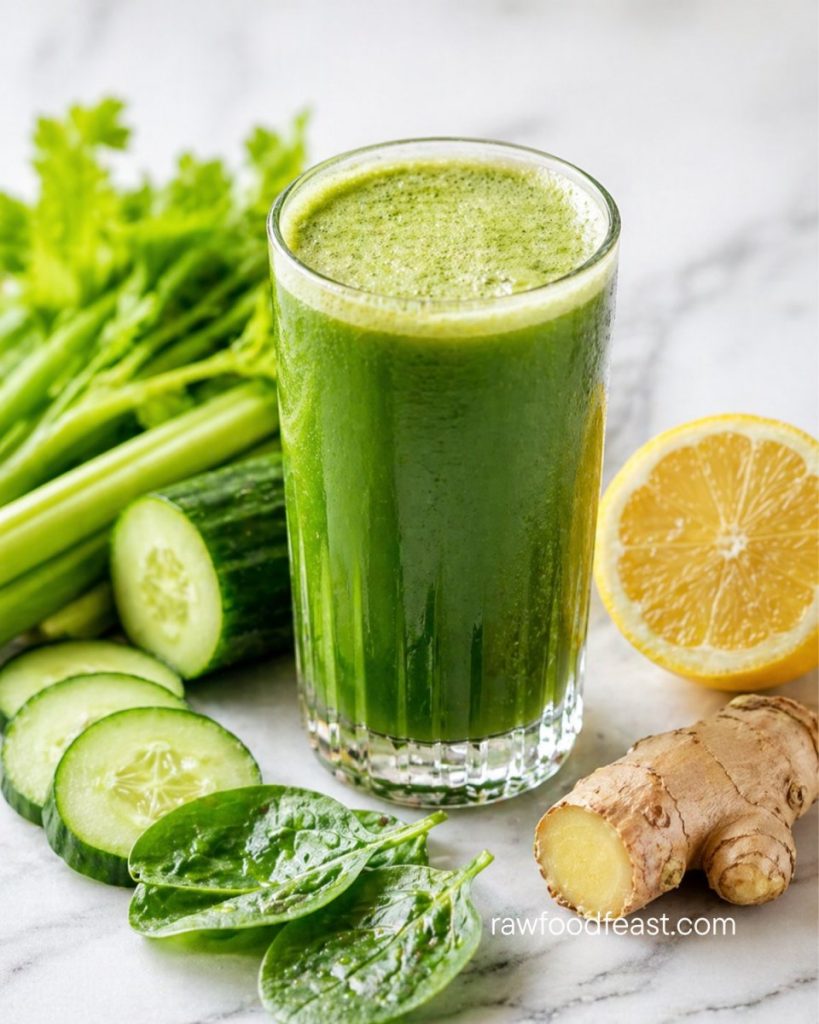
A fresh juice first thing in the morning — something green, something hydrating. Celery, cucumber, a handful of spinach, lemon, maybe ginger. Your body wakes up gently, minerals arrive immediately, and you feel clear-headed before you have even finished the glass.
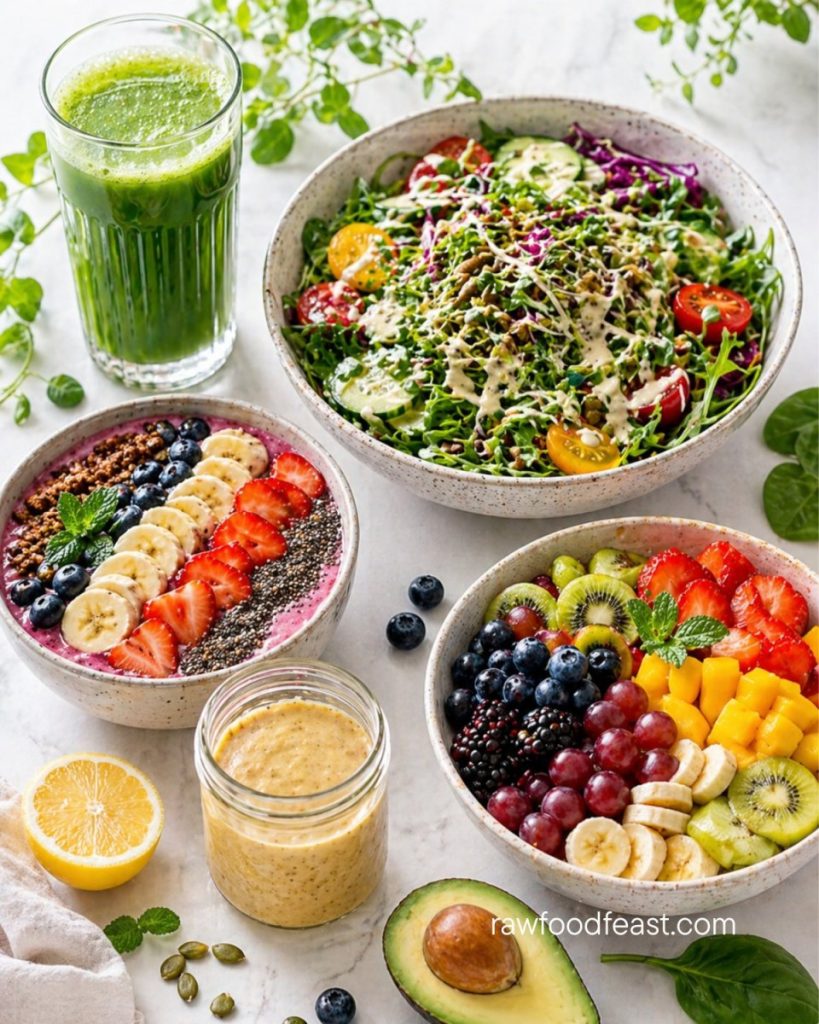
Mid-morning, a smoothie bowl or a plate of seasonal fruit. Something sweet, something satisfying, something your body actually wants after a night of fasting. This is not a snack you eat because a meal plan told you to — it is food that tastes genuinely good and gives you steady energy through the morning.
Lunch is a big raw salad with a delicious dressing — and that dressing matters. Tahini-lemon. A ginger-chickpea-miso blend. Something creamy with avocado and herbs. The salad — with the right dressing and enough volume — is the most satisfying meal of the day. Leafy greens, sprouts, shredded beets, cherry tomatoes, seeds. This is abundance.
Afternoon, another juice or a bowl of fruit. Light, nourishing, enough to carry you through. A juice before dinner — especially citrus, which helps your body absorb iron from the leafy greens you are about to eat. Dinner is something simple and raw — cucumber noodles with a rich sauce like the Pasta Puttanesca, a wrap filled with sprouts and marinated vegetables in the dehydrator, or a lighter salad with what is left in the kitchen.
This is not a restriction plan. This is eating more of what your body actually needs — not less of everything. People lose weight eating this way because every meal is rich in fiber, vitamins, minerals, enzymes, and hydration. The body is not starving. It is thriving. And a thriving body does not hold weight it does not need.
If you want to build this kind of eating into a daily rhythm — with recipes, practical guidance, and people doing it alongside you — Healthy & Free is an online community built around practical, delicious whole food (un)cooking and juicing. Come join us and enjoy food that gives you energy, happy digestion, and glow.
What that daily rhythm actually looks like in practice — and how to time your juice and whole food for the best results — is covered in When to Drink Juice During the Day.
What Are the Best Juices for Natural Weight Loss?
Green juices are where this begins. Celery, cucumber, spinach, romaine — these are deeply hydrating and mineral-rich in ways that shift how your body functions from the inside out. A single glass of green juice delivers potassium, magnesium, and silica alongside chlorophyll and plant compounds that calm inflammation and support your liver’s ability to process what it needs to release.
Add ginger for digestion — it warms the gut, stimulates the production of digestive enzymes, and gets things moving. Add lemon for its cleansing effect on the liver and the way it enhances mineral absorption. These are not “weight loss juices” — they are juices that support a body finding its balance. The weight loss is what happens when that balance arrives.
If you are new to juicing and want a simple place to start, the recipe and reasoning behind a morning juice that actually works — and why simplicity matters more than complexity when you are beginning — is laid out in The Best Beginner Morning Juice.
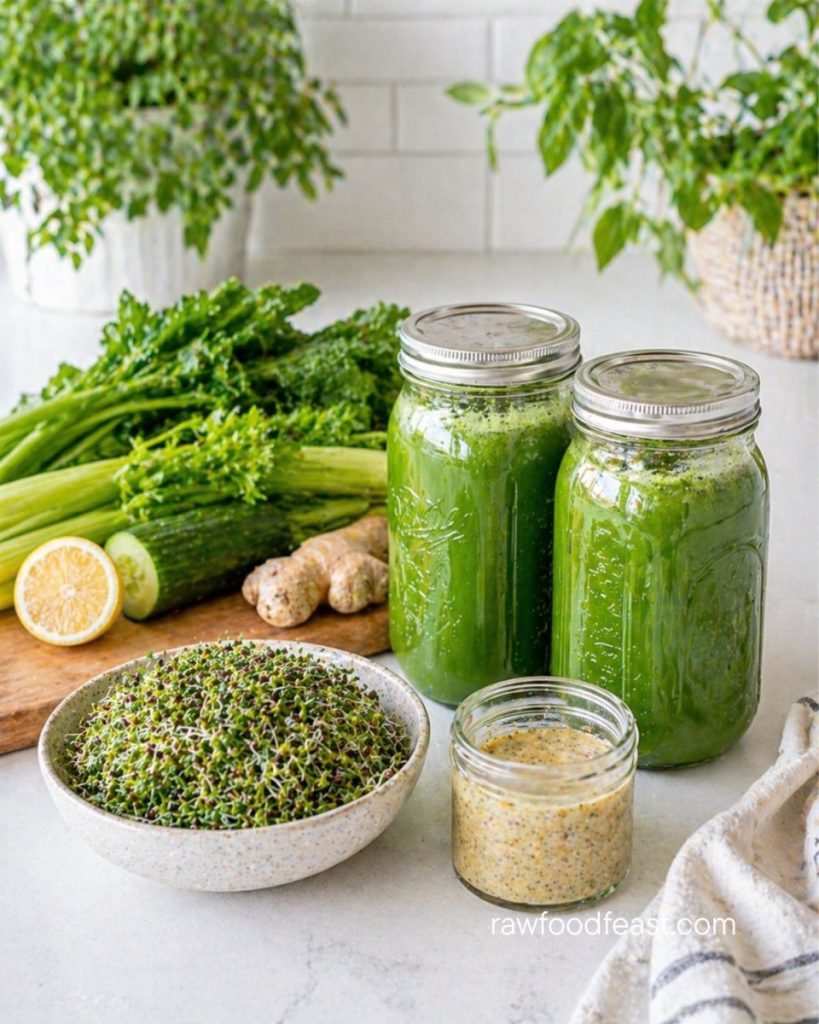
The one thing that makes a genuine difference in juice quality — and in how much nourishment actually ends up in your glass — is the juicer. A cold press juicer presses produce slowly and gently, preserving the enzymes, minerals, and plant compounds that a fast-spinning centrifugal machine destroys with heat and oxidation. The juice tastes brighter, lasts longer, and delivers more of what your body is looking for.
I use both and love both for different reasons — if you are not sure which one fits your lifestyle best, this side-by-side breakdown makes the choice simple: Nama J2 vs Hurom H320N.
Use discount code RAWFOODFEAST to save on the Nama J2 & Hurom H320N cold press juicers, the M1 plant-based nut milk maker, and accessories.
Why Long-Term Matters More Than Fast Results
The appeal of fast weight loss is real. Seeing the scale drop in a week feels like progress. But the body does not work on a weekly timeline — it works on a pattern-recognition timeline. If the pattern is restriction followed by return to old habits, the body learns to store more aggressively every time. That is the jojo effect in action, and it gets harder to break with every cycle.
The alternative is slower — and permanent. When you build a way of eating around fresh juice, raw salads, nutrient-dense sprouts, whole fruits, and food that genuinely tastes good, the body does not rebound because there is nothing to rebound from. You are just eating well — every day, without forcing it. What that transformation looks like week by week — the energy shifts, the skin changes, the way your body composition settles into something that feels right — is explored in What Happens When You Eat Raw Food for 30 Days.
When I work with someone in The 6-Week Reset, the focus is never on a number on the scale. It is on building a way of eating that stays. When the foundation is right — gut health, fiber, hydration, real food — the body finds its weight and keeps it there. And what I see, consistently, is that the weight takes care of itself. People finish the six weeks and keep going — not because they have to, but because they finally found a way of eating that feels right and sustains itself. No jojo. No rebound. The benefit continues long after coaching ends because the foundation is long-term, not short-term.
Your Body Already Knows What to Do
Weight loss is not something you force. It is not something you earn through suffering. It is something that happens naturally when you consistently give your body what it actually needs — the minerals, the fiber, the hydration, and the living food it has been asking for all along.
Every glass of fresh juice is your body getting what it needs. Every big salad with a dressing that makes you close your eyes for a second is nourishment landing exactly where it should. Every handful of sprouts, every ripe mango eaten over the sink, every smoothie bowl you actually look forward to making — that is your body getting closer to where it wants to be.
You do not need to count. You do not need to restrict. You just need to eat well — abundantly, joyfully, consistently — and let your body do what it has always known how to do.