 Mirjam Henzen
 There is something so satisfying about reaching into your fridge, grabbing a piece of this almond carrot pulp flatbread, and realizing you made it from the pulp that was already sitting on your counter. Dry, pliable, and deeply savory — it holds its shape, holds your toppings, and holds up for weeks. Nothing like the flatbread or crackers you find in health food stores. So much better.
The flavor comes from a deliberate combination: coconut aminos for depth, caraway for warmth, turmeric for earthiness, and a touch of onion powder that ties it together. The base — almond pulp from homemade almond milk and carrot pulp from your cold-press juicer — does the structural work. Golden flax meal and psyllium husk turn it into a dough that spreads, dehydrates, and flexes rather than cracks.
This is what zero-waste raw vegan food actually looks like.
Why This Flatbread Works So Well
What makes this flatbread so satisfying is the layering of two kinds of pulp — the fine, slightly fatty texture of almond pulp and the fibrous, golden body of carrot pulp. Together they create something dense and substantial, with enough structure to work as a flatbread base for lunch or a side for a big raw salad for dinner.
The coconut aminos are doing more than seasoning. They add a savory, slightly sweet depth that you would not get from salt alone — without any oil or soy. Caraway seeds bring a warm, fennel-adjacent note that pairs naturally with carrot without competing with it. Turmeric gives the finished flatbread its deep golden color and a mild earthiness that grounds everything else.
Blond flax meal acts as both binder and structure — it absorbs liquid and firms the dough as it dehydrates. The carob powder adds a subtle richness that works with the savory spices rather than against them. And the psyllium husk powder, added last and mixed briefly, is what makes the almond carrot pulp flatbread pliable rather than brittle.
What to Do With Carrot Pulp After Juicing?
When you juice a bunch of carrots, you get two things: bright carrot juice and fiber-rich carrot pulp. Both are ingredients. The pulp holds fiber, color, and concentrated carrot flavor — and this flatbread starts there.
If you juice regularly, and you’ve been wondering what to do with carrot pulp: this almond carrot pulp flatbread is the savory answer. The carrot pulp adds body and a natural sweetness that deepens during dehydration. It is what gives this flatbread its golden color and its satisfying density. The dehydration process concentrates all of that into something genuinely worth making.
For something on the sweeter side, the same carrot pulp can go straight into a raw dessert. The full recipe for that is in Carrot Pulp Cake with a Creamy Coconut Caramel Frosting — another zero-waste recipe built entirely around what the juicer leaves behind.
How to Make Almond Carrot Pulp Flatbread
Five pieces of equipment. That is all it takes to build a raw food kitchen that feeds you — and the people you love — in the best, most nourishing way possible.
A cold-press juicer. A plant-based milk maker. A food processor. A dehydrator. A high-speed blender. These are the essentials — the tools that make this kind of (un)cooking not just possible but genuinely easy. The blender is not needed for this particular recipe, but it is the backbone of any raw food kitchen: creamy spreads, silky dressings, high-fiber smoothies, nourishing soups. Together with the other four, it covers everything. And all of it works without heat — which matters more than most people realize. Cold-press technology and low-temperature dehydrating work gently, without destroying the enzymes and nutrients that make raw food so powerful in the first place. Everything that goes in comes out exactly as nature made it.
That is what builds strong immunity. What gives you steady energy instead of crashes. What keeps your gut working the way it should, your skin clear, your body actually fed rather than just full. Raw food and fresh juice do not ask much of your digestive system — they give it exactly what it needs to thrive.
The Nama M1 plant-based nut milk maker makes fresh almond milk in under two minutes — creamy, with every enzyme intact, and the pulp ready to go straight into your food processor. No straining, no mess, no waste. How the M1 works and what makes it different from anything else on the market is covered fully in The Nama M1 Plant-Based Milk Maker.
Your cold-press juicer handles the carrots and gives you both the pulp and the juice this recipe needs, with nothing wasted and nothing lost to heat or oxidation. What that fresh carrot juice does for your liver and energy once it is in your glass is covered in Carrot Apple Ginger Juice Benefits: What Actually Happens in Your Body.
The dough comes together in the food processor in minutes. The dehydrator does the rest, completely hands-off. Start in the morning and have flatbread ready by evening.
If you want more recipes like this one — high-fiber, easy to make, and designed to give you real energy, happy digestion, and that glow — Healthy & Free is where they live. Easy wins, every day, with people doing it right alongside you.
Tips, Variations, and Storage
Add the psyllium husk last and mix briefly. It is the key to that pliable, foldable texture — but over-mixing after adding it firms the dough quickly and makes it harder to spread evenly. A short, light mix is all it needs.
On the carob powder: It adds a gentle richness and depth that works beautifully with the savory spices — not a deep chocolate flavor, just warmth. If you want a little heat, a pinch of cayenne works well alongside the caraway and turmeric.
To serve: This flatbread works as a wrap base or an open-faced sandwhich on its own. Load it with sliced tomatoes and fresh basil, cucumber ribbons with dill, or shredded beet with a squeeze of lime. It holds toppings well and does not go soft quickly.
Storage: Store the almond carrot pulp flatbread in an airtight container in the fridge — it keeps for at least a month. The flatbread stays pliable when refrigerated — the psyllium husk is what keeps it that way.
Both the almond milk and the carrot juice in this recipe come from two specific pieces of equipment. The M1 plant-based nut milk maker handles the almond milk in under two minutes. For the carrot juice and pulp, either the Nama J2 or the Hurom H320N will give you everything this recipe needs.
If you are deciding between the two: Nama J2 vs Hurom H320N: The Real Differences Between These Hands-Free Slow Juicers. Use discount code RAWFOODFEAST to save on any Nama or Hurom tool.
What to Serve With Almond Carrot Pulp Flatbread
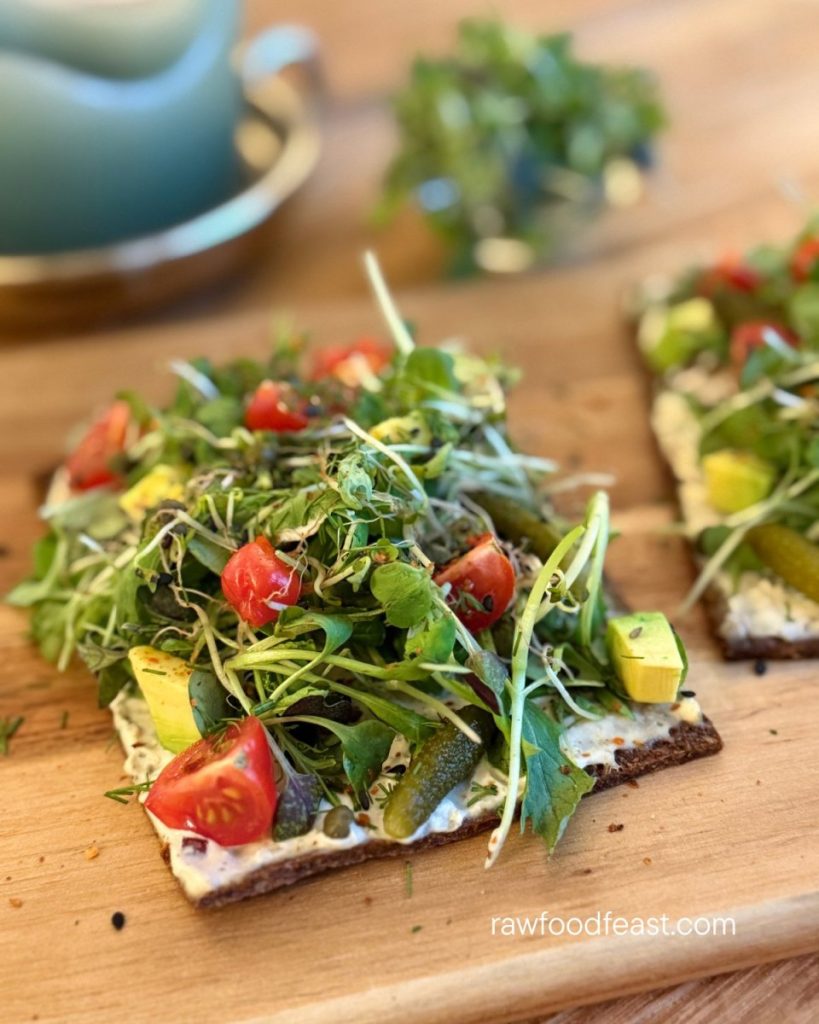
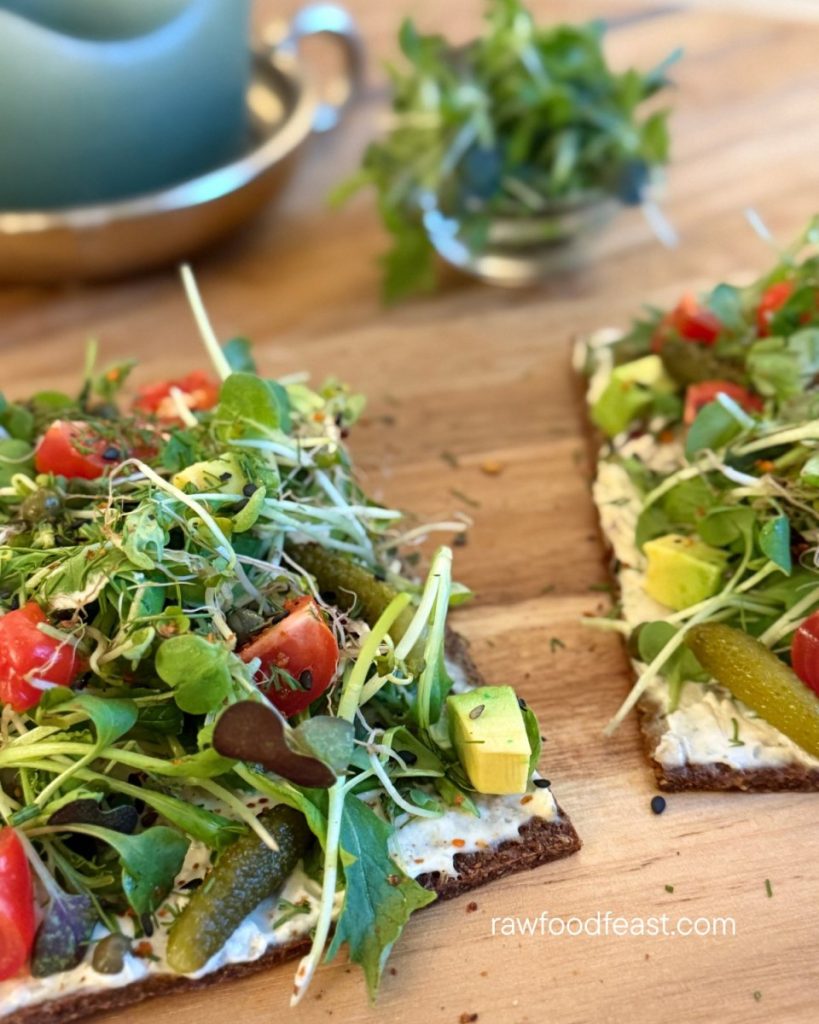
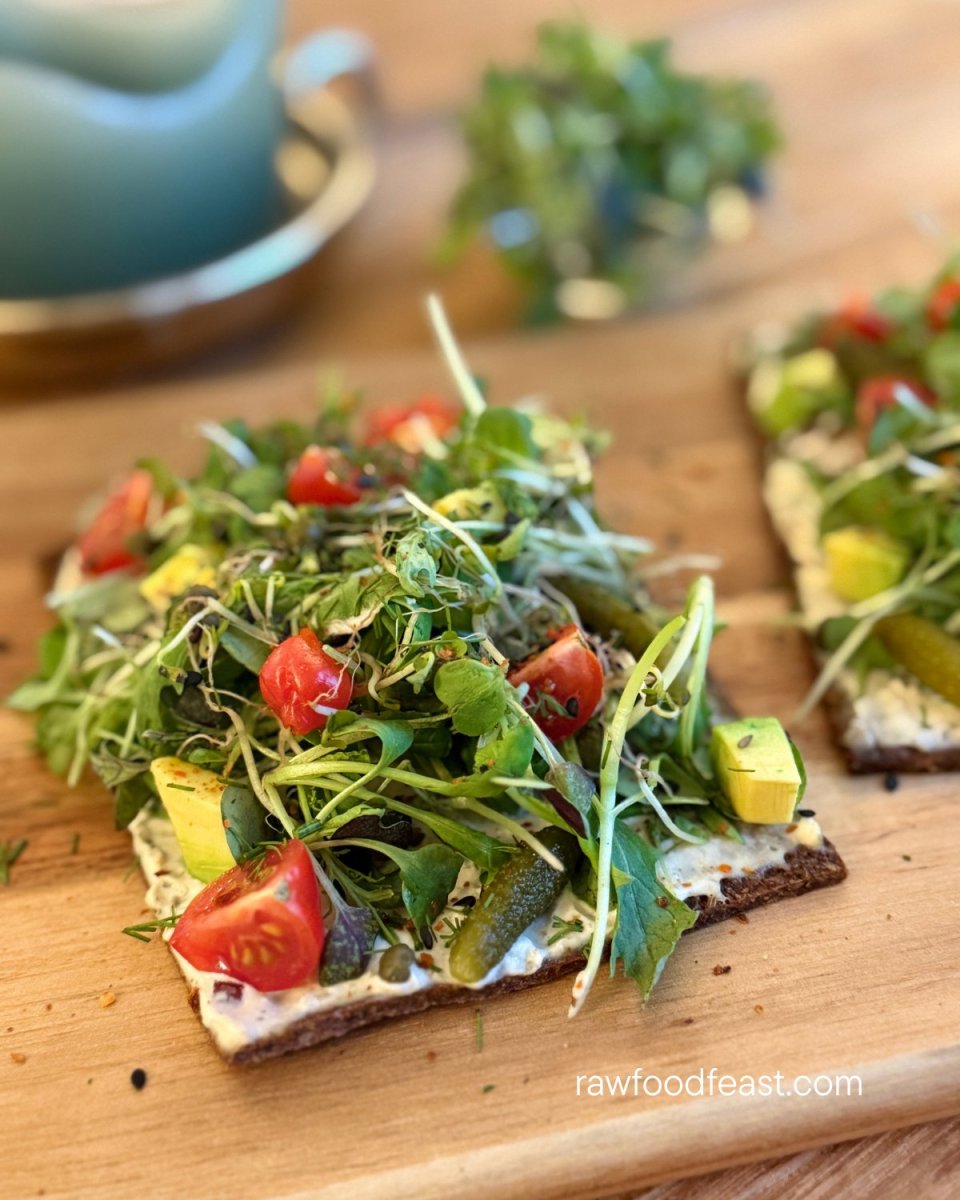
This flatbread works as the base for almost anything you like. My favorite way to load this almond carrot pulp flatbread: a spread, leafy greens, marinated carrots, a few capers, fresh dill, and a generous pile of sprouts on top — they make everything look gorgeous.
What I love most about a meal like this is how much plant diversity lands on one piece of flatbread without any effort. The recipe itself already covers a range of plants — almonds, carrot, flax, carob, caraway, turmeric, onion. Add leafy greens, marinated carrots, and sprouts on top and you are stacking even more variety into a single lunch or dinner. That is exactly what your gut microbiome wants. The more diverse the plants you eat across a week, the better your gut bacteria thrive — and 30 different plants a week is the number that makes a real difference.
If you want to understand what happens in your body when fiber variety is missing, that is covered in Signs of Fiber Deficiency: Why Your Gut Is Still Sluggish (And How to Fix It with 30 Raw Plants). A loaded piece of this flatbread counts for more than you might think. It is also high in fiber from three different sources — carrot pulp, flax meal, and psyllium husk — which means your digestion and your gut lining are both getting what they need.
Once you start making flatbread from pulp, it is hard to go back to throwing it away. A piece of food that uses everything — and tastes like something you would make even if you had nothing to use up. That is the best kind of recipe.
Almond Carrot Pulp Flatbread (Raw, Vegan, Oil-Free, Gluten-Free)
Ingredients
Equipment
Method
- Add 1 cup almonds, 4 cups water, and 1 pitted Medjool date to the Nama M1. In under two minutes you have the creamiest homemade almond milk ready. The leftover almond pulp goes straight into the food processor.
- Juice the carrots with a cold-press juicer. This will yield about 2 cups of carrot pulp and delicious carrot juice.
- Add all the ingredients, except the psyllium husk powder, to the food processor and blend into a smooth dough.
- Add the psyllium husk powder and mix briefly.
- Divide the dough into two equal parts and spread evenly onto two non-stick dehydrator sheets, about 1/4 inch / 0.5 cm thick. Shape with your hands or a spatula.
- Dehydrate at 145°F / 63°C for two hours.
- Flip the flatbread onto fresh dehydrator trays and carefully remove the non-stick sheets. Dehydrate for another 5–7 hours at 115°F / 46°C. The flatbread should be dry and pliable.
- Score each sheet into 4 equal pieces.
Nutrition
Notes
Tried this recipe?
Let us know how it was!


Thank you for sharing this recipe! Does it have psyllium husk as well as stated in steps 3 and 4? How much? I don t see it in the ingredients list.
Hi Adriana, thanks so much for your review and question. It’s 1 tbsp of psyllium husk powder. I updated the recipe right away. Enjoy making it!