Mirjam Henzen
 The headlines have been impossible to miss. Microplastics found in human blood. In breast milk. In the lining of arteries. In brain tissue. In research published in 2024 and 2025, scientists found microplastic particles in 100% of the human placentas they examined — and in cardiac tissue from people with no prior diagnosis. The fear that followed is real. So is the question underneath it: what can you actually do?
Most of the answers you’ll find send you straight to the supplement aisle. Capsules, powders, specialized protocols. Some of them have genuine value. But the framing misses something important: your gut already has a mechanism for this. It has always had one. And the foods that remove microplastics most effectively are the same foods your gut has been asking for all along.
What Microplastics Actually Do in Your Gut
Most microplastics get in through what you eat and drink. Plastic packaging puts particles into food. Tap water carries them. Sea salt, bottled water, even some produce — they all contain particles you cannot see or taste. Once swallowed, they travel through your stomach and into your intestines. That is where the real exposure happens.
This is the window that matters. Once particles have made it into your bloodstream, that is a different conversation. But in the gut — that is where you have real influence over what happens next. The longer microplastics sit against your gut wall, the more opportunity they have to work their way through. How fast everything moves is what changes that picture.
What the science consistently shows is that two things make the difference. How quickly everything moves through — the faster, the better. And whether there is something in the gut that physically grabs onto particles and carries them out before they get a chance to stick around. Both of those things come down to what you eat.
What influences transit speed and particle binding most powerfully? Fiber.

How Fiber Works — and Why Raw Food Delivers It Best
Not all fiber does the same thing. This is worth understanding, because it changes how you think about which foods to eat and why.
Soluble fiber dissolves in water. When it enters the gut, it forms a thick, sticky gel. That gel traps particles — including microplastics — as it moves through. Pectin is the most studied example of this. It is the soluble fiber found in apples, pears, carrots, and citrus, and it grabs onto particles particularly well. The gel it forms does not just carry microplastics through — it keeps them from settling against your gut wall in the first place.
Insoluble fiber works differently. It does not dissolve. Instead, it adds bulk to stool and gets the gut moving — the wave-like rhythm that determines how quickly everything passes from one end to the other. More bulk means things move faster. Faster movement means less time for particles to sit against the gut wall. These are not small effects. They are the gut’s built-in clearance system, and fiber is what keeps it running.
Raw whole food gives you both types at once. An apple gives you pectin in the flesh and insoluble fiber in the skin. Celery is insoluble fiber wrapped around a water-dense stalk. Leafy greens deliver insoluble fiber alongside the minerals that keep the gut wall strong. The full picture of how each fiber type interacts with digestion — and when each helps most — is explored in When Fiber Helps Digestion (And When It Doesn’t). This is what makes raw food so effective here: not a single isolated compound, but the combination of fiber types as they naturally exist in the plant, working together.
Which Raw Foods Have the Most Microplastic-Clearing Fiber?
No exotic ingredients required. The foods with the most useful fiber for this are ones you likely already have on rotation — the question is just knowing why they earn their place.
The first is apples. They are one of the richest natural sources of pectin of any fruit — a single medium apple contains around 1 to 1.5 grams of pectin, most of it in the skin. Eat them whole, unpeeled. The thick gel that apple pectin forms in the gut is well documented, and it works exactly as described: it grabs onto particles and moves them out. Pears work similarly and are often even higher in soluble fiber than apples.
Leafy greens deliver dense insoluble fiber per gram of food — exactly the kind that creates bulk and keeps things moving. They also bring the minerals — magnesium and potassium in particular — that keep your gut wall strong and doing its job. Leafy greens are in a league of their own here. Not just salad ingredients — one of the most consistently useful foods you can eat every single day.
Celery earns its place through insoluble fiber combined with very high water content. That combination does two things at once: it adds bulk and it hydrates your gut, which is essential for fiber to work well. Dry fiber without enough fluid slows everything down. Hydrated fiber moves. Celery — eaten as whole stalks, not just juiced — is a simple daily addition that keeps transit going without much thought.
Carrots bring both gel-forming and bulking fiber together, which makes them one of the most complete options on this list. Raw carrot sticks are one of the easiest additions you can make. Berries — blueberries, raspberries, strawberries — are among the highest fiber-per-calorie foods available. Raspberries contain around 6 to 8 grams of fiber per cup, a mix of both types. They are easy to eat in quantity, which matters — fiber works best when it is consistent and daily, not in occasional high doses.
Flaxseed and chia seeds round out the list. Both form a thick gel inside the gut. Ground flaxseed creates a slippery, gel-like coating as it moves through — one that keeps things moving and makes it harder for particles to cling to the gut wall. Chia absorbs many times its weight in water and swells into a thick gel as it travels. Both give you gel-forming and bulking fiber in the same seed. Ground flaxseed stirred into a raw fruit bowl or sprinkled over a salad is one of the simplest daily additions you can make.
Chlorella and Psyllium — Whole Food Additions That Actually Work
This is where most microplastics advice gets tangled. People are handed a supplement protocol when what they need is a food list. But two of the most effective additions here are not supplements at all — they are whole food products.
Chlorella is a single-celled freshwater algae. Not an extract, not an isolated compound — a whole food. It has been studied for its ability to grab onto heavy metals and environmental toxins in the gut and carry them out. That ability comes from its cell wall, which has a natural affinity for latching onto things that do not belong and moving them through.
The article Do I Need Supplements? The Truth About B12, Isolates, and Why Food Wins explains why whole food sources like chlorella work differently from isolated compounds — they arrive whole, the way nature made them, with everything still in place. Stir chlorella into green juice, blend it into a smoothie, or mix it into water. The taste is earthy and strong — start small and build from there.
Psyllium husk is the ground outer coating of the psyllium seed — pure soluble fiber, and one of the most gel-forming substances you can find in a kitchen. Stir a teaspoon into a glass of water and watch it transform. It swells almost immediately into a thick, slow-moving gel that travels through your gut picking up material as it goes. But psyllium is also a kitchen ingredient: it acts as a natural binder in raw wraps and flatbreads, holding them together without oil, gluten, or heat.
If you want recipes that turn ingredients like psyllium husk powder into food you genuinely love eating, Healthy & Free is an online community built around that kind of practical, delicious whole food (un)cooking. Come join us and enjoy raw-inspired food that gives you energy, happy digestion, and glow.
Activated charcoal is sometimes mentioned in this context too. It is porous and does grab onto things in the gut. As an occasional addition it has its uses. It is less something to build a daily routine around than chlorella or psyllium — those two are the ones worth making a habit.
What Does Detoxing Microplastics Naturally Actually Look Like?
The version of this that works looks nothing like a detox program. No strict start date, no elimination phase, no row of powders by the kitchen sink.
Start the day with fresh fruit: pears, apples, berries. Your gut is empty and ready to move, and soluble fiber eaten first thing travels the full length of the digestive tract with the morning’s movement. It is also gentle — hydrating, mineral-rich, and easy on a body that has been fasting overnight.
Lunch is a a big juicy salad. Leafy greens, grated carrot, celery, cucumber, a handful of sprouts. Add some ground flaxseed. You have got the gel-forming fiber and the bulk-and-sweep fiber working together in one bowl. The body knows exactly what to do with this combination — it has been doing it all along.
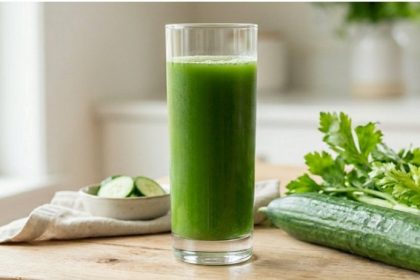
If you are adding psyllium husk, stir a teaspoon into a fresh-pressed carrot juice before a meal and drink it before it fully sets. Or use it in a wrap with carrot pulp from your juicer — same fiber, more interesting form. If you are adding chlorella, a teaspoon in green juice or smoothie is enough. For the full picture of how raw food supports the body’s natural elimination — including liver, kidneys, and lymph working alongside the gut — How to Detox Naturally: Juicing + Raw Foods to Support Liver, Lymph, and Gut walks through each pathway in detail.
None of this requires a drastic change. The difference between eating raw whole food casually and eating it with this kind of intention is mostly just knowing why each food is earning its place.

How Does Your Gut Microbiome Play a Role?
There is a layer here that goes beyond how fast things move.
Fiber — specifically the prebiotic kind, like pectin and inulin (the type found in apples, garlic, and chicory that your gut bacteria particularly love) — feeds the bacteria that keep your gut wall intact. When these bacteria are well fed, they send out tiny signaling compounds that tell your gut lining to stay strong and tight. When fiber drops, those signals drop too. The lining gradually weakens. When fiber is consistent, it holds.
So fiber is doing two things at once here. The first is practical — speeding everything up, forming gel, grabbing particles. The second is foundational — keeping your gut wall strong enough that fewer particles can cross it in the first place. You cannot separate those two effects. They happen together, every time you eat this way.
The goal is 30 different plant varieties a week. Not 30 servings of the same three vegetables — 30 genuinely different plants, rotating through fruits, leafy greens, root vegetables, seeds, and herbs. That variety is what keeps your gut bacteria rich and diverse — and it is that diversity that sustains both layers working for you. If you are curious what low fiber actually feels like in the body — and whether your gut might be showing early signs of it — Signs of Fiber Deficiency: Why Your Gut Is Still Sluggish (And How to Fix It with 30 Raw Plants) covers this in full.
Can Fiber Really Reduce Microplastic Absorption — and What Are the Real Limits?
The honest answer is yes — and it matters most right here in the gut.
Fiber works during the window between swallowing something and the point where particles could be absorbed through the gut wall. In that window, gel-forming fiber grabs and carries. The bulking fiber speeds things along. No special product, no protocol, no timing window. Just food doing what food does.
What fiber cannot do is reach particles that have already moved beyond the gut and into your bloodstream. Microplastics have been found in blood, lung tissue, and arterial plaque — that is the fatty buildup that can accumulate inside blood vessel walls over time and eventually affect how freely blood flows through them.
Whether the body can clear particles from tissue once they have settled there is genuinely open territory. Research into this is still early. What the body is capable of under the right conditions — given real nourishment, real rest, and consistent daily support — is something we keep underestimating. The gut is where the daily load comes in, and every day you eat this way, a smaller fraction of it gets through. That is not a small thing.
The lymphatic system — your body’s internal drainage network that moves fluid, waste, and immune cells around — is the next layer of support beyond the gut. How it works, and how raw food helps it keep flowing, is covered in Signs Your Lymphatic System Is Congested — And How Raw Foods Help It Flow Again. Fresh juice works at a different stage entirely — supporting the liver, lymph, and kidneys once particles have moved beyond the gut. How that works is covered in Does Juicing Help with Microplastics? Yes — But Differently Than You’d Think.
How to Eat Foods That Remove Microplastics Every Day
The way foods that remove microplastics work is simpler than you’d might think. An apple added to your fruit bowl for breakfast. Celery alongside your lunch salad. A handful of raspberries in the afternoon. Ground flaxseed stirred into a smoothie bowl. Psyllium husk powder in a wrap you are making anyway. Chlorella in a green juice you are already drinking.
This is not a detox program with a start and end date. It is a way of eating — one that your gut already knows how to use. The foods that remove microplastics most effectively are not a special category. They are raw whole food. Specifically the kind with high fiber, high water content, and enough variety to keep your gut working at its best.
The shift from eating well to eating with this kind of intention is mostly just understanding. You are not doing more. You are just seeing more clearly why what you are already doing matters.
Every apple. Every salad. Every morning fruit bowl. It all adds up quietly, consistently, without needing to be measured or tracked. Your gut has had this mechanism all along. You are just giving it what it needs to do its job.