Mirjam Henzen
 It often starts with a winter that won’t quite end. Every cold lingers a little longer than it should. A small cut takes a week to heal. Your skin keeps breaking out where it used to clear easily. And somewhere along the way, you notice food has gone slightly flat — your sense of taste isn’t what it used to be.
These are some of the signs of zinc deficiency. They tend to show up together, in places you’d never think to connect to one mineral. Zinc runs through more than 300 different processes your body does every day — your immunity, your skin barrier, your hair, your sense of taste, your DNA repair. When intake drops, those systems slow one by one until the picture becomes hard to miss.
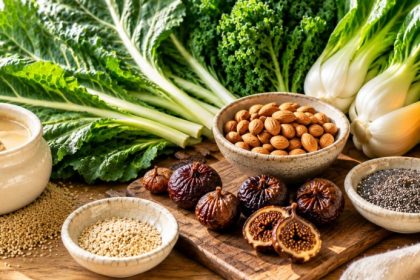
The good news: raw plant foods are full of zinc. And one simple traditional practice — sprouting — makes that zinc more available than almost anything else you can do in your kitchen.
What Does Zinc Actually Do in Your Body?
Zinc isn’t a single-job mineral. It runs through more than 300 different enzyme processes — the work your cells do to build proteins, repair DNA, fight infection, heal wounds, and grow new tissue. Your immune system depends on zinc to recognize invaders and to clear them once the work is done. Your skin barrier rebuilds with zinc. Your hair follicles depend on it. The cells lining your gut, where so much of your body’s defense actually happens, can’t repair themselves without it.
Zinc also runs your senses of taste and smell. The cells lining your taste buds turn over every two weeks, and they need zinc to rebuild correctly. If food has been tasting flat or your sense of smell isn’t what it used to be, low zinc is often part of the picture.
So zinc isn’t a nutrient you need in large amounts. It’s a nutrient you need consistently — your body uses it everywhere, every day, and turns it over fast.
What Are the Signs of Zinc Deficiency?
These are the signals that tend to show up when zinc has been running low for a while. Most people notice two or three — rarely all eight at once.
1. Frequent colds and slow recovery from illness. Zinc is what your immune cells use to identify and clear infections. Low intake shows up as a winter that won’t quite end.
2. Slow wound healing. Cuts, scrapes, and post-procedure healing all rely on zinc-driven tissue repair. When healing drags on, this is often the missing input.
3. Hair thinning or hair loss. Hair follicles depend on zinc to build the proteins each strand is made from. When supply lags, more strands shift into the resting phase — and you start to notice the shed.
4. White spots on your fingernails. Small but telling. Zinc shortage at the nail bed can leave small chalky marks where the nail wasn’t built quite right.
5. Acne or skin breakouts. Zinc calms the inflammatory side of skin chemistry and supports the barrier function that keeps pores clear. When intake is low, breakouts often pick up.
6. Loss of taste or smell. The cells in your taste buds need zinc to rebuild correctly. If food has been tasting flat, this is one of the earliest signs.
7. Brain fog or difficulty concentrating. Zinc helps your brain send clean signals between cells. When supply is short, focus and recall slow before you can name why.
8. Loss of appetite or food tasting off. Low zinc can dim hunger cues and dull the satisfaction food usually delivers — which then drives intake even lower.
The same scattered-signal pattern shows up across other nutrient series too. If fatigue and pale skin are also part of the picture, the iron side is unpacked in 8 Signs of Iron Deficiency — and the Raw Plant Foods That Restore Your Energy. If sleep trouble or muscle cramps are showing up, the magnesium overlap is explored in 6 Signs of Low Magnesium — and the Raw Foods That Fix It Every Day. And if your skin’s been feeling dry and your focus has been drifting too, the omega-3 picture overlaps with zinc on more signs than you’d expect — covered in 8 Signs of Omega-3 Deficiency — and the Plant Foods That Restore Your Balance.
Why Sprouting Makes Plant Zinc Easier to Absorb
Whole seeds, nuts, grains, and legumes store their minerals inside a compound called phytic acid — the natural mineral pantry that keeps the seed dormant until conditions are right to grow. Phytic acid does its job well: it holds zinc, iron, and calcium tightly until the seed sprouts.
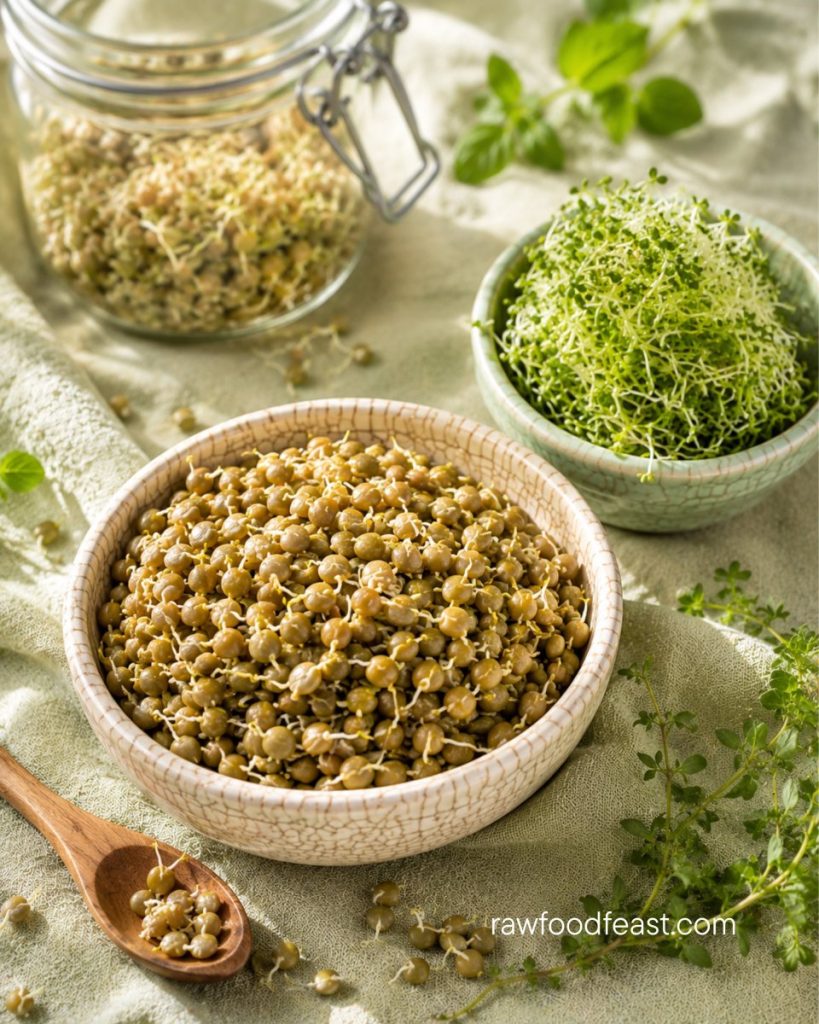
The moment a seed germinates, that pantry unlocks. Phytic acid drops by roughly 25 to 50% during sprouting, depending on how long you sprout for. The minerals it was holding become available — your body can absorb them the way it absorbs minerals from leafy greens or fresh produce. Sprouting also activates the enzymes the seed itself uses to digest its own storage proteins, which means you get more of what’s already there.
This is why sprouted lentils, sprouted chickpeas, sprouted seeds, and broccoli sprouts deliver so much more usable zinc than their dry counterparts. The full picture of what changes during sprouting — phytic acid, enzymes, vitamin C, the whole transformation — lives in Benefits of Sprouting: Why Sprouts Are One of the Most Nutrient-Dense Foods You Can Eat.
For sprouting times on any specific seed or legume, the free sprouting calculator at howlongtosprout.com walks you through each one from soak to ready.
The Plant Foods That Deliver Zinc Every Day
These are the foods that do the work — and the practical amounts that move your levels.
Pumpkin seeds deliver about 2.5mg of zinc per ounce (roughly a quarter cup). The highest plant source by serving, and one of the most enjoyable to eat by the handful.
Hemp seeds bring about 3mg per three tablespoons — among the highest plant zinc sources, with a soft texture that blends into smoothies, salads, or breakfast bowls.
Sesame seeds and tahini deliver about 2.8mg per ounce. Raw tahini or sesame seeds add zinc to dressings, dips, and morning smoothies.
Sprouted lentils give you about 1.3mg per cup — meaningfully more available than dry because of what sprouting does to phytic acid.
Cashews bring about 1.6mg per ounce. Soaked overnight, they make cashew cream or stand alone as a handful with fruit.
Broccoli sprouts and other fresh sprouts contribute smaller per-serving amounts that add up — and they bring the freshest, most enzyme-active form of zinc available from plants.
If you’re tracking your daily intake, plant variety actually does the work for you. Pumpkin, hemp, sesame, sprouted lentils, cashew, and broccoli sprouts all show up as different plants in Fiber First, the fiber tracker for gut health that counts every plant you eat in a week, plus your daily fiber and hydration. Knowing how many different plants you’ve already had makes the zinc picture clearer than chasing one specific food.
How Much Zinc Do You Need Each Day?
The general recommendation is 8mg of zinc per day for women and 11mg for men. Soaking and sprouting seeds, nuts, and legumes — the everyday practice in plant-based and raw vegan kitchens — opens the absorption picture wide. Phytic acid drops, minerals become fully available, and daily food does the work.
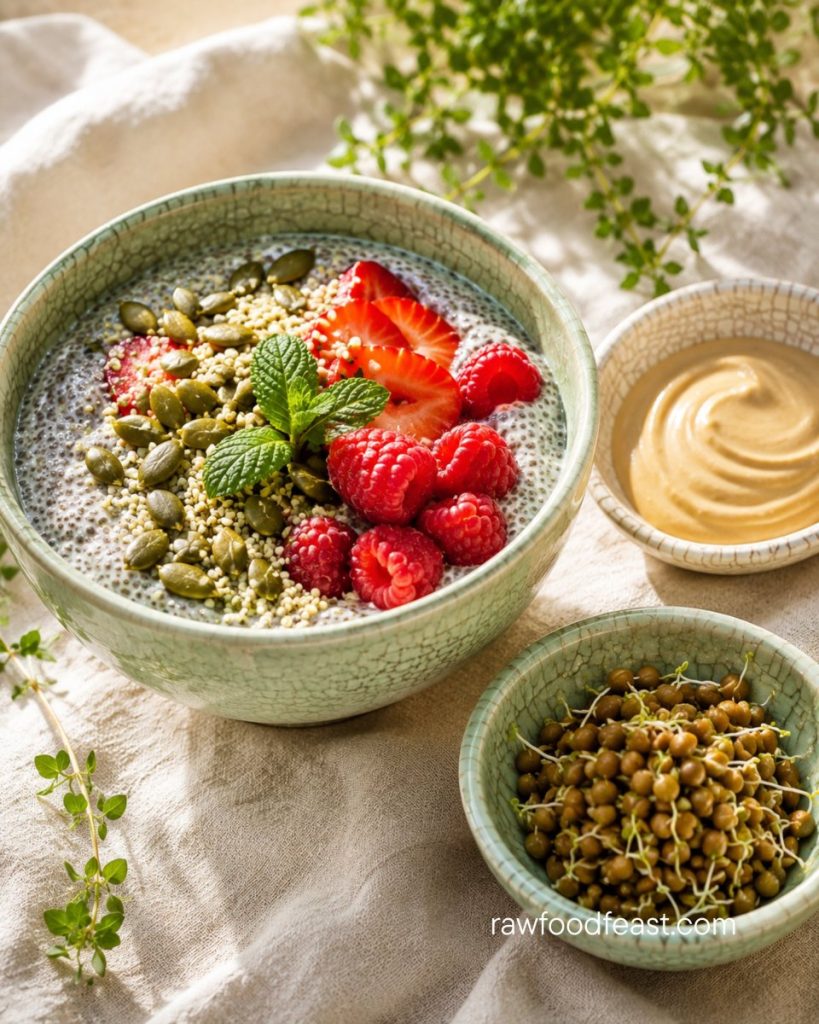
In practical terms, that’s an ounce of pumpkin seeds (about 2.5mg), three tablespoons of hemp seeds (about 3mg), a cup of sprouted lentils (about 1.3mg), and your usual greens. Stack two or three of those across the day and you’ve covered it comfortably.
Soaking is the everyday lever most raw food kitchens already use. It triggers enzyme activity and lowers phytic acid — not as completely as a finished sprout, but enough to matter day to day. Soak times vary by seed: almonds want twelve hours, cashews just four, chia gels in twenty minutes. The free soaking calculator at howlongtosoak.com keeps every one of them in one place, simply check and you’re set.
What a Zinc-Steady Week Actually Looks Like
A week that covers zinc doesn’t ask for effort. A handful of pumpkin seeds on a salad. Hemp seeds stirred into a morning smoothie. Tahini in a dressing or drizzled over greens. Sprouted lentils added to a lunch bowl. A few cashews or cashew cream through the week. None of it has to be deliberate once it becomes routine.
The shift happens in weeks, not days. Skin cells and gut lining cells turn over every few weeks — the zinc you eat this week becomes the cells your body is using a month from now. That’s why people who add daily pumpkin seeds don’t feel different the next morning, and why those who keep it up start noticing the change somewhere around the four- to six-week mark.
Intentional daily choices, steady intake, and a body that catches up on its own time. Your skin clears. Your immune system steadies. Your sense of taste sharpens. The signs you noticed start fading not because anything dramatic happened — but because you finally gave your cells what they were waiting for.