Mirjam Henzen
 Does food combining work? Ask a mainstream nutritionist and they’ll tell you the research doesn’t support it. Ask someone who has been eating raw plant food for years and they’ll tell you it changed their digestion completely. Both groups are working with the same body — and landing in completely different places.
The honest answer is more nuanced than either side usually admits. And it has a lot to do with the strength of your gut.
Does Food Combining Work? Here’s What the Research and Practice Actually Show
Food combining is the principle that different foods digest at different rates and require different conditions — and that pairing certain foods together at the same meal affects how smoothly that digestion goes.
The mainstream objection is that the body is well-equipped to digest proteins, fats, and carbohydrates at the same time. Which is true — the body can do it. But that is a bit like saying a traffic system can handle ten thousand cars simultaneously. It can. The question is whether it moves as smoothly, and at what cost.
What practitioners actually observe — and what many people experience when they start paying attention — is that certain food combinations leave them feeling light and energized, while others leave them bloated, heavy, and slow. That pattern is consistent enough to be worth understanding, and dismissing it entirely misses the more interesting question: why does it work for some people and not others? It is something I see consistently with clients in my 6-Week Reset program — simplifying combinations is often one of the first things that makes a noticeable difference.
Why Your Body Handles Different Foods Differently
Each food comes with its own set of requirements. Simple sugars and watery fruits move through the digestive system fastest — they need very little processing and can clear the stomach in 30 to 60 minutes. Complex carbohydrates take longer. Proteins take longer still. Fats are the slowest, requiring the most digestive work and the most time.
Different foods also need different enzyme environments. Some digest best in a more alkaline environment. Others need more acidic conditions. When foods with very different requirements arrive at the same time, the body has to manage competing demands simultaneously.
Think of it this way: every food you eat is communicating with your digestive system. It sends signals — enzymes get triggered, pH shifts, the gut responds. When you eat one food, or a few that digest similarly, those signals are clear and easy to act on. When many different foods with very different digestion times land at once, it is like everyone in a room talking to you at the same time. You can follow it. But it takes more effort, and something always gets less attention than it would in a smaller group or one on one.
The body is remarkable at managing complexity. But managing something is not the same as handling it optimally. That distinction matters more for some people than others — and the gut microbiome is a big part of why.
The Gut Microbiome Connection
One of the reasons food combining gets dismissed so readily is that some people eat anything in any combination and feel completely fine. But that does not mean food combining does not work — it means the gut is the variable.
A fiber-rich, diverse gut microbiome is genuinely more equipped to handle digestive complexity. When you have been eating a wide variety of raw plants consistently, the gut develops a resilience that comes from being well-fed and well-used. The microbial diversity that builds over time creates a more capable digestive environment — one that handles a mixed plate more smoothly than a depleted gut can.
Someone coming from a history of low-fiber eating, processed food, or years of digestive sensitivity has a gut that has not built that capacity yet. For them, food combining matters more — not because the principles are different, but because the system has less slack. What a well-fed gut handles easily, a less resilient gut struggles with.
Over time, as the gut strengthens through consistent raw plant eating, combinations become more forgiving — not because the principles stop being true, but because the body gets better at the work. Why fiber is so foundational to building this kind of gut resilience is covered in Signs of Fiber Deficiency: Why Your Gut Is Still Sluggish (And How to Fix It with 30 Raw Plants).
The link between digestive health and mental clarity is closer than most people realize too. When digestion is overburdened, the effects show up well beyond the stomach — in energy, focus, and mood. Why the gut is where brain fog so often starts is explored in How to Clear Brain Fog Naturally: Why It Starts in Your Gut (And How Raw Food Lifts It).
The Food Combinations That Work — and the Ones That Don’t
Leafy greens are the great combiners of the plant world. They digest well alongside fruit, fat, protein, and starchy vegetables — their neutral digestive profile means they sit comfortably with almost anything. If you are ever unsure what works together, leafy greens are almost always a safe answer.
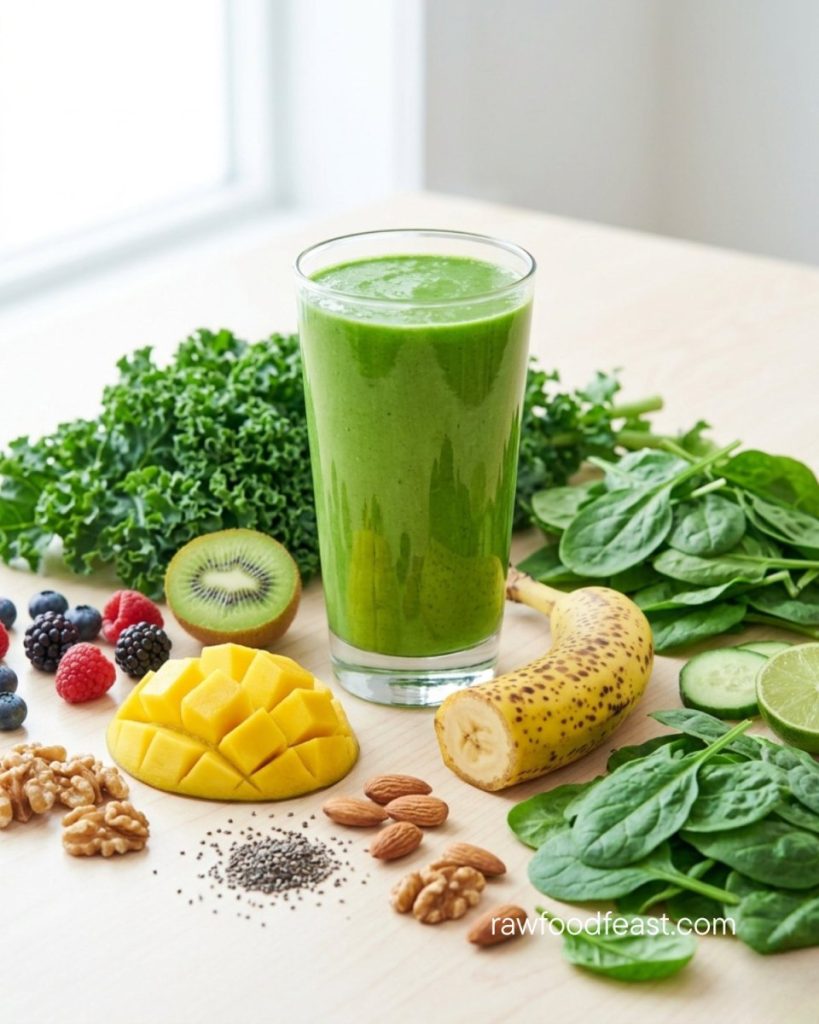
Sweet fruit pairs well with leafy greens for the same reason. A smoothie of spinach, banana, and mango is a combination that works for the vast majority of people — the greens do not slow the fruit down significantly, and the fruit causes no problem for the greens.
Cucumber and zucchini — both botanical fruits — also sit well alongside most fruit. Their digestion time is close enough that the body moves through them smoothly. Celery behaves similarly, for the same reason: it is high in water, light to digest, and creates no meaningful competition for the fruit alongside it.
Where things slow down is when fat enters the picture. Nuts and seeds digest significantly more slowly than fruit — when eaten together, they hold everything up. Fruit that would normally clear your stomach in 40 minutes is now waiting. For most people this shows up as a fullness that lingers longer than expected, sometimes mild bloating. It is not harmful — it is just heavier.
Avocado is worth separating from that category. It is a botanical fruit with a much higher water content than nuts and seeds, and its fat is lighter and easier to process. Most people find avocado alongside fruit and greens noticeably more comfortable than nuts or seeds in the same combination. It is still fat, and it will slow digestion down somewhat — but it does not behave like a handful of cashews does.
Sweet fruit and acid fruit are worth separating when you can. Sweet fruits like dates, bananas, and mangoes need a different enzyme environment than acid fruits like citrus and pineapple. This combination is not a serious problem for most people, but it is one of the most consistent triggers for those who are sensitive.
The principle underneath all of this: the closer the digestion times and enzyme requirements, the smoother the combination. You are not memorizing a chart — you are developing a feel for what your body moves through easily and what it labors over.
If you want to build a daily food practice that puts these principles to work — with recipes, support, and a community doing it alongside you — Healthy & Free is an online community built around practical, delicious whole food (un)cooking and juicing. Come join us and enjoy food that gives you energy, happy digestion, and glow.
Melons — Why They Need Their Own Space
Of all the food combining principles, this is the one worth applying consistently regardless of where your gut is right now: eat melons alone.
Watermelon, honeydew, cantaloupe — all melons digest faster than almost anything else you can eat. They are so high in water and simple sugars that they move through the digestive system very quickly, needing almost no processing time. Papaya is in the same category — similarly fast, similarly best eaten on its own.
The problem is not the melon itself. It is the queue.
When melon is eaten after a meal or alongside slower-digesting food, it is ready to move on long before everything else is. But it cannot pass through until what came before it is processed — so it sits. And melon sitting in a warm environment starts to ferment. The result is gas, bloating, and that uncomfortable fullness that people sometimes blame on the melon itself, when the real issue is the company it was keeping.
Eat melon alone, on an empty stomach, and the experience is completely different — light, hydrating, clean. Give it 20 to 30 minutes before anything else follows. It is one of those small adjustments that makes a disproportionately noticeable difference, and one that even people with strong, well-adapted guts typically benefit from.
How Juicing Changes the Food Combining Rules
Juice is a different conversation when it comes to food combining — and the reason why matters.
It is not that juice has no fiber. Cold press juice still contains soluble fiber — the kind that dissolves in water, feeds gut bacteria, and supports a healthy digestive environment. What is lost in the juicing process is most of the insoluble fiber — the pulp, the physical structure that slows whole food down as it moves through the digestive system. That distinction is what changes everything about how combinations work. Without insoluble fiber, juice does not sit in the digestive queue the same way whole food does. It absorbs quickly, moves fast, and does not create the same competition between ingredients that whole food combinations can. The full explanation of what happens to fiber during juicing is covered in Does Juicing Remove Fiber? Soluble vs Insoluble, Explained Simply.
This is why combinations that do not work well as whole foods can work perfectly well as juice. Apple, carrot, and ginger is one of the most popular juice combinations — and those same foods eaten together in large quantities as a whole meal would feel very different in the body. In juice form, the issue of competing digestion times largely disappears.
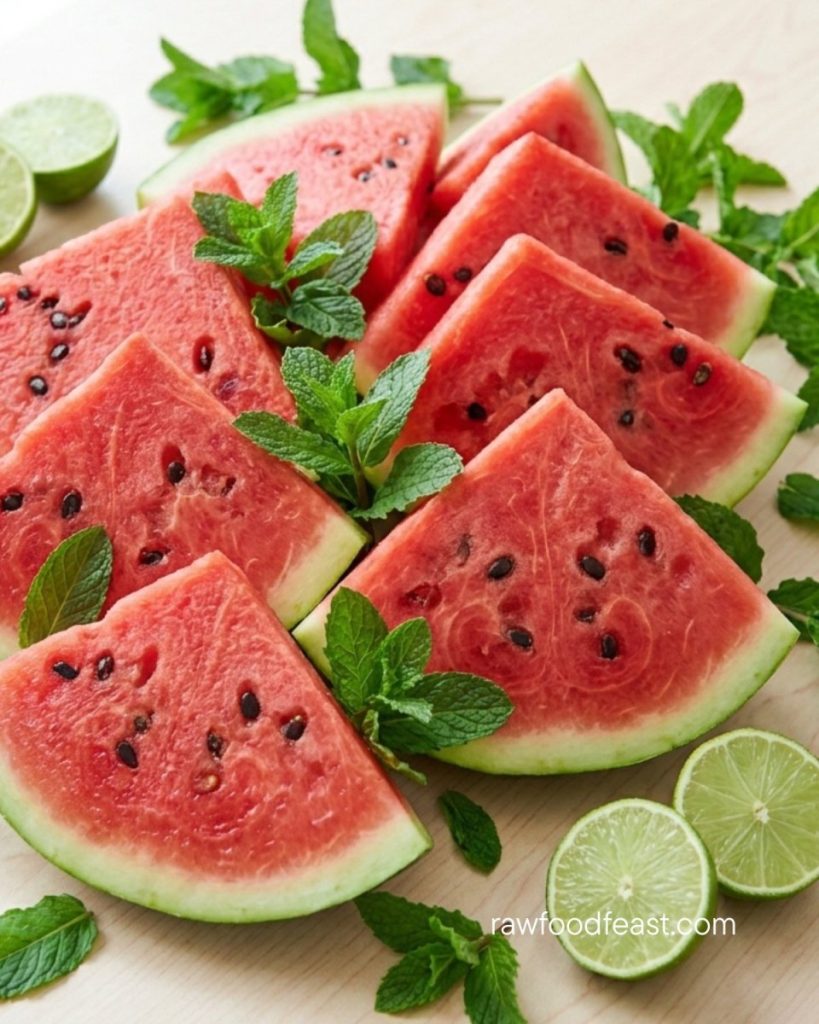
Watermelon is a good example of how the rules shift. Whole watermelon is at its best eaten alone — it moves so fast that anything alongside it sets up fermentation. Watermelon juice still moves fast, but the gap between it and other juice ingredients narrows considerably. Most people can handle watermelon juiced alongside other fruit much more comfortably than the same combination eaten whole. A juice of watermelon, lime, and fresh mint is a clean, hydrating combination that works really well — simple, light, and nothing like the digestive challenge the whole-fruit version might create.
For the juice combinations that do the most for digestion day to day, Best Juices for Gut Health: What to Drink Daily for Better Digestion, Immunity, and Skin covers them in full.
Who Needs to Pay the Most Attention to Food Combining?
Food combining matters for everyone — but not equally. How much attention you need to pay depends on where your gut is right now.
If you have existing digestive sensitivity — regular bloating, gas, sluggish digestion, or a history of IBS — food combining is one of the most practical tools available to you. Simplifying your combinations gives your digestive system less to manage at once, which almost always means easier digestion and less discomfort. Start here before looking elsewhere for answers.
If you are transitioning from a history of low-fiber eating, food combining is worth taking seriously while your gut is rebuilding. The microbiome needs time — and consistent raw plant fiber — to develop the resilience to handle complexity well. In the meantime, simpler combinations reduce the load on a system that is still finding its feet.
If you have been eating a raw, plant-rich diet for a long time and your digestion feels strong and responsive, you have more room. You might combine nuts and fruit and feel perfectly fine. The principles still apply — your gut has simply gotten better at the work.
The fatigue that comes with overburdened digestion — that specific tiredness that does not lift even when you are eating well — is something many people never connect to their food combinations at all. Why digestion has such a direct effect on energy levels is explored in Eating Healthy but Still Tired? Here’s What Your Digestion Is Missing.
Magnesium is worth noting here too. It supports the smooth muscle contractions that move food through the digestive system. A gut that is running low on magnesium digests more sluggishly regardless of what combinations you eat — the muscle simply does not have what it needs to do its job well. The signs of low magnesium and which raw foods address it most effectively are covered in 6 Signs of Low Magnesium — and the Raw Foods That Fix It Every Day.
The people who find food combining most transformative are usually those whose digestive system has been working overtime for a long time — sensitive guts, years of heavy combinations, digestion that has never quite felt settled. When they simplify what lands together at the same meal, the shift can be immediate and striking. Energy lifts. Bloating quiets. The heaviness after eating starts to go. Not because food combining is a miracle, but because the digestive system finally has room to work the way it was designed to.
Food combining is not a rigid system to follow forever. It is a framework for understanding what is actually happening when you eat — and why some combinations leave you feeling alive and light while others leave you heavy and slow. Start paying attention to how you feel an hour after eating. The patterns become obvious quickly, and what to do about them becomes obvious right along with them.