Mirjam Henzen
 Juicing celery looks simple — and in practice it is, once you know what you’re doing. But there’s a gap between throwing celery into any machine and actually getting maximum yield, intact nutrients, and a clean daily practice that stays consistent. Most people who run into trouble are either using the wrong type of juicer, skipping a prep step that costs them yield, or not knowing how quickly fresh juice starts to lose its potency.
This guide covers the whole picture: why the type of juicer changes what ends up in your glass, where the Walker method came from and why the protocol still holds up, exactly how to prepare and juice celery on a cold press juicer, what yield to realistically expect, and how to store juice when you need to make it ahead. By the end you’ll have everything you need to make daily celery juicing genuinely easy.
Does the Type of Juicer Affect Celery Juice Quality?
Celery is one of the most fibrous vegetables you can put through a juicer. Its long stringy fibers run the full length of the stalk and they behave very differently depending on how they’re processed. In the wrong machine, those fibers wrap around the auger, block the pulp outlet, and reduce yield significantly — sometimes by a third or more of what you’d get from a well-matched juicer.
But the machine choice isn’t just about yield and clogging. It’s about what happens to the active compounds in the celery during extraction. Apigenin, luteolin, phthalides, chlorophyll — these are heat-sensitive. The extraction method determines how many of them make it into your glass intact, and how many are degraded before you ever drink them.
Norman W. Walker — the American naturopath who pioneered raw juice therapy in the early 20th century and spent decades documenting the effects of fresh vegetable juices on the body — was specific about this. His work consistently emphasized that juice extracted without heat, at low speed, preserves the enzyme activity and live compounds that make fresh juice therapeutically different from cooked or processed food. His original Norwalk press used hydraulic pressure to extract juice with no friction at all. Cold press juicers today operate on the same principle — slow mechanical pressing rather than fast spinning — and they’re the closest widely available equivalent to what Walker’s protocol was built around.
How you juice celery matters because you’re not just making a green drink. You’re trying to get the concentrated active compounds of a whole bunch of celery into a glass in a form your body can absorb within minutes. The method either supports that or works against it.
Cold Press vs. Centrifugal: What Happens to the Nutrients
There are two main types of juicers you’ll encounter: centrifugal and cold press. Understanding the difference is the single most important decision you’ll make about your juicing practice.
Centrifugal juicers
A centrifugal juicer works by spinning a blade at very high speed — typically 6,000 to 14,000 RPM (rotations per minute) — to shred the produce and fling the juice outward through a mesh filter. The speed is what causes the problem. That much friction generates heat, and heat degrades the heat-sensitive compounds in celery — including chlorophyll, which oxidizes visibly (the juice turns brownish-green quickly), and the flavonoids that support liver function and reduce inflammation. Centrifugal juice also incorporates more air during extraction, which accelerates oxidation and means the juice loses potency faster after it’s made. For celery specifically, centrifugal juicers also tend to struggle with the long fibers, yielding less juice and requiring more cleanup.
Cold press juicers
A cold press juicer — also called a masticating or slow juicer — uses a rotating auger to slowly crush and press the produce against a filter screen. No high-speed spinning, no friction heat. The extraction is slow and mechanical, which preserves the enzyme activity, keeps the chlorophyll intact, and produces a denser, more nutritionally concentrated juice. Cold press juice also oxidizes more slowly, which is why it keeps better in storage than centrifugal juice. For celery, a cold press juicer extracts significantly more juice from the same bunch — and the juice is noticeably different in color, taste, and how long it stays fresh.
If you’re juicing celery daily as a committed practice, a cold press juicer is not optional. It’s the right tool for the job.
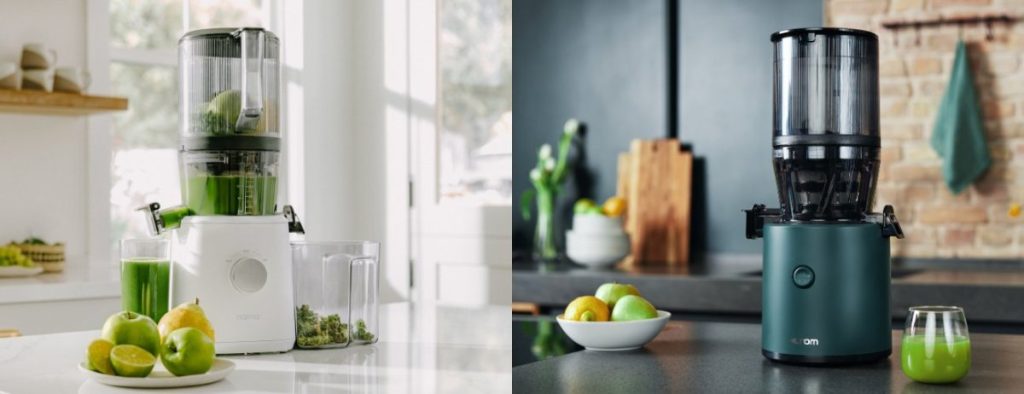
Both the Nama J2 and the Hurom H320N are exceptional cold press juicers for celery. Here’s how they compare side by side so you can choose the one that fits your kitchen and routine: Nama J2 vs Hurom H320N: The Real Differences Between These Hands-Free Cold Press Juicers.
Use discount code RAWFOODFEAST to save on all Hurom & Nama cold press juicers, the Nama M1 plant-based nut milk maker, and accessories.
Norman Walker Celery Juice: The Original Protocol
Norman W. Walker developed his approach to raw juice therapy in the early 20th century, building on the idea that the body’s ability to absorb and use the nutrients in fresh produce is dramatically increased when the insoluble fiber is removed and the juice is extracted without heat. He invented the Norwalk Hydraulic Press — a two-stage juicer that first grinds the produce into a pulp, then presses that pulp under hydraulic pressure to extract every drop of juice. It remains the gold standard for juice extraction quality, though at a significant price point.
Walker’s celery juice protocol called for 500ml (16oz) of pure, freshly pressed celery juice — the yield from roughly one whole bunch — consumed first thing in the morning on an empty stomach. The empty stomach timing was deliberate: with nothing else in the digestive system, the juice moves through quickly and the concentrated minerals and plant compounds are absorbed without competition. He documented this timing and quantity across decades of clinical observation, and 16oz from one bunch remains the benchmark that most serious celery juicing protocols are built around today.
You don’t need a Norwalk press to follow this protocol. A quality cold press juicer, like the Nama J2 or Hurom H320N, extracts juice using the same low-heat, slow-pressure principle and produces results that are meaningfully close. What Walker’s work gives you is the confidence that the method has a long documented history — this isn’t a social media trend, it’s a practice with roots going back over a century of naturopathic clinical use.
The full picture behind what celery juice actually does in the body — from Walker’s original findings to current research, is here: Celery Health Benefits: The Science Behind 90 Years of Juice Therapy.
For a deep dive into what celery juice specifically does for the liver — bile flow, liver cell protection, and what the research and naturopathic practice both say: Does Celery Juice Help the Liver? What Actually Happens When You Drink It Daily.
How to Prepare Celery for Juicing
Good prep takes little time and makes a real difference to both yield and flavor.
Choose fresh celery
Fresh celery snaps cleanly when you bend a stalk — that snap tells you the water content is high and the fibers are intact. Celery that bends without snapping is dehydrated and will yield noticeably less juice. Look for stalks that are firm and bright green with tightly packed ribs. The leaves add a noticeably more bitter flavor — most people prefer to trim them off, but taste it both ways and decide what works for you.
Wash thoroughly
Whether you’re using organic or conventional celery, wash each stalk thoroughly under cold running water, running your fingers along the ridges where residue collects. For conventional celery, a short soak in water with a splash of apple cider vinegar before rinsing is worth the extra minute.
Cut to fit
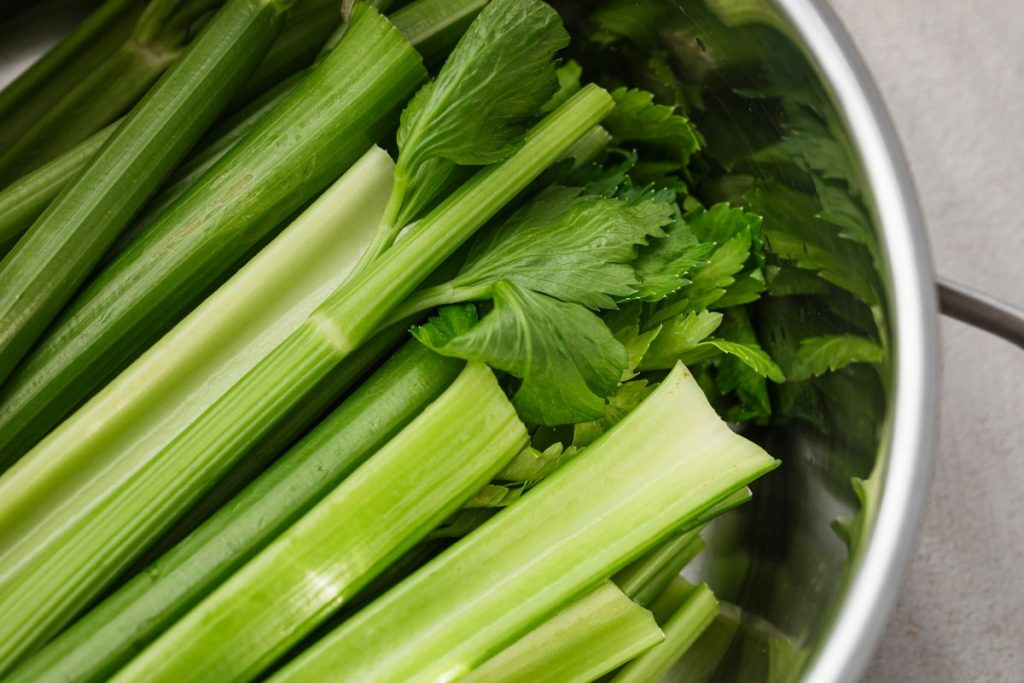
For hands-free cold press juicers like the Nama J2 and Hurom H320N, cut the bunch into thirds. This isn’t just about fitting the feed chute — it’s also about managing the fibers. Cutting across the stalk shortens the long stringy fibers that can otherwise ball up and slow extraction. Shorter pieces load more evenly into the hopper, extract more cleanly, and leave less fiber wrapping around the auger. One bunch cut into thirds, loaded into the hopper, and the machine does the rest.
Skip the base
The very base of the bunch — the part where all the stalks join together — is dense and woody. It doesn’t juice well and contributes to clogging. Trim it off before you load the hopper.
Step-by-Step: Juicing Celery with the Nama J2 and Hurom H320N
Both the Nama J2 and Hurom H320N are self-feeding cold press juicers — you load the hopper, press start, and the machine feeds the produce down automatically. This hands-free design is particularly well-suited to celery because it controls the feed rate and prevents overloading, which is the main cause of clogging with fibrous vegetables.
Step 1: Prep your celery
Wash the bunch, trim the base, and cut the stalks into thirds. One bunch of celery, roughly 450–500g, is your target quantity for a 500ml (16oz) serving.
Step 2: Load the hopper
Stack the cut celery pieces into the hopper. Fill the hopper all the way up, close the lid, and press start.
Step 3: Run the juicer
Let the juicer do its work. Both the J2 and H320N run quietly and steadily through celery. Within minutes you’ll have fresh celery juice ready to drink.
Step 4: Check the pulp
When the hopper is empty, check the pulp container. Dry pulp is a good sign — it means the machine has extracted most of the available juice from the celery. The drier the pulp, the better the yield.
Step 5: Drink immediately
Pour the juice directly into a glass and drink it straight away. Fresh celery juice is at its peak the moment it comes out of the juicer. If you need to store it, see the storage section below — but same-day, right after juicing, is always the best approach.
Timing matters more than most people realize. Here’s exactly what happens in your body when you drink celery juice first thing on an empty stomach: Best Time to Drink Celery Juice for Digestion and Bloat Relief.
How Much Juice Does One Bunch of Celery Make?
One bunch of celery yields approximately 400–500ml (13,5–16oz) of juice in a quality cold press juicer. That’s a fairly wide range, and it comes down to a few variables.
Freshness is the biggest factor. A fresh, crisp bunch with high water content will yield toward the top of that range. Celery that’s been sitting in the fridge for several days will usually yield a little less.
The juicer matters too. A quality cold press juicer with a tight filter screen and good pressing pressure will extract more than a centrifugal juicer or an older machine with a worn auger. This is one of the places where investing in a good juicer pays back in juice volume over time — you’re getting more from the same produce.
Prep technique also plays a role. With the Nama J2 and Hurom H320N, cutting the bunch into thirds is the simplest way to do it — the pieces fit the hopper perfectly, you can load the whole bunch in one go, press start, and walk away. No feeding stalks one at a time, no standing over the machine.
The 500ml (16oz) benchmark — one bunch, one glass — is realistic with fresh celery in a good cold press juicer. That’s the Walker standard and it’s achievable consistently once you have the right setup and fresh produce.
Organic vs. Conventional Celery: Does It Matter?
Organic is ideal for juicing — when you juice a whole bunch at a time, you’re concentrating everything in those stalks. So if you can choose organic, it’s worth it.
That said, don’t let it stop you. If conventional celery is what’s available or what fits your budget, use it. Soaking the stalks in water for a few minutes with a splash of apple cider vinegar and then scrubbing with a vegetable brush works really well too. The most important thing is that you actually make the juice — consistent conventional celery juice will always do more for your body than perfect organic celery you never buy.
How to Store Celery Juice and How Long It Keeps
Fresh celery juice is at its best the moment it comes out of the juicer — that’s when enzyme activity and nutrient potency are highest. That said, juice made with the Nama J2 or Hurom H320N stays fresh for significantly longer than juice made with a centrifugal machine — because slow pressing introduces far less air and no heat, which slows oxidation considerably. If you can drink it fresh, always do — your body will notice the difference.
If your schedule makes same-morning juicing difficult, here’s how to store it without losing too much:
Storage method
Pour the juice into a glass jar with a tight-fitting lid, filled as close to the top as possible. The less air in the jar, the slower the oxidation. Nama glass jars work great for this, as do these bottles, which are also excellent for freezing juice.
How long it keeps
Celery juice from either the Nama J2 or Hurom H320N keeps well in the fridge for up to 72 hours in a sealed jar. The color will darken slightly and the flavor will mellow over time, but the core minerals and plant compounds remain. Fresh is always best — but 72 hours gives you real flexibility without meaningful loss.
Can you freeze celery juice?
You can. Freezing slows enzyme activity quite a bit but doesn’t destroy it the way heat does — some is preserved, especially when juice is frozen immediately after pressing. The minerals and plant compounds remain largely intact. It’s not the same as fresh, but if freezing is what makes your practice sustainable, it’s a worthwhile option.
Batch juicing
If mornings are tight, juicing the night before and storing in sealed jars in the fridge is a practical solution that works well. Some people find this easier to sustain long-term than daily morning juicing — consistency matters more than perfect timing.
Most Asked Questions About Juicing Celery
Do I need to remove the celery leaves before juicing?
You don’t have to. The leaves are nutritious and juice perfectly well. They do add a slightly more bitter, earthy flavor to the juice — some people love it, some find it too strong. If you’re new to celery juice, try juicing without the leaves first to get used to the base flavor, then experiment with adding them back.
Can I juice celery in a blender?
You can make something close to celery juice in a blender by blending the stalks with a small amount of water and straining through a nut milk bag. It works in a pinch but it’s not the same drink. High-speed blending generates heat and incorporates air, both of which degrade the active compounds. The juice also oxidizes faster. If you’re juicing celery regularly for its concentrated benefits, a cold press juicer is worth the investment — it pays for itself in yield and quality over time.
The full comparison of what celery juice and a celery smoothie each do in your body — and how to choose between them — is here: Celery Juice vs. Celery Smoothie: What’s the Difference and Which Is Better for You?
Why does my celery juice taste bitter?
Three common causes: the leaves are included and you’re sensitive to their flavor, the celery is old and the flavor has concentrated toward bitter as the water content dropped, or you’re using a centrifugal juicer which extracts differently and does pull more of the bitter compounds. Try fresh celery without the leaves first. If it’s still bitter, check the freshness of your celery — it should snap cleanly when bent.
How often should I juice celery?
Daily is the protocol Walker documented and the frequency that produces the clearest results in the body over time. Intermittent juicing — a few days a week — still has value but tends to produce less noticeable outcomes. If daily feels like too much to start, three to four times a week is a reasonable beginning. The goal is a sustainable practice, not a perfect one.
Can I mix celery with other vegetables in the juicer?
For the targeted benefits that make pure celery juice worth doing — the concentrated organic sodium, the direct liver and lymphatic support, the empty-stomach absorption — pure is the approach. Adding cucumber or a small amount of lemon is a common gentle introduction for people adjusting to the flavor. Once you’re used to it, straight celery is the way to go for a focused daily practice. Save the combinations for a second juice later in the day.
Is it better to juice celery cold or at room temperature?
Cold celery from the fridge juices well and produces a refreshing glass. Room temperature celery may yield very slightly more juice because the cell walls are slightly more relaxed, but the difference is negligible in practice. Use whatever temperature your celery is at — don’t wait for it to warm up.
Fresh celery. Cold press juicer. Stalks cut into thirds. One bunch, 500ml, first thing in the morning on an empty stomach. Drink it straight away.
That’s the protocol Norman W. Walker built and documented over decades. Everything else in this article is context and detail that helps you do it well consistently. The practice itself is simple — and simple is what makes it sustainable.